
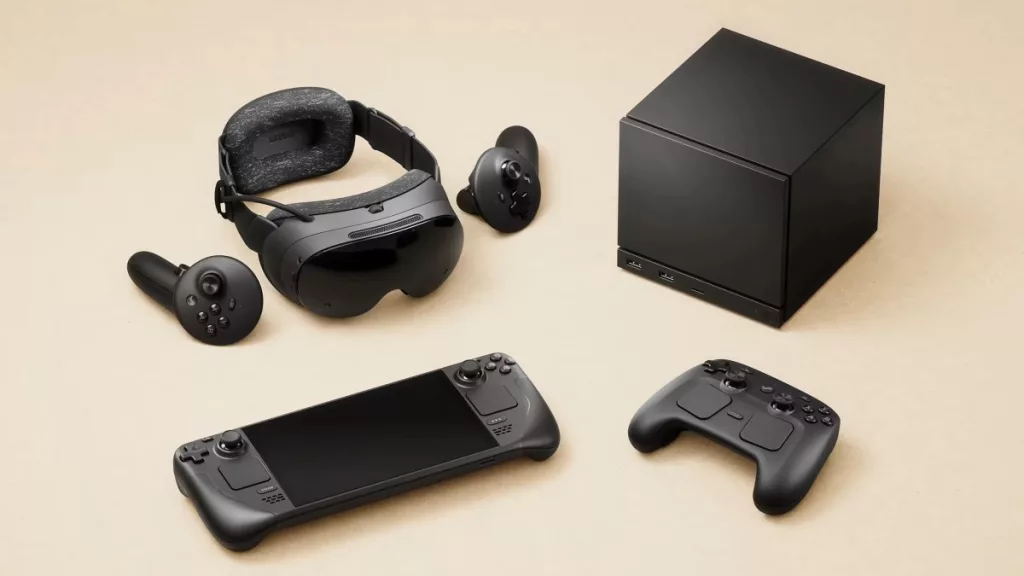
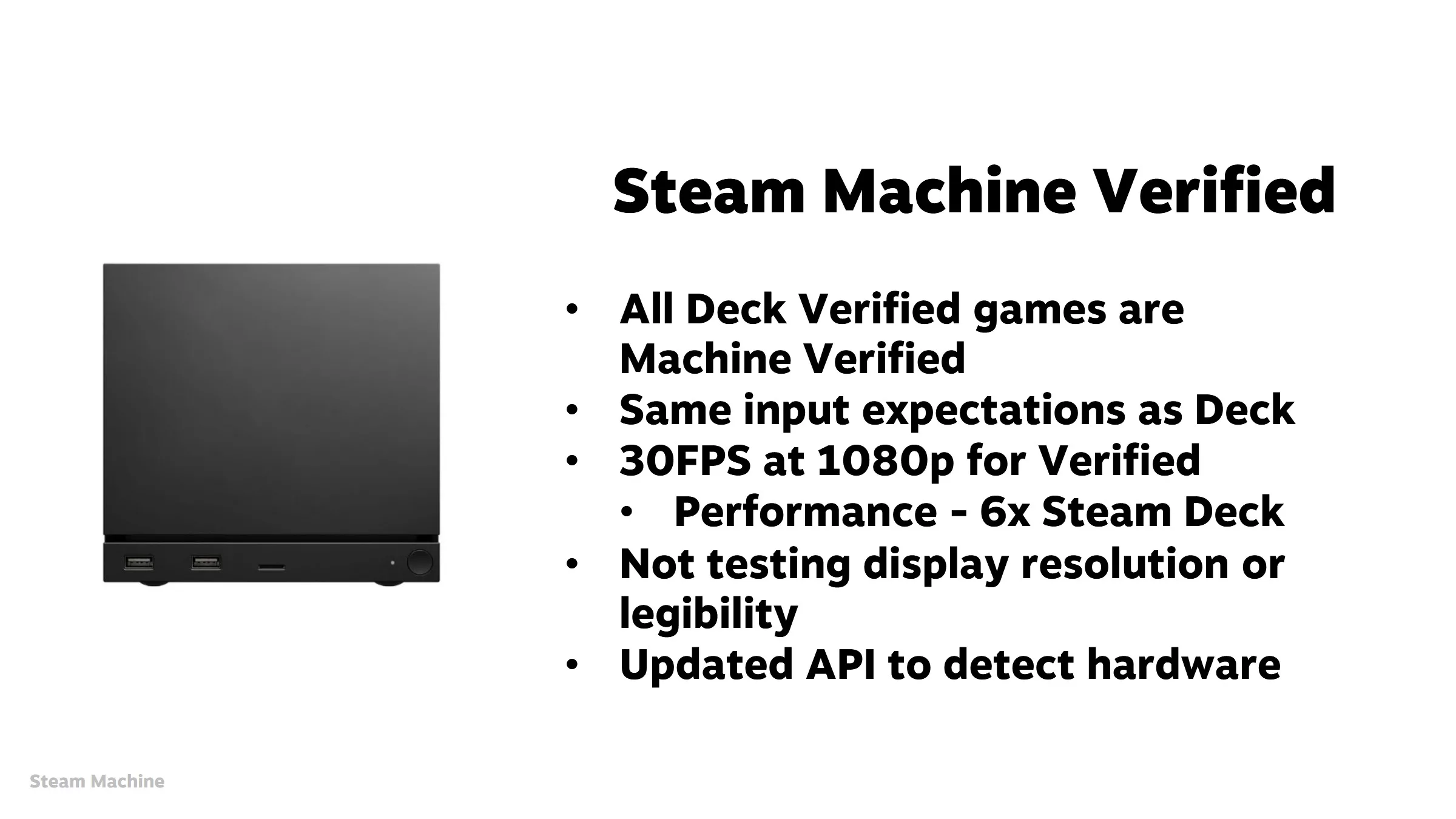
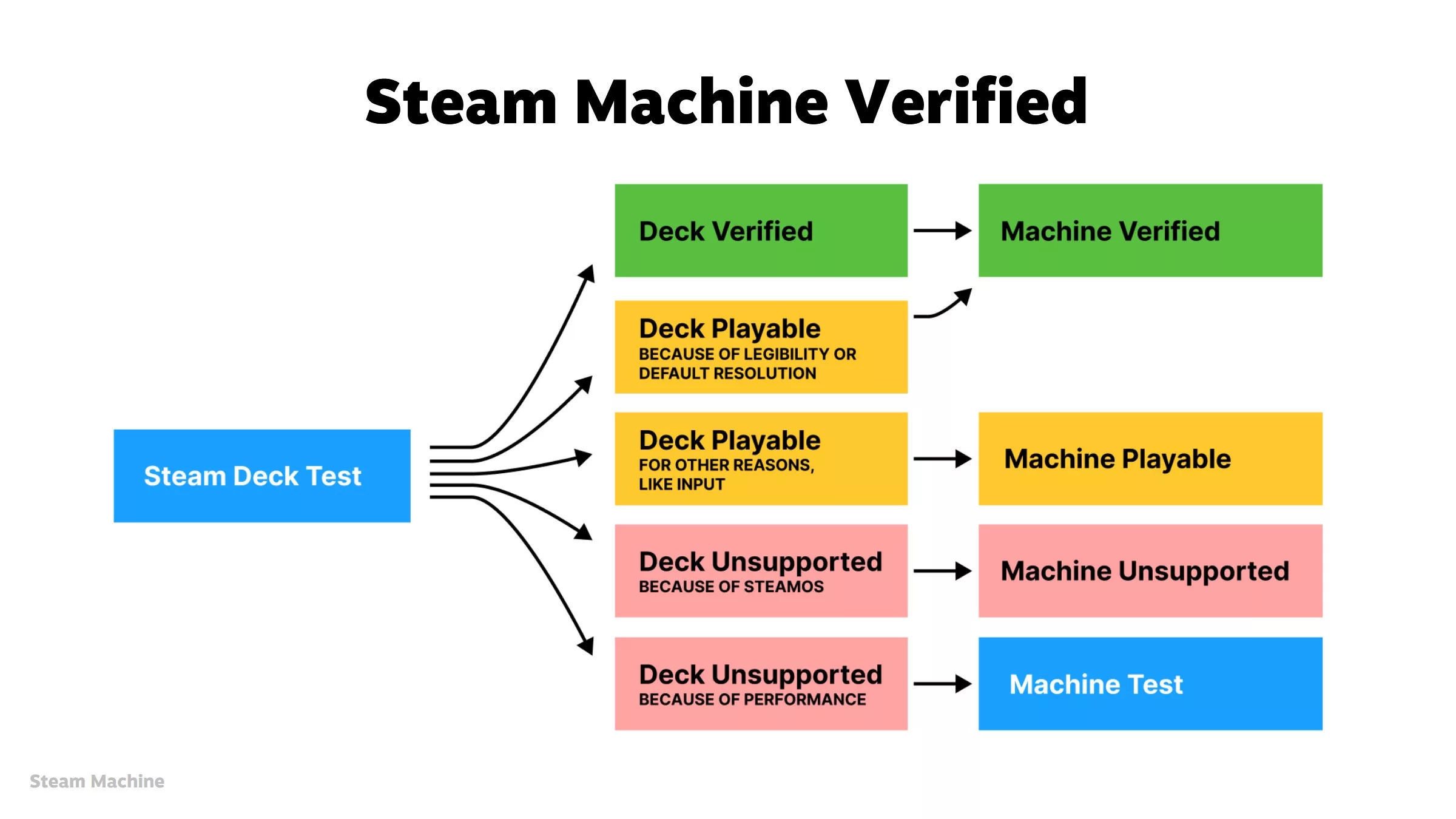
Valve has detailed its verification requirements for both the Steam Machine PC gaming system and the Steam Frame wireless VR headset. Guidance to game developers for the Steam Machine is very similar to that provided for the Steam Deck and, for the most part, has only a few differences. For starters, any game that already meets Steam Deck verification is automatically verified for the Steam Machine. Per Vavle, this means there will already be over 25,000 games ready to run on the new gaming system. However, the reverse won’t necessarily be true since the Steam Machine will have more powerful hardware, so it stands to reason that a game which may be verified for it might not be for the gaming handheld, but Valve has added a recommendation to developers that “Optimizing for lower spec machines expands your audience.”
That being said, Valve is asking developers to target 1080p 30 FPS as the goal in order to meet verification requirements for the Steam Machine. This is definitely a lower-end spec for PC gamers, but it could allow the custom AMD APU to more efficiently reach 4K via upscaling technology. Other general guidance includes providing support for different aspect ratios, something the PC community usually hopes for with various ultrawide ratios such as 21:9, 32:9, and 16:10 for gaming laptops. Not saving graphic settings to the cloud is another, while conversely, offline support should be included. Multiple controller support is also being requested, even if a game is single player, and if a title specifically only supports keyboard and mouse, it will only be verified for the Steam Machine.
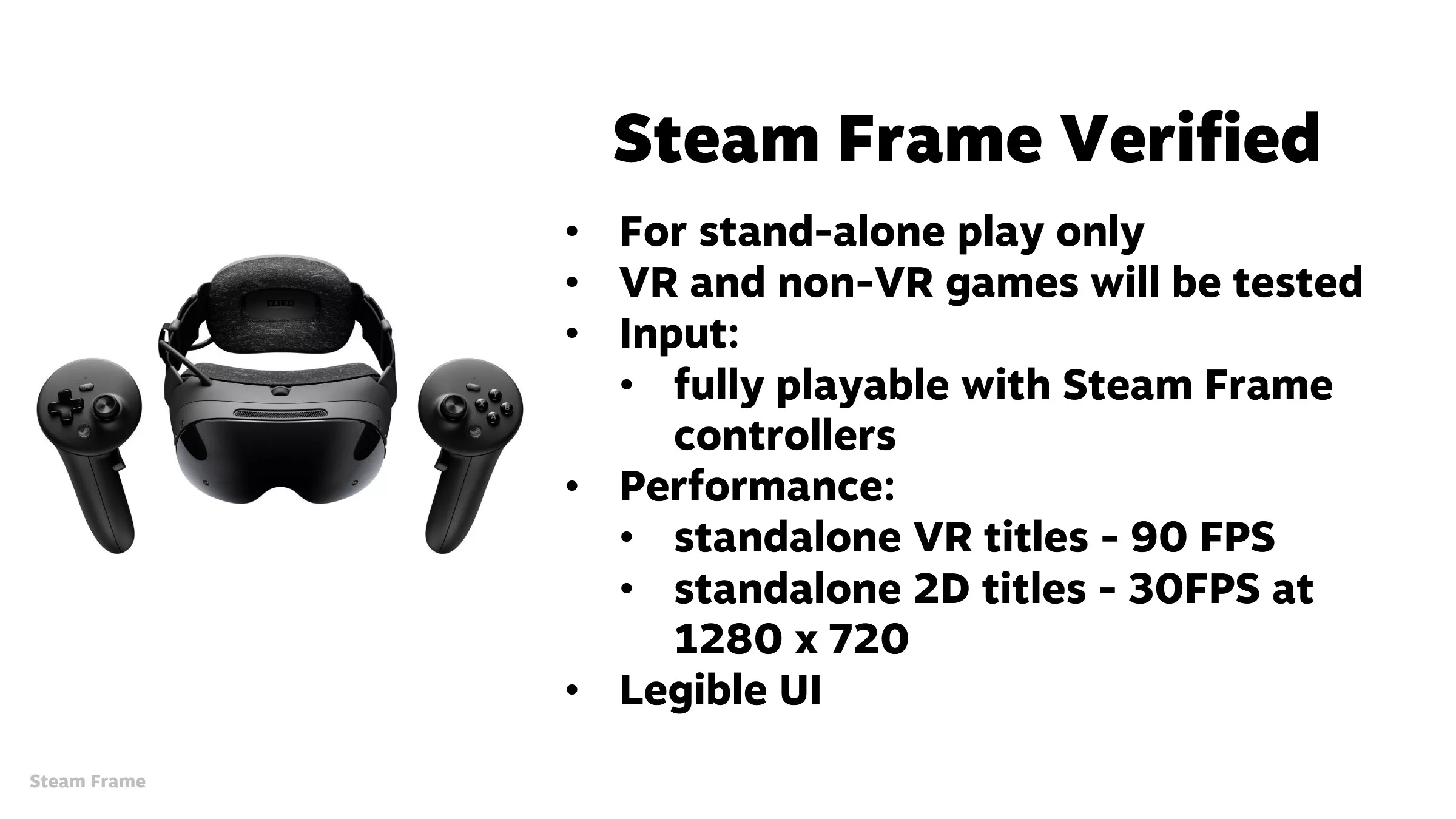
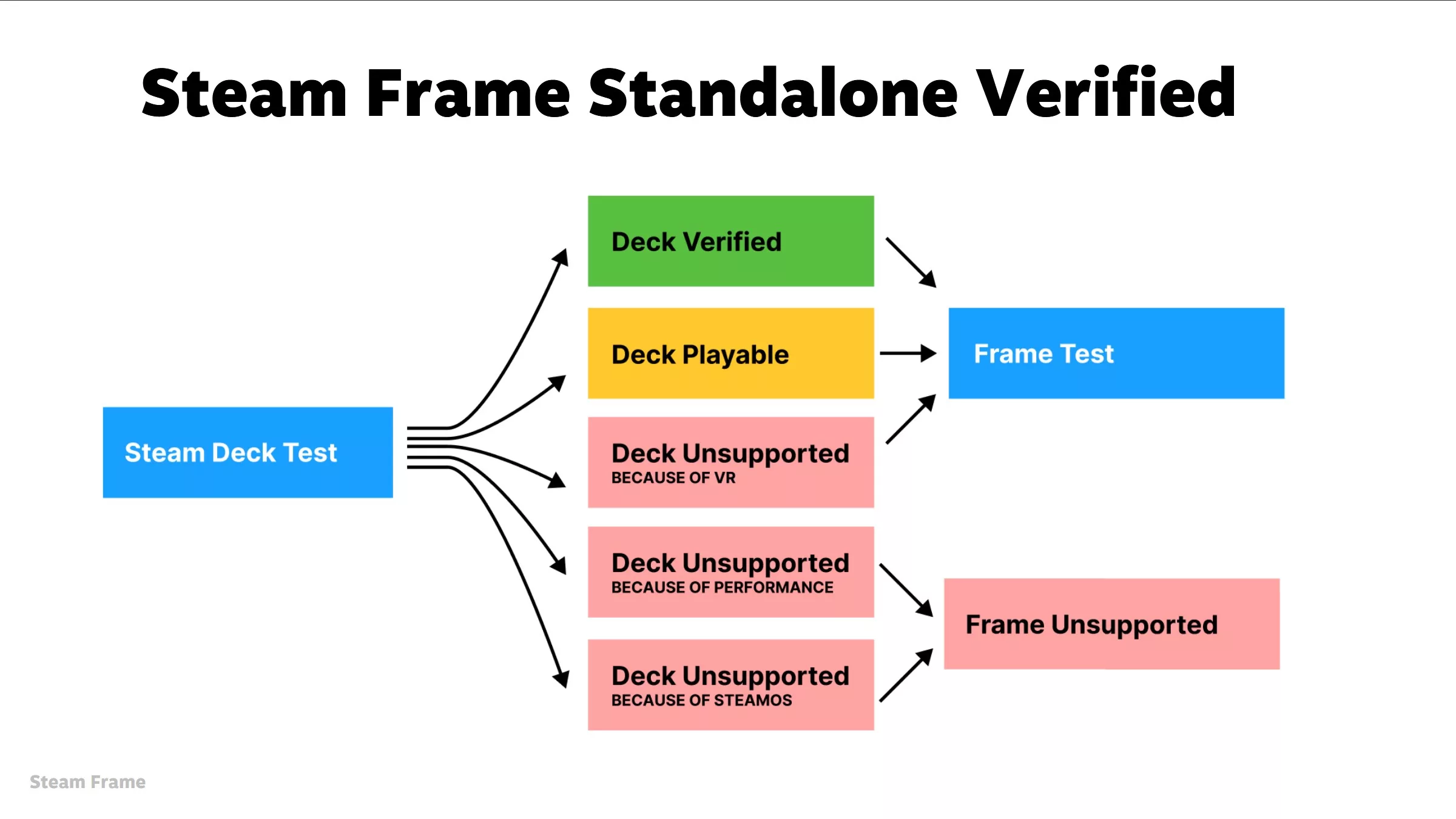
Regarding the Steam Frame wireless VR headset, Valve has laid out its verified requirements, showing modest performance needs for its ARM-based processor. Support for x86 gaming is once again provided via Steam’s Proton integration, and there are no verification requirements for streaming from PC to the Steam Frame via its USB dongle. However, for standalone play, games must be compatible with the Steam Frame’s controllers and able to reach up to 90 FPS for VR-designed games and 30 FPS for 2D titles. Developers must also ensure an optimized UI focused on legibility.
- No verified program for streaming
- If it runs well on your host PC, it will run well on Steam Frame
- Streaming requires no special integration, including for VR titles
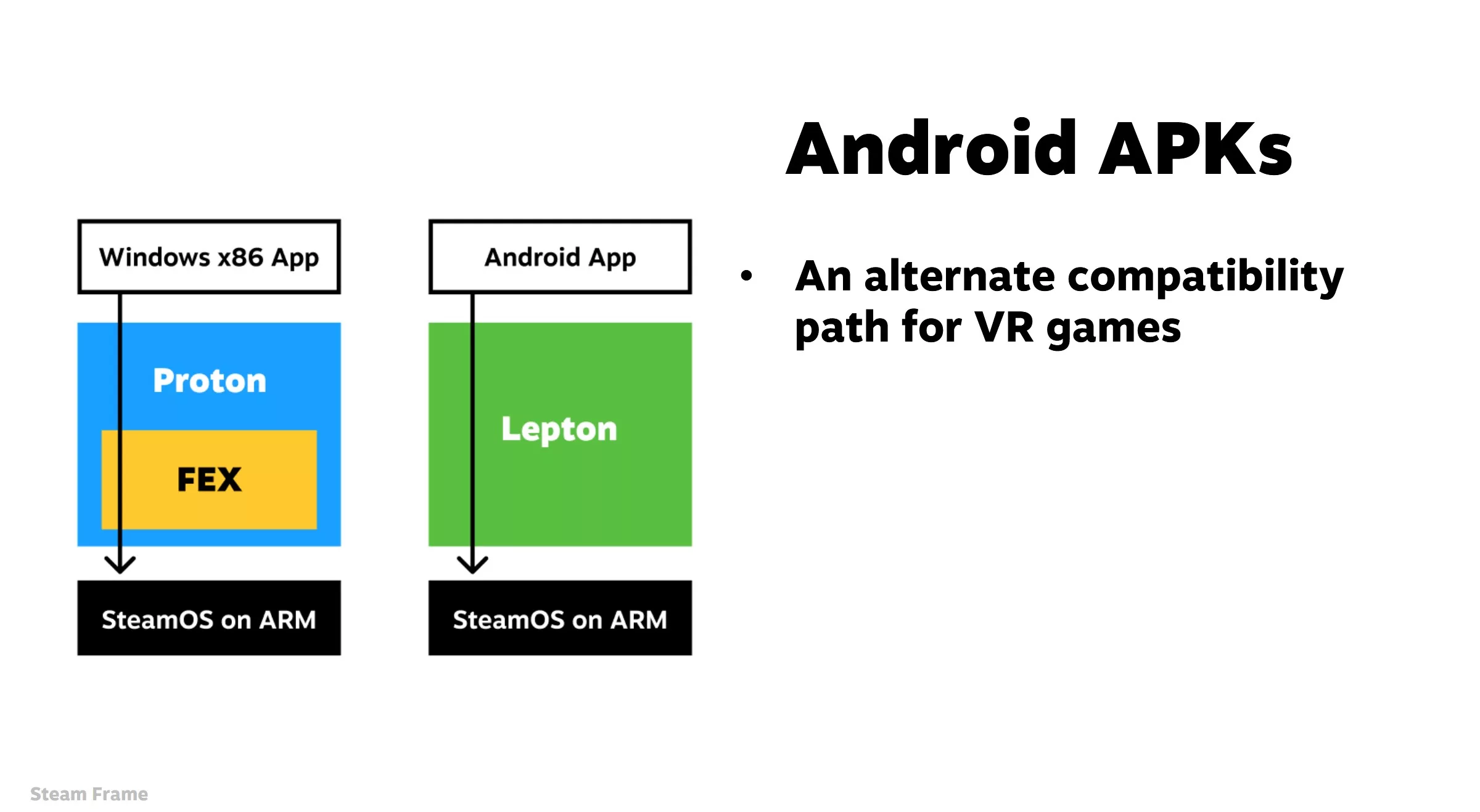
Some other items being asked of developers in relation to Proton Integration are to avoid using invasive DRM or anti-tamper solutions. Valve adds that it has its own built-in support for a number of mainstream solutions, but acknowledges there are still challenges for custom integrations. Valve also stated that the Legion Go S and Legion Go 2 are currently in a SteamOS compatibility phase, which indicates potential greater adoption of its OS. There’s still no release date for either the Steam Machine or Frame, nor pricing, but we could be getting closer to an official announcement. More information for the above can be found in Valve’s GDC 2026 official slide deck here.
Discussion (19 replies)
Join Discussion →Commenting on the headline... well no shit sherlock.
I have little faith the GabeCube will succeed. For me it's too little too late. The steamdeck didn't really have competition, but the Steam Machine will compete both with consoles and gaming pcs.
If it wants to cater to the casual gamer, it better be cheap, the rumored target was around $700, that's PS5 Pro territory which is so much faster, that was a hard pill to swallow but with the current ram prices we'll be lucky if it retails at $999. And it's not like they can afford to subsidize the price, especially if they want to open the platform to other OEMs as rumored.
Regarding the headline ... Tell me your new gaming device cannot compete with similar market products without telling me its performance will be worse. The statement is pure marketing spin. If you cannot compete in a market, re-frame the discussion to ensure your product is seen positively and your competitors are seen negatively.
I want GabeCube to succeed, but as the days and info come and go, my faith dwindles. However, the Frame still looks very promising, and depending on price, I may very well work on getting one.
I think the Frame could be the real Gem
I had the Oculus Quest before Facebook bought them, would not have bought it otherwise. Then my wife won the Q2 in a contest and gave it to me. Talk about full on Metaverse, quite unsavory. Looking forward to ditching that ecosystem for the Frame. I'll also close out my Facebook account where I have not been active for 10 years.
I think it has a good chance of succeeding because developers will finally have a minimum spec PC they can confidently target and optimize for. It should get the people hanging onto their Core 2 Quads and Nehalems to upgrade and stop bitching about AVX2 requirement in games. That really gets on my nerves because we should've had AVX-512 support in games by now but the stragglers make progress impossible.
LMAO anyone still using those likely does not have money for a modern upgrade. Or if they do, they have been saving a loooong time. I want the valve hardware to do well because it is the first time it seems truly possible that millions of PC gamers could migrate away from microslop.
imo, $700 would be fine, if it fully supports FSR 4 & 4K upscaled gaming
but unfortunately there are 2 issues here
by contrast in january (CES) 2028, AMD (& Microsoft) will have
so effectively the window for valve is just little more than a year. after that new RDNA 5 apus will make the current proposed steam machine obsolete
Maybe the measure was wrong but I'm a 4k gamer. And it seems that FSR with 4k gaming... in star wars outlaws (not exactly the most demanding of games.) using high quality takes less video memory (less than 8 gig for sure) to run at 4k?? Less upscaling meant more vram use. And that was with everything else maxed... but I need to double check that after I get some work stuff done.
once you get any kind of nanite like (or open world) technology involved then memory requirements balloon
most playstation ports consume memory
forza horizon 5 has a memory leak which causes it to consume more vram if you keep playing it for some time
but it is game specific. if valve can validate which games/settings/scenes work for 8gb vram then that should provide some assurance
Some people have a weird principle of hanging onto hardware until it dies, even if they can afford something better. And I guess turning down/tweaking settings to run modern software on such old hardware turns them on.
They will probably implement a warning message to the effect of "This game is not optimized for Steam Machine" for VRAM intensive games. Developers could also implement Steam Machine detection in their games and warn the user of bad experience if someone insists on running settings too high for Steam Machine to handle.
AFAIK RDNA3 does not support FSR4, much less 4.1.
Not directly: https://github.com/007Lore/AMD-FSR-4-INT8