
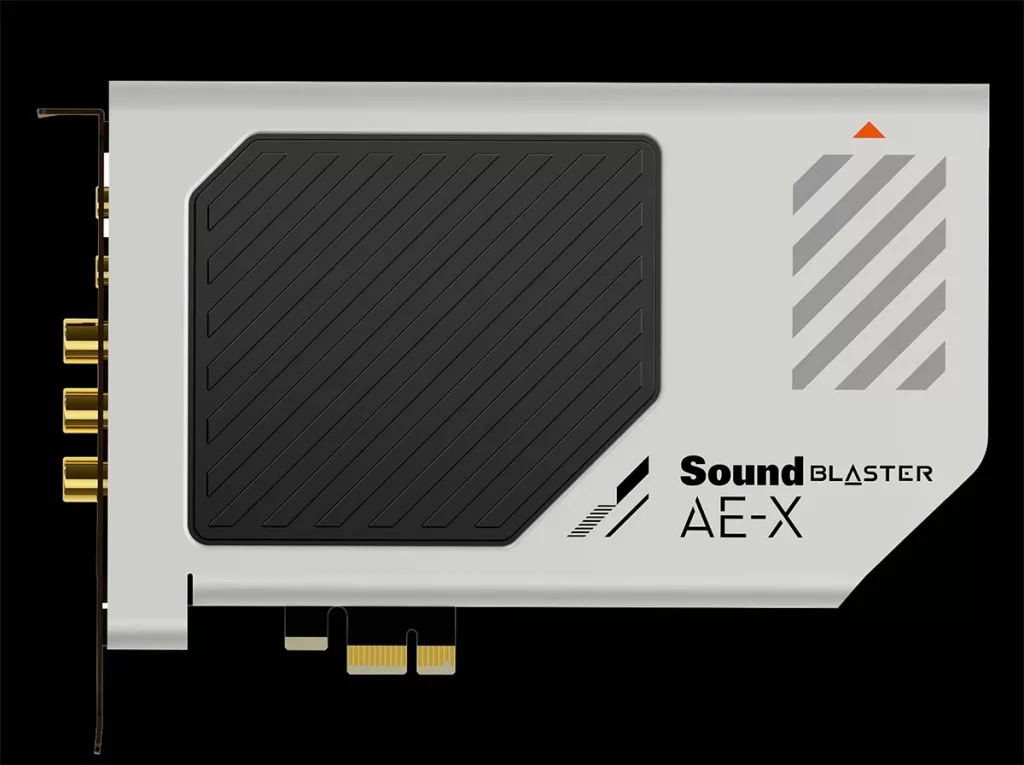
Onboard audio has gotten decent over the past decade. Motherboard manufacturers have been quietly dropping better Realtek codecs and op-amps onto their boards, and for casual listening or gaming with mainstream headphones, it largely does the job. But “largely does the job” is not the same thing as “actually good,” and Creative is betting there are still enough enthusiasts who know the difference to justify a proper dedicated card in 2026. Enter the Sound Blaster AE-X.
The AE-X is a PCIe 3.0 add-in card built around the ESS ES9039Q2M dual-channel DAC, part of the HyperStream IV architecture. Creative is claiming a 130dB signal-to-noise ratio, which on paper clears the company’s own AE-9 flagship, and the card supports 32-bit/384kHz PCM playback alongside direct DSD256 decoding, making it one of the few consumer-oriented PCIe cards to handle native DSD without software conversion. Headphone amplification is handled by Creative’s X-amp discrete architecture, rated for cans up to 600 ohms, which covers just about every planar magnetic and high-impedance dynamic headphone on the market. Output power is rated at 350mW at 32 ohms. ASIO 2.3 support is included for low-latency recording and monitoring work, and connectivity includes optical S/PDIF input and output alongside the usual analog outputs. On the software side, Creative ships the AE-X with Scout Mode positional audio, AutoEQ headphone calibration presets, and its Creative Nexus app integration.
Pricing on the product page alleges you can buy it for $179. It also appears to be available on Amazon for July delivery. The card slots into a standard PCIe x1 slot, so it should fit in virtually any current ATX or mATX build.
The dedicated sound card market has contracted sharply since its early 2000s heyday, but the segment that remains is well-defined: users driving high-impedance headphones, running optical S/PDIF chains, doing low-latency recording without an external USB interface, or simply wanting to pull audio off the motherboard entirely in noisy system environments. The AE-X positions itself at that crowd. The 600-ohm headphone amp spec is useful if you are running something like a Sennheiser HD 800 (Ed: That’s a 300-ohm part dude) or a Beyerdynamic T1, and the DSD256 support will appeal to anyone who has assembled a high-res music library. The $179 price point lands above entry-level cards but below the extreme audiophile tier, making it a reasonable ask for a desktop build where audio quality is part of the point.
For most builders, onboard audio is fine. But if your headphone collection skews above 150 ohms, or if you have been running optical out to an external DAC anyway, the AE-X is worth a closer look.
Discussion (19 replies)
Join Discussion →Yea.. my wireless headset gains nothing from a sound card.
Looks like it's up on Amazon now https://www.amazon.com/Creative-Blaster-Hi-res-Discrete-Headphone/dp/B0H1PZ7ZGF/
Doubt my wireless headset will benefit from this... lol
Sennheiser HD 800 are 300 Ω headphones. The article says they're 600!
Please change! People could damage their headphones!!!
[URL unfurl="true"]https://ca.sennheiser-hearing.com/products/hd-800-s[/URL]
Added a call out.
And they're so efficient even at 300 Ohm, that you can run them off of any headphone output.
Impedance is only one variable :)
At this price point it really is putting it in competition with much better external options. I would have preferred seeing a half height option with just standard balanced and SE headphone outputs. As it sits, unless you just absolutely need internal, this price puts it in much stronger competition with external options.
This is definitely true - the AE-X is a 'traditional' sound card.
I think that limits its market somewhat, especially relative to most options having USB (and/or wireless) capability, and thus their own 'sound cards' built in.
What you're describing is really closer to an audio interface - I use audio interfaces personally, but they do come with some baggage that may not be desirable for many consumers. Balanced outputs being a big one, since they require some level of conversion (even just physically) for standard speakers.
Personally if Creative were to push more toward the audiophile side, I'd like to see multiple pairs of balanced outputs, so that speakers and headphones would share different paths that could be selected at the operating system (well, software) level. This would allow for things like a balanced headphone amplifier to have its own output alongside a set of studio monitors, as well as a solid set of EQ for each.
Being able to have custom Equalizer APO profiles per output and then being able to route live input monitoring (which would need to be implemented in hardware) would be the icing on the cake.
Creative needs to make decent drivers for their sound cards before releasing another one. When you need to use homemade drivers to make them work right, the manufacturer needs to pay attention. And it's been like that for about 20 years.
This card at least is based on a Realtek codec that backhauls over USB (over PCIe)- so it's just their software stack behind it and whatever other tweaks they did.
There's presumably not much to screw up here; should even work on Linux out of the box, though I'd like to see that tested first.
I will say that I had to use third-party drivers for my old X-Fi Titanium, and by old I mean like ~20 years almost? 15? But it's up and running on Windows 11 with the full software suite.
That is exactly when and why I stopped looking at anything from Creative Labs
In Linux many years ago they actually officially gave up and said to the community "you guys handle the drivers" and boy did they ever. The Linux drivers are so f*cking good (as least as far as the X-Fi is concerned). A few times I found myself saying "I wish these same community developers would make the Windows drivers too!"
There's nothing wrong with the optical out on my motherboard that sends unprocessed audio to my desktop amp which powers my bookshelf speakers and my DT 770 Pro's at 32ohm.
I really do feel sorry for anyone running wireless headsets/headphones. I was one of those people. Until I learned that I was missing so much due to compression and the extremely crappy DAC's built in to them.
Sure but I also dont run a receiver, wires for my headset, additional wires for a microphone e, have to plan space for a receiver and all of that for what is ostinsibly a minor difference in sound quality. At least to me.
I also switched from a classic home theater system to a sound bar and have been happy with that.
Audio interface (Rodecaster Duo), a pair of 5" studio monitors, 10" studio sub under the desk, whatever headphones I want (wired), a broadcast mic (wired)... it sounds great though!
But for the most part, I could get by with a headset and a sound bar.