

Big things can come in small packages, and NVIDIA’s RTX Spark looks to be a good example of what a consumer-grade ARM processor can be when paired with a powerful GPU. NVIDIA finally revealed its long-awaited RTX Spark processor last month following years of rumors and leaks. Born of a collaboration between NVIDIA and Mediatek, the RTX Spark features a 20-core Grace GB10 CPU with a Blackwell-based GPU. This ARM processor is one of the few designed to work with Windows 11, and NVIDIA has been working closely to develop drivers for it; the latest GeForce driver version 616.00 (via Windows Latest) has revealed there are at least two variants of the RTX Spark.
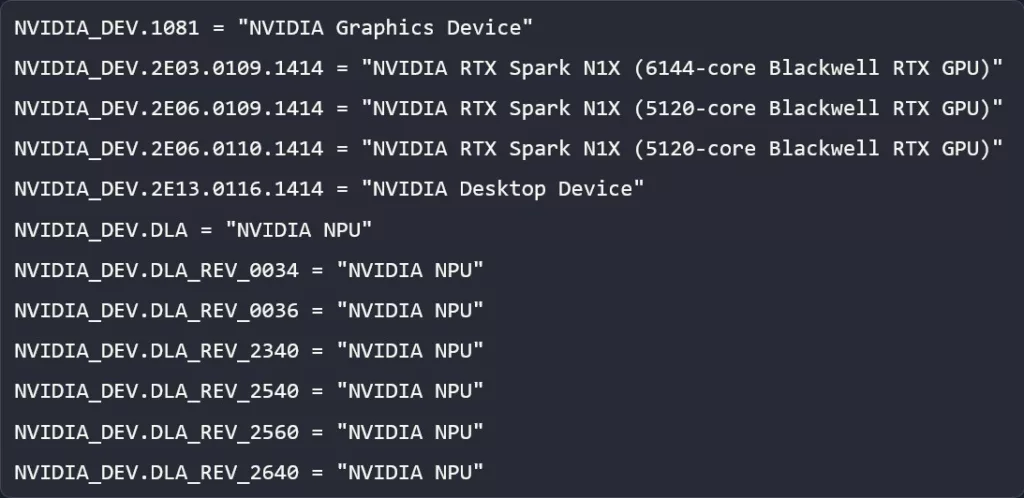
The driver seemingly confirms that there are two N1X variants with different GPU core counts, while three are listed along with an unknown desktop device. This does, however, leave a question as to whether NVIDIA is planning to release more variants with fewer cores, since at one point it was reported that an N1 model could be a possibility, but it’s also possible that the chip manufacturer has chosen to commit to a single branding for now. One features 5,120 CUDA cores while the other has the maximum count of 6,144 CUDA cores. NVIDIA’s partners are already preparing a range of laptops powered by the RTX Spark, and it’s been reported that desktop products from Acer, ASUS, Dell, GIGABYTE, Lenovo, and MSI are also planned for release by the holidays.
“Get RTX Spark in a small, ultra-efficient desktop. Built to run personal AI agents 24/7 right at your desk plus game and create with the full power of RTX graphics.”
– NVIDIA
It will be interesting to see how the RTX Spark performs in a desktop configuration, which will presumably feature the maxed-out core count version. From productivity to gaming, there’s a lot of ground to cover in a Windows environment, and the CPU/GPU/NPU package has a lot of potential waiting to be unlocked, but driver integration and support will be crucial to its success.
Discussion (2 replies)
Join Discussion →So what kind of gaming we looking at here, windows, but arm, so....
GIven that gaming is much more sensitive to the GPU than CPU, and ARM can be a pretty capable CPU when you want it to be... I'd say the GPU count tells the story.
The 5070 has 6,144 Blackwell cores, so that's roughly the same as the higher core count in this. Power would be the other part of that - I doubt they are going to push this at 250W like they do the discrete GPU. So I would put it at or above the 5060 in performance (3,840 cores), but probably falling short of a full discrete 5070 when pushed hard.