
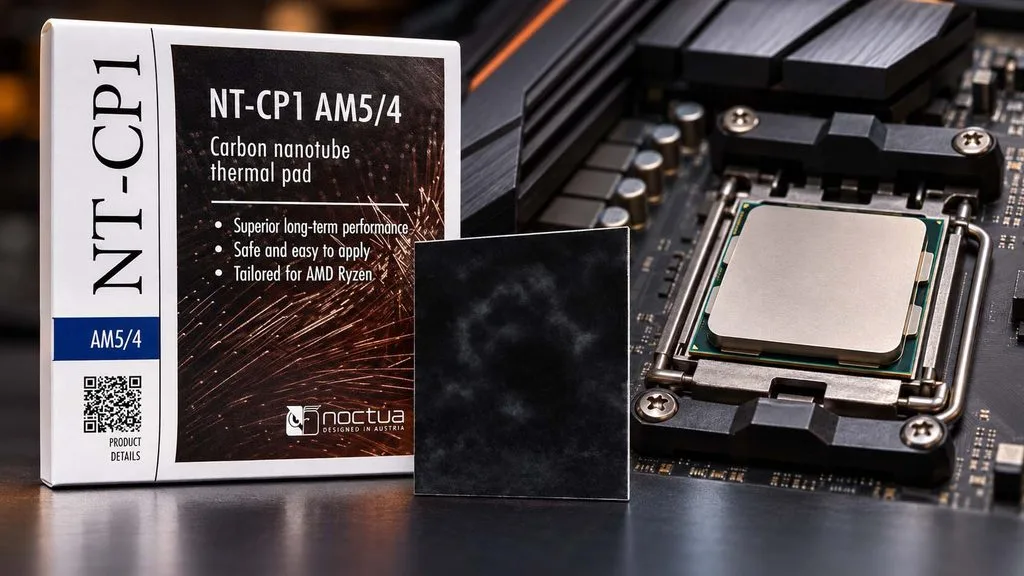
Two months after its original September target came and went, the carbon nanotube thermal pad we first covered back at Computex is finally something you can buy. If you’ve been waiting for an excuse to never repaste a Ryzen chip again, this is the product.
Noctua today launched the NT-CP1 AM5/4, the first retail product from its exclusive distribution deal with Atlanta-based Carbice. The pad is 90µm thick, precut to 33x33mm, and fits both AM5 and AM4 processors. MSRP is $24.95 (€24.95), and it’s available now through Noctua’s official Amazon stores (see pricing box below), with other retailers getting stock shortly. Carbice manufactures the pads in the United States from recycled aluminum and waste carbon gas, and Noctua says the spent pad can go into standard aluminum recycling.


The pitch hasn’t changed since the partnership was announced in June. Rather than degrading through pump-out or dry-out, Noctua says the NT-CP1 improves over its first few hundred to few thousand thermal cycles as the nanotubes conform to surface microstructures, then holds steady for years. Installation is a “peel, press, peel” affair, and the polymer coating is said to keep the contact surfaces electrically non-conductive unless that layer is penetrated. Noctua CEO Roland Mossig calls it a pad that “never needs to be replaced.” Noctua has even published a guide on speeding up the activation phase with automated Prime95 runs, which tells you something about how much that break-in period matters.
This is the same technology AMD bundled with the Ryzen 7 5800X3D 10th Anniversary Edition, and that CyberPowerPC has offered pre-applied since 2025, so there’s some independent data to work with. LTT Labs tested the 90µm Carbice Ice Pad on a Ryzen 9 9950X3D with both an NH-D15 G2 and an Arctic Liquid Freezer III 360. Against Noctua’s own NT-H2 paste and PTM7950, the pad ran 4 to 8°C warmer in short-term testing, narrowing to about 4°C after Carbice’s suggested activation procedure. LTT also found some pads lost 15 to 20% of their nanotube forest on the first removal, and Carbice advises against reuse.
Igor’sLAB put an NT-CP1 press sample through lab-grade TIM testing and came away more upbeat on the long game. His measurements showed roughly 4 W/mK effective conductivity, a bondline settling near 69µm, and only a 0.8 to 1.5% change after 10,000 severe thermal cycles. The catch is that the pad doesn’t flow like paste or PTM, so it’s more sensitive to mounting pressure and warpage. His verdict: “extremely durable, yes; completely foolproof, no.”
So who is this for? Not the enthusiast who swaps coolers every few months. At $25 for a single-use pad, you can buy a tube of NT-H2 that covers multiple builds and runs cooler on day one. The NT-CP1 makes sense for the build-it-and-close-the-case crowd: SFF systems that are a pain to open, family PCs, and machines you’re building for someone who will never repaste anything. LTT itself flagged that “gets better over time” is a convenient answer to weaker short-term numbers, and Igor’s cycling data is the closest anyone has come to validating it independently. It’s promising, but nobody has three years of consumer data yet. Noctua says it will collaborate with Carbice on future products, so an Intel version seems like a matter of when, not if.
Discussion
Join Discussion →No replies yet. Be the first to reply on the forum.