
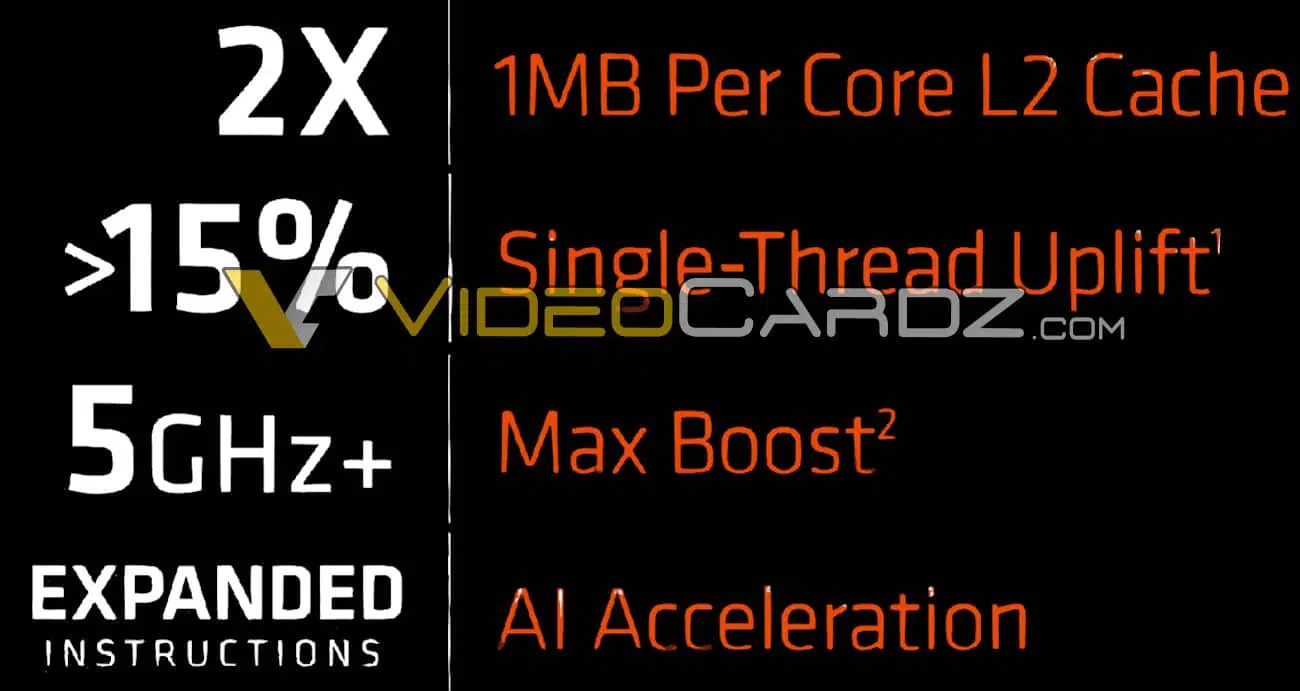
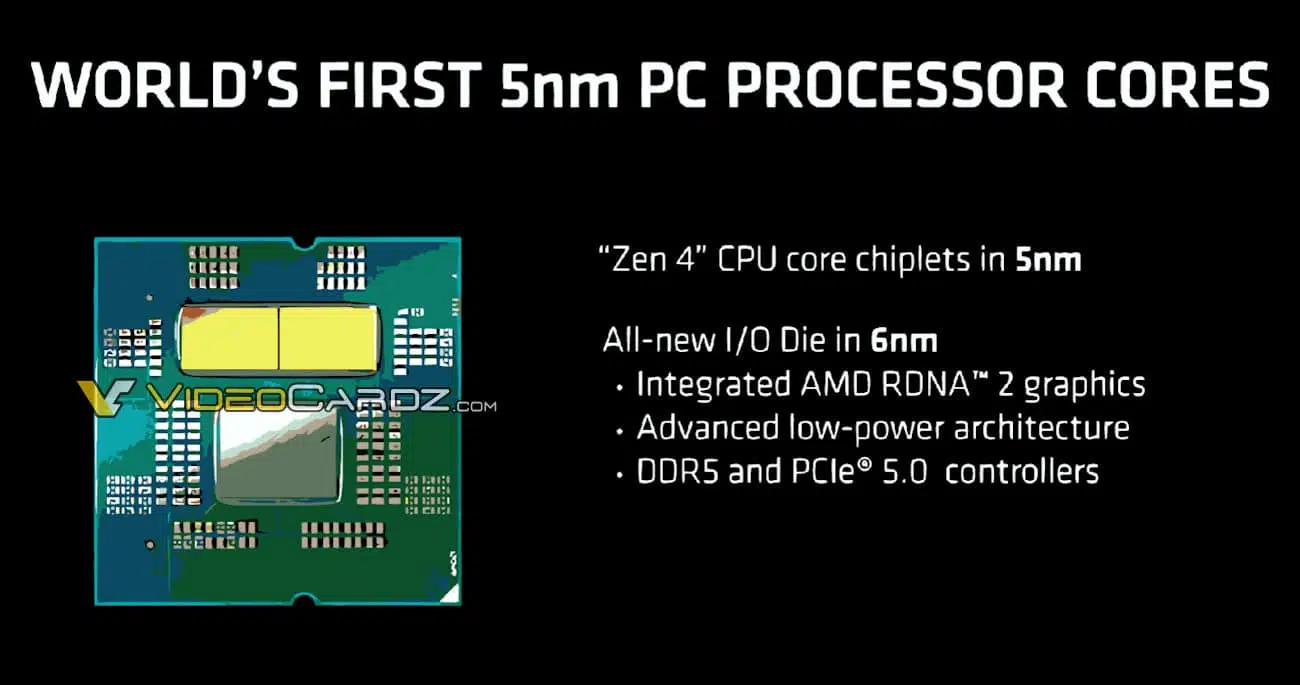
It won’t be long until AMD officially announces its Ryzen 7000 Series processors at Computex 2022, but VideoCardz has provided an early teaser of what red team plans to share with a leaked slide that can confirm some of the improvements that the new CPUs are set to bring. Among those is a substantial boost in single-threaded performance; AMD claims that its Zen 4-based Ryzen desktop processors will boast more than a 15% uplift in that department. Users can also expect a new range of SKUs that are capable of hitting maximum boost clocks of over 5 GHz out of the box, a number that even the current Ryzen 9 5950X flagship can’t quite match on its official list of specifications. Another slide can confirm two 5 nm core chiplets based on the new Zen 4 architecture, one 6 nm I/O, DDR5 and PCIe 5.0 controllers, and an RDNA 2-based iGPU. AMD’s Ryzen 7000 Series processors will launch this fall, although exact release dates are still to come.
AMD reaffirms its Ryzen 7000 series will support PCIe Gen5 standard as well as DDR5 memory technology. The LGA1718 socket will retain compatibility with AM4 coolers. Furthermore, the rumor about high-power TDP SKUs has been confirmed. The next-generation AM5 socket will support up to 170W, however, this is not mentioned for Ryzen 7000 specifically.
In terms of performance, AMD is claiming its Zen4 core architecture will offer over 15% single-thread uplift (sadly we do not have the footnotes explaining what is being compared here), 2X bigger (1MB) L2 cache per core and Max Boost over 5 GHz.
Furthermore, AMD has finally revealed what is under the new heatspreader. There are two 5 nm Zen4 core chiplets and one 6nm I/O. There is clearly no room for a third CCDs, but there is really no way to tell how will this design evolve in next generations.
Source: VideoCardz
Discussion (10 replies)
Join Discussion →15%... are they being conservative? That isn't going to cut it.
Why not?
If it's compared to the 5800X3D, seems that wouldn't be so bad at all.
It might - the 5800X3D is only faster than a 5800X in CPU cache-bound workloads. Anything else and the 5800X is faster, as are its larger core count siblings.
Well, it's enough to put it over the top in some specific scenarios, as you say, even over Alder Lake. And those scenarios are the ones I tend to care more about in my personal PC.
So if you can beat that by 15%, that doesn't seem to bad at all.
But if you are just talking about generic single threaded benchmarks, yeah 15% isn't enough to catch up to Alder Lake. But I don't run single threaded benchmarks on a daily basis.
If it doesn't beat it on release I'd be curious to see what a year's worth of driver and bios updates does for it.
It's going to need them for DDR5 - still, the cores themselves need to be stout. That's the one thing that Intel did with Alder Lake (after years of... not so much), and Alder Lake is still cache-bound itself, which Raptor Lake looks to address.
I'm going for the fastest Raptor Lake when they come out. Can't bring myself to go back to AMD.
When I upgrade next I'll go with the platform that is best at that time. I won't be pre predicting what platform that will be.
I like this. I probably won’t be upgrading for another couple of generations myself. Who knows what it will look like by then
I'm doing both - several of each - but more for my own education and to have discrete compute resources on tap for... projects.
Actually plan to have the 12700K system on the desk as well as the 5700G and 5800X3D. Different purposes for each, with the 5800X3D system being intended to be more mobile, and the 5700G to primarily be a Linux desktop, very likely Fedora.
I can't say that I'd be able to pick one over the other with the same GPU backing them up.