
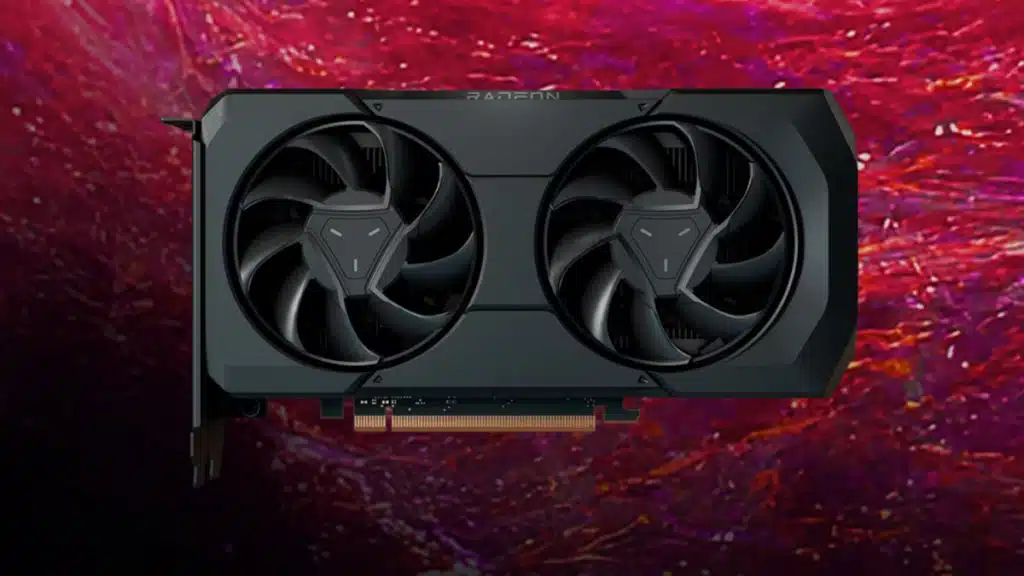
There is a rule of thumb in this business that has never once failed me: when a company works this hard to keep a product away from reviewers, the product is the reason.
AMD launched the Radeon RX 9050 at the end of July with about as little fanfare as a graphics card launch can have. No review program and no samples. According to Hardware Unboxed, no permission for board partners to send one out either. Club386 noted at the time that they had not been offered a card and did not expect to be (Ed: You know, we didn’t get offered anything either – but did we ask?). The launch was limited to Latin America, Asia-Pacific, and Japan, with no date at all for North America or Europe, and with Australia and Korea excluded outright. That last detail is funny in a way AMD probably did not intend, because Australia is where Hardware Unboxed lives.
They got one anyway. So did TechSpot, their written arm (Ed: That article is written by a dude with the same first name in the video, I’d say they only got one), through what they describe as side-channel contacts. The condition was that they could not name the partner, could not show the card, and could not photograph the box. Every product shot in that review is a different graphics card with a disclaimer under it. I’ve been at this a while and this is the most cloak and dagger approach to a review that I can recall.
Overview of the Radeon RX 9050
The RX 9050 is a Navi 44 die with half of it switched off. Where the Radeon RX 9060 XT uses 2,048 active cores and the vanilla RX 9060 uses 1,792, the RX 9050 gets 1,024. Boost clock drops from 3,130 MHz to 2,600 MHz. You get 8GB of GDDR6 at 18 Gbps on a 128-bit bus for 288 GB/s, and a 92W board power, all of which AMD confirms on its own product page. Hardware Unboxed’s read is that this is a bin for Navi 44 silicon that could not meet RX 9060 spec, which AMD has not confirmed and which sounds entirely plausible.
Ninety-two watts is low, and I want to give credit where it is due before taking it back. TechSpot measured a peak hotspot of 59°C with the fans at a whisper-quiet 960 RPM. It is a cool, quiet, efficient little card. It also still needs a PCIe power connector, because AMD missed the 75W slot-power ceiling by seventeen watts, which is the one thing that would have given this product a reason to exist.
Benchmarks
Across ten games, TechSpot recorded a 49 fps average at 1080p and 33 fps at 1440p. The GeForce RTX 5050 was 20% faster at 1080p. AMD’s own Radeon RX 7600, a card from two generations ago, was 22% faster. Stepping up to the RX 9060 XT 8GB produced 86 fps, a 76% increase over a card that costs roughly $120 less.
Individual results tell the same story with more texture. In A Plague Tale: Requiem at 1440p the RX 9050 managed 32 fps and actually finished behind the older RX 6600. In Stalker 2 at 1440p it hit an 8 fps VRAM wall, though in fairness so did every other 8GB card in the chart including the RX 9060 XT 8GB. The 16GB version of that same card returned 42 fps.
TechSpot scored it 30 out of 100 and closed with a heading I am going to let stand on its own: “Budget Gamers Deserve Much Better Than This”. Hardware Unboxed put “$280 Radeon E-Waste” in the thumbnail (Ed: I payed less than that for a Radeon 9800 Pro, top of the line stuff!). Both Steves concluded that the card cannot make sense above $200.
At $280 against an Intel Arc B580 that sells for around $310 with 12GB of VRAM and 27% more performance, the math is not close. And that is the comparison AMD loses, not the one against Nvidia.
The 4GB Shenanigans
Here is the thing I have not seen enough coverage of, and it is the reason I am writing this as its own post rather than a line in the Weekender.
There are two Radeon RX 9050s. They share the exact same product name. This was apparent back at the end of July, when we covered ASRock’s Challenger listings surfacing in both 4GB and 8GB GDDR6 configurations before AMD had said much of anything about the card. The 8GB version is the one described above, running on a 128-bit bus. The other has 4GB on a 64-bit bus, which halves the memory capacity and halves the bandwidth to 144 GB/s. AMD has since confirmed the 4GB card is OEM-only, which means it will not appear on a shelf next to the 8GB card. It will appear inside a prebuilt system, on a spec sheet that says “Radeon RX 9050 graphics” and nothing else.
Nobody has benchmarked it yet. Given that the 8GB version is already hitting VRAM walls at 1440p, I do not think anyone needs a chart to guess how a 4GB version handles a 2026 game.
If you are buying a prebuilt this fall, check before you pay (Ed: Or… don’t buy a prebuilt?). Open GPU-Z or the Adrenalin software and look at two fields: memory size and bus width. A 128-bit bus and 288 GB/s means you have the 8GB card. A 64-bit bus and 144 GB/s means you have the other one. If a retailer’s listing only says “RX 9050” with no capacity, ask, and treat a non-answer as a 4GB answer.
Conclusion
I do not think AMD blocked these reviews out of malice. I think somebody looked at a cost-per-frame chart during an internal review, understood exactly what would happen when that chart went public, and made a decision that seemed like a good idea at the time.
Reviewers exist so that the person spending $280 on a graphics card, who almost by definition cannot afford to spend it twice, knows what they are getting. Withholding samples does not stop that information from arriving. It just delays it until after some people have already bought.
If you are genuinely shopping this tier, look at used hardware, look at the Arc B580, or save up. When we tested the Radeon RX 9070 GRE and put it head to head against the RTX 5070, the gap between a card that makes sense and one that does not came down almost entirely to what you get per dollar, not what the architecture is called. RDNA 4 is a good architecture. This is not a good product at this price point.
Discussion (6 replies)
Join Discussion →Its the first in a future of price increases, thats all. All other future higher performing cards will be priced higher.
supposedly next gen AMD is releasing only one chip AT2 for enthusiasts
RDNA 4 to continue at "budget" ($500 & below) end
the top dog AT0 is probably only for prosumers or the extremely rich gamers
so RDNA 4 cards will have to hold the fort until RDNA 6 launches in whatever shape & form
this means that the 4gb 9050 xt could be selling well into 2030 !!
There wont be any budget gaming anything any time soon.
Perhaps in a few years the budget gaming will be on a hacked used nvidia h200 from a failed startup.
I don't see how you can not see it as malice.
They want consumers to not know what they are buying.
Their website purposely misleads by giving gaming numbers that the 4GB cannot achieve because of the VRAM limitation
Yea there is no way. Unless they made some ground breaking texture compression leaps.