
Introduction
Computing evolves, and individual components within computers, and so it is time for the power supply to evolve. ATX 2.0 Power Supplies are in the rear-view mirror as ATX 3.0 Power Supplies make their debut. MSI is leading that charge, with the launch of its PCIE5 ATX 3.0 compatible power supplies with a real 16 PIN 12VHPWR connector and cable.
Today is the launch of three MPG PCIE5 ATX 3.0 compatible series PSUs from MSI, as well as two MEG PCIE5 ATX 3.0 ready series PSUs. This article will focus on the MPG PCIE5 series, as we do have one of them in hand to test in a future review, consider this an early product introduction article.



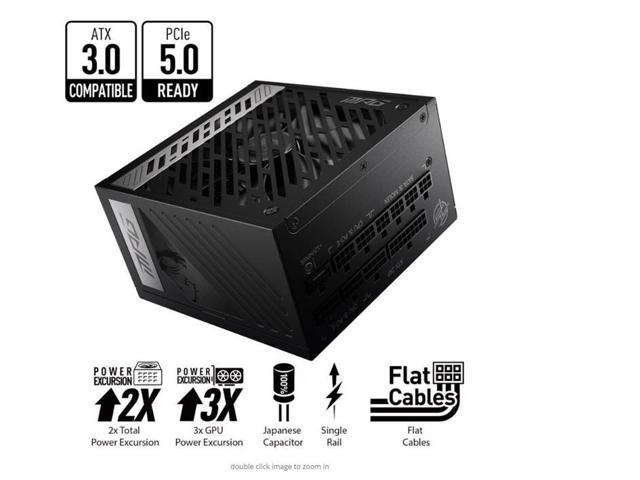


The new line of power supplies coming from MSI today will specifically be designed to handle the transient power spike burden of high-end GPUs and CPUs pulling lots of power. These power supplies are designed for the new generation of GPUs, CPUs, and computer build specifications.
Today MSI launches its MPG A1000G PCIE5 ($199.99), MPG A850G PCIE5, and MPG A750G PCIE5 power supplies. In addition, two MEG PCIE5 series are also launching, the MEG Ai1300P PCIE5 and MEG Ai1000P PCIE5, we will look closer at those power supplies and specifications when we have one in hand to review.
In our introduction article today, we will introduce the new MPG PCIE5 power supplies, detail their specifications, and show you pictures of the MPG A1000G PCIE5 PSU that we have in hand. This is not a full review today; we will be reviewing the MPG A1000G PCIE5 PSU in our standard rigorous validation methods which takes time to test properly. Until our review is done, we can show you pictures and specs and see what these new power supplies are all about.
MSI MPG PCIE5 Power Supplies
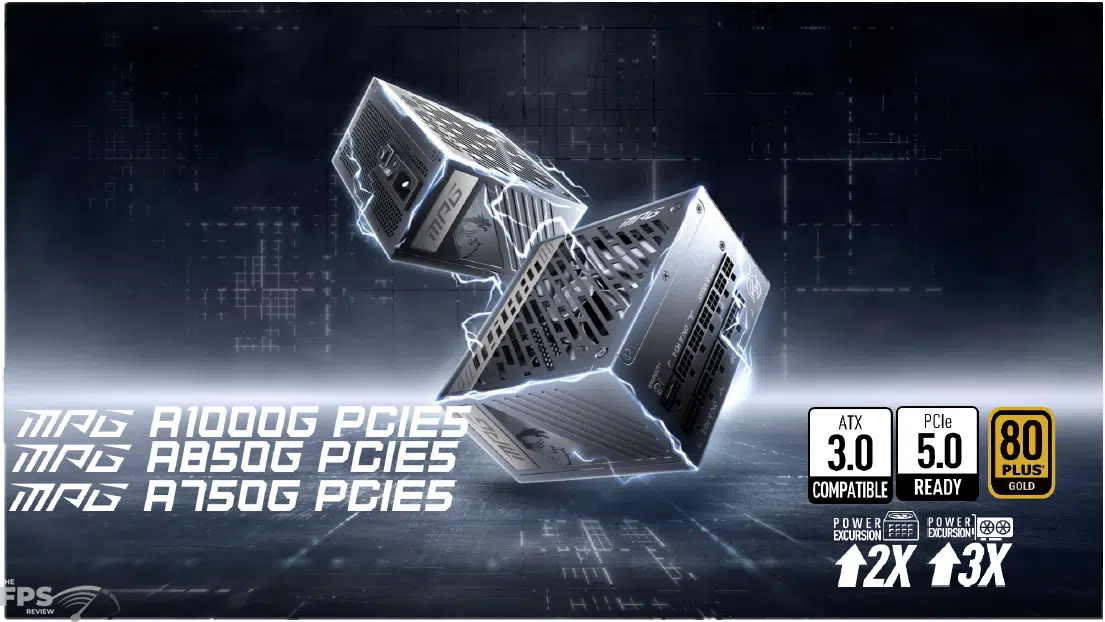
MSI is launching three distinct power supplies under its MPG branding, the MPG A1000G PCIE5, MPG A850G PCIE5, and MPG A750G PCIE5. MSI has made the statement that these are made for gamers and creators. MSI’s MPG branding stands for MSI Performance Gaming and represents MSI’s next to the highest tier of products. MSI’s MPG brand is all about high-performance gaming with slick looks to match at an affordable price.
The new key features of these power supplies are that they are ATX 3.0 compatible and PCIE 5.0 ready with 12VHPWR and they have the ability to handle Power Excursions. What are these technologies? Let us talk a little about each one before we move on to the specs of the power supplies.
ATX 3.0
All three of the new MPG PCIE5 series power supplies are ATX 3.0 compatible. The ATX specification is defined by Intel, and up to now the most recent version of ATX power supplies has supported up to ATX 2.53. (The ATX 2.0 standard was launched in 2003, yes 2003, that long ago.) The new ATX 3.0 specification (ATX Version 3.0 Multi Rail Desktop Platform Power Supply Design Guide) implements some much-needed features and features that will benefit both lower power efficiency in power supplies, as well as power supply’s ability to deal with high power components and power excursions. A really great run-down on ATX 3.0 is explained well on PC World.
It has an output port that is compliant with PCIe 5.0 and Intel PSDG (Power Supply Design Guide) ATX 3.0, also the power supply can hold up to 2x total power excursion and 3x GPU power excursion.
-MSI on MPG A1000G PCIE5
12VHPWR
One of the major inclusions with ATX 3.0 is the new PCIe 5.0 12VHPWR connector that is possible on power supplies. It is a 12-pin power cable with 4 data sense pins for sideband signaling (Sideband Signaling Pins), equally a total of 16-pins. The full implementation of this can support up to 600W of power delivery, but naturally, if the capacity of the PSU isn’t enough it will be less. The specification provides for a 150W cable option, 300W cable option, 450W cable option, and finally 600W cable option.
Also, be weary that there will be so-called 12VHPWR “adapters” on some power supplies that exist, which split off to two or more 8-pin PCIe power connectors PSU side to a 12-pin adapter, and not a true 12VHPWR connector pinout power supply side. These lack the data sense sideband signaling. Such is the case with the Lian Li SP850 power supply we just reviewed. That PSU uses an adapter, but power supply side it is just two standard 8-pin PCIe connectors, no data sense side band signaling pins. All three of the MSI MPG PCIE5 power supplies here support true power supply side PCIe 5.0 16-pin 12VHPWR.
Power Excursions
The other aspect of ATX 3.0 is its definition for its ability to handle power excursions, also called transient power spikes, which will occur on your devices, like your GPU. Add-in Card Power Excursions (also called Transient Power Spikes) are defined by the PCI SIG PCI Express CEM 5.0 specification.
“The PCIe CEM 5.0 spec addresses the need for occasional power excursions by permitting the card to briefly exceed the existing limits on supply power while still abiding by the power limits on a time-averaged basis. This allows the power supply and Add-in Card to jointly withstand increased power demands with a limited duration and magnitude.”
-PCI SIG PCI Express CEM 5.0 specification
What this in essence means is that devices like your GPU can exceed the maximum TDP or power delivery of the card by as much as 3x, meaning a 600W power draw can spike to as high as 1,800 watts for a specifically defined set of time, in microseconds. You could see a 450W card hit 1350W for microseconds, etc. The power supply must be able to deal with these microsecond power spikes that greatly exceed the maximum power delivery.
PCIe 5.0
How can a power supply be PCIe 5.0 you might ask? What does a power supply have to do with PCI-Express? Well, it is the PCI SIG (which defines the PCIe spec) that also defines the power excursions that an ATX 3.0 compatible power supply must comply with over the PCIe 12VHPWR cable. Therefore, the PCIe 5 spec is simply that, it is a spec, not an actual physical bus, it is a spec that defines what the PSU must adhere with on the 12VHPWR PCIe cable. In that regard, if you see PCIE5 on the box, you know that the power supply is based on the new specification, and thus supports the 12VHPWR connector and its ability to deal with power excursions as defined by the spec. That is what makes these new MPG power supplies PCIE5 PSUs.
Discussion (19 replies)
Join Discussion →Alright, countdown to NA availability!
I updated the pricing info for A1000G PCIE5 in the review, and here is the link to The Official U.S Online Store for MSI where it is in stock.
https://us-store.msi.com/MPG-A1000G-PCIE5
Man, at US$200 for a new-spec 1000W PSU?
That's not even offensive, and approaching affordable.
Yep, almost makes me want to order one even though I don't really need one yet.
Thanks, @Brent_Justice for all these intro-breakdowns of new tech and architectures. There's a lot happening these days and it's nice having a quick resource to go back to and refresh with before making a purchase decision.
Almost a month later and still no sign of these. Has MSI given any word on when we'll start seeing these in stores?
With a 4090 on the way and no word from EVGA on a cable (possibly cablemod?) I was thinking about another PSU myself, but no word on availability. You would think these would be available once the new video cards hit the market.
Yes thst kinda annoys me to. I sent a duppprt request in a d got back. Use the adaptor.
Whatever keyboard you are using, you should douse it in fire. That, or maybe we should call 911, you may be having a stroke.
1000W models are going to become the BASELINE model in a couple of years.. Calling it now...
We're already more or less there; take the power limits off an i7 or R7 and a top-end GPU and you're already at 700W before the rest of the system.
This means that 850W is just enough, which to most of us means get the next highest capacity unit.
I'd only be comfortable with 850W or lower if power limits were planned in to the build.
The 1000w version of this PSU is selling ridiculously quick. I thought about getting one a few times, but I'd be pushing it with my current system. Price gouging is definitely not reserved for just GPU's this time. Too bad the higher wattage variants aren't available at all right now.
Remember when PSUs were that part that so many didn't pay attention to beyond a certain wattage or energy rating? Now with ATX 3.0 they've become the latest hot-ticket item. I, and others, noticed that one of those 4090 reports was from someone who managed to snag a 1300W MSI somehow, in China.
All these people grabbing these 1000W ATX 3.0 power supplies may regret it later on if they throw in a 4090 with their other high end components. I did many of calculators on my main system, and it was around 930 to 950W, but having the headroom is always best practice.
I totally agree. I feel I'm at the edge of the comfort zone with the 1000W one I have with my 5800X3D/3090 Ti. I want to drop a 1200-1300W in there when I can. My other rig has a 1200W (from the days when I ran 2-3 GPUs) but both are ATX 2.0.