
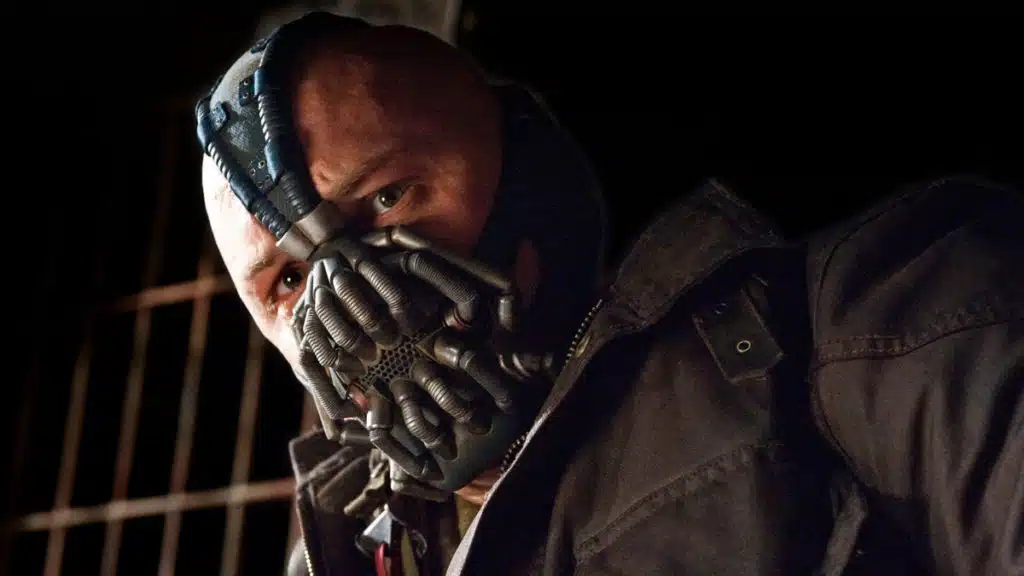
Poor audio is one of the top reasons as to why more and more Americans are watching video content with subtitles enabled, according to language-teaching app Preply, which surveyed over 1,200 Americans this year on whether they use on-screen text and learned that many, particularly younger generations (i.e., Gen Z and Millennials), prefer to watch content with subtitles on for reasons that include hard-to-hear dialogue and background music that’s too loudly mixed:
Our results confirmed that 53% of Americans are using subtitles more often than they used to, and audio mixing issues seem to be at least part of the reason why. A whopping 78% have difficulty hearing dialogue due to loud background music in films and TV shows, leading 55% of respondents to agree that it is harder to hear dialogue on screen than it used to be.
When it comes to productions being overall not as well lit, 44% of Americans agree that recent productions are using darker visuals than past ones. Not only that, but 35% agree that actors and TV personalities are talking faster than they used to.
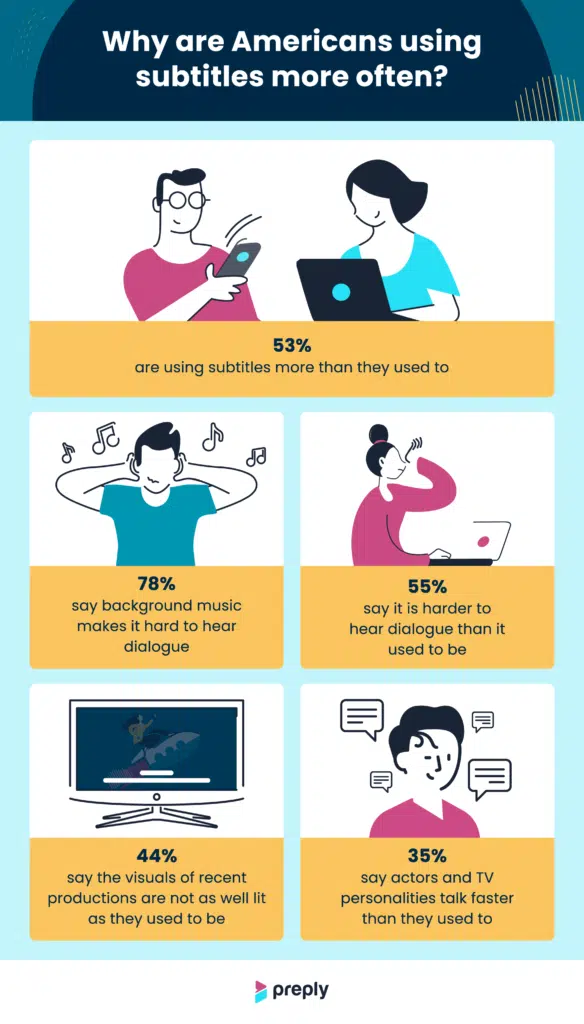
Here are some of the reasons as to why Americans are using subtitles, according to a second infographic that lists Gen Z as the generation that’s most likely to use subtitles (70%):
- Nearly 3 in 4 respondents claimed muddled audio from their content.
- 61% use them when accents are difficult to understand.
- 29% prefer to watch their content at home quietly, leaving subtitles on so as not to disturb roommates or family.
- 27% of Americans rely on subtitles to keep them focused on what they are watching while juggling the distractions of multiple screens, children, pets, work, the news, and more.
- Nearly 1 in 5 regularly use subtitles in order to learn a new language.
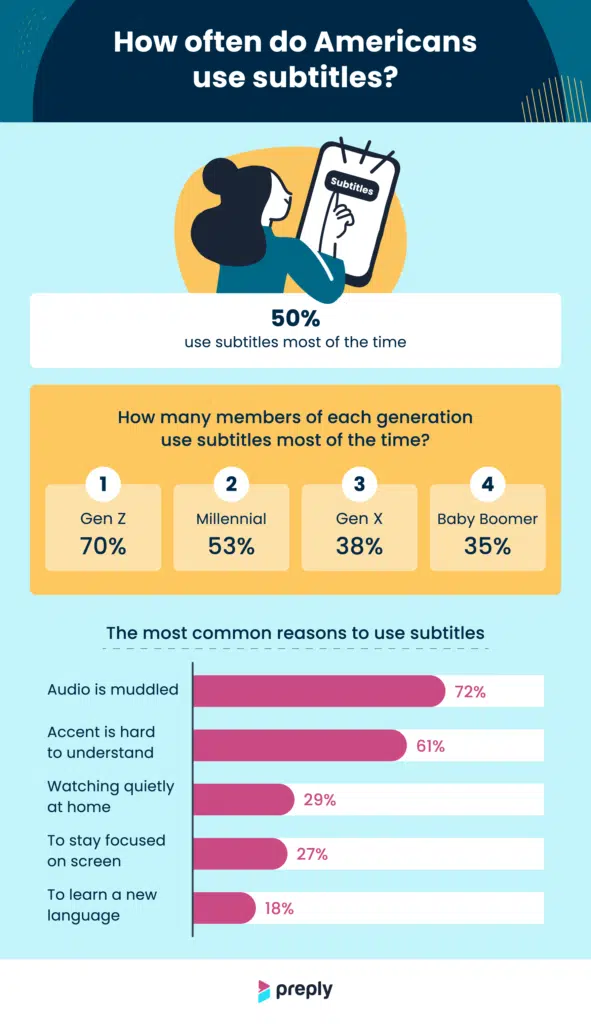
Tom Hardy, Sofia Vergara, and Arnold Schwarzenegger are some of the celebrities who Americans have the toughest time understanding, further survey results suggest, with
Peaky Blinders, Derry Girls, and Game of Thrones topping the list of TV shows where respondents had trouble understanding dialogue.
Over 50% of Americans have used subtitles to better understand actors with an accent, with Scottish seemingly being the accent that Americans have the hardest time understanding.
Discussion (12 replies)
Join Discussion →Yep, audio mixing is largely crap and has been for some time. I remember the Dolby days of DVD where you could always count on whispers followed by explosions. It changed a little during BD with DTS-MA but I don't think it had anything to do with the format. Now, once again, I'm noticing the same crap mixes all over again. Remote is always handy and I too sometimes say screw it and leave the subs on.
I always wished the center channel was dialog only - no music, FX, etc. That way I'd always have some minimal failsafe way to adjust the volume for dialog.
I always boost the center channel anyway. Then again, I also always have subtitles enabled.
[when living in an apartment with thin walls recently, I ran in 3.0 - left, right, and center channels, just for dialog]
Subs drive me bonkers - my inlaws have to have them on ... also have a habit of just randomly rewinding and fast forwarding because they didn't hear something -even though they have subs on. Even when they have a music channel on, they still have the subs on. I just have to grit my teeth and try to stay outside as much as possible. (And of course, if they are over at my place, listen to them complain that they couldn't hear anything because I won't turn the subs on)
But - I have to confess - a lot of things the audio is very poorly done. I have to tinker with my Receiver from time to time if a title is mixed poorly - I can usually get it to be audible (is that the right word? Similar to legible, but for hearing?), but it takes some fidgeting. I've found that on my Yamaha -- clicking the center volume up 1 or 2 notches from the auto-level, and turning on Pure Direct (supposedly turns off all post-processing) will usually do it.
I'd rather not be able to hear and just make up my own dialog than have subs: they just completely ruin a movie for me, because all I do is stare at the subs and I miss the movie movie. May as well be reading the book at that point.
Not saying audio mixing hasen't gone downhill, but as a native dutch speaker I have had subtitles on since, well always so I may notice it less.
I also wonder how many younger people have hearing issues due to constantly having earbuds in blasting all the time.
Had subtitles on since forever, just to avoid the, what did they say? And having to rewind.
I feel pretty much the same. I enjoy those moments when I can watch something by myself and just crank it up a bit more but most of the family gets stressed if I do it when they're watching something with me. The main exception is when we watch something with the projector and then it's expected to be the theater-audio-blasting experience. I've put a lot of money and effort into the best picture and sound so I tend to be grumpy for the same reasons when it comes to using subs.
I've been complaining about audio for years. My wife rips in to me when I have to crank up the volume just to hear wtf the people are saying, only to have our eardrums blown out by an extremely loud next scene. It's complete $H!T mixing. No amount of money spent on audio equipment can fix it.
Thanks for posting about this issue! I can't believe it isn't discussed more often. Dialogue clarity has gotten so bad that everyone in my family has grown accustomed to watching movies and television with subtitles on as the rule. I fought the temptation at first, but the rewinding became too frequent that I eventually gave up. I turn them off for some content, but they're staying on by default for now.
My hearing is impeccable; it's better than Superman's, so that's not the issue.
I blame commercials, that's when I really started to notice it. The volume on the commercial was 10x that of the show. It's particularly bad on something like Fox News, where it's aimed at mostly elderly (for example)
Far as I know, only the elderly actually watch "television".
I stopped over twenty years ago.
This is true. Anyone under the age of 60 at least knows how to commercial skip.