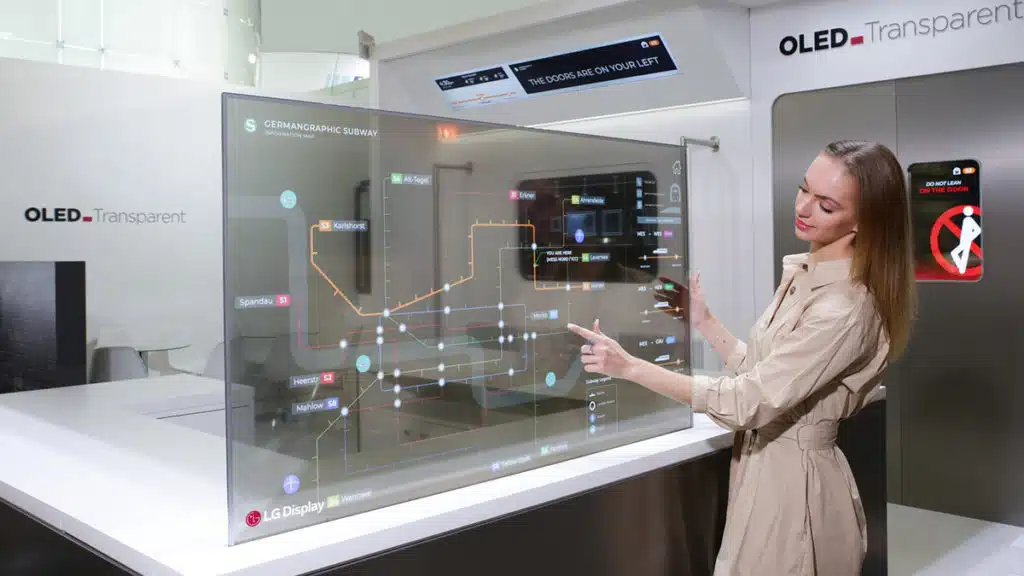
LG Electronics may launch its first transparent OLED TV in 2024, according to South Korean publication The Elec, which reported this week that LG has already pitched the display to electronics makers but has no plans to release it next year, possibly for reasons that include lower demand in TVs prompted by the economic downturn.
“For a launch to happen in 2023, LG Electronics would have gone into development sometime during the second half of this year, but there were no such movements,” writes The Elec, who goes on to point out that Xiaomi had launched a 55-inch transparent OLED TV called Mi Lux in 2020, but it didn’t sell as great as the company might have hoped.
The publication’s sources also suggest that LG is still developing the look of its transparent OLED TV, whose panel is apparently delicate and will require reinforced glass.
Some of LG’s most recent OLED products include the 27GR95QE and 45GR95QE, its first UltraGear gaming monitors with 240 Hz OLED panels.
“Equipped with the world’s first 240Hz OLED panel, which is exclusively manufactured by LG, the new 27- and 45-inch models deliver a record-breaking response time of 0.03 milliseconds Gray-to-Gray (GTG), not to mention superior self-lit picture quality complete with accurate, lifelike colors and infinite contrast,” LG wrote in a press release for its new premium monitors dated December 12, 2022.
Both are currently available for pre-order, with the 27GR95QE and 45GR95QE costing $999.99 and $1,699.99, respectively.

Discussion (12 replies)
Join Discussion →If you want deep blacks transparent is NOT the way to go. I mean I get it's use for things like a HUD layer in a window or display layer in glasses you wear or something to that effect for more integration. or in contact lenses you wear or layers you have implanted in your eyes to give you a HUD. Couple that with 3nm tech and you might be able to make some neat bio tech stuff.
Can’t wait for this to be on every single glass surface in retail
High end retail maybe. Us peons are barely getting proper AC.
Because I always wanted to see the wall behind the TV when it's off.
It's not like you can have anything behind it that is not homogeneous, it would be visible even when it's on.
[URL unfurl="true"]https://www.vox.com/the-goods/2019/2/7/18215629/walgreens-cooler-screens-frozen-food-eye-tracking-ads[/URL]
Now that isn’t using transparent OLED, but give it a few years
Imagine looking at jewelry with proper eye tracking and multiple displays they could have a stocked case with nothing actually in it.
But why?
What could the possible practical application of this be?
Ok. This IS a practical application, but then why call it a TV?
Yeah the only practical applications I can think of are HUDs, some fairly limited AR situations, and to replace pane glass in windows/display cases/refrigerators for ... advertisements.
It really would make a horrible TV. Maybe TV is just the way they translated it from Korean or something?
They called it a TV so some schmucks with more money than sense will buy it so they can watch tv through their floor to ceiling windows and gaze at their ocean/mountain view at the same time.
I'd be more interested in this if it somehow leads to holographic tech. I feel like there's an engineering concept here that could see this tech lend itself to such an application in using mirrors, multiple screens/film, sensors, and an enclosure. Back in the 80s I was at a Russian expo in Norway where I saw some primitive tech that was fairly effective, but it was the prism/rainbow color of those old holograms but you could look at images from almost any direction with full-depth perception.
I could see getting VERY close with this tech but it would require a TON of slim tall 'screens' to work, eye tracking software, and a TON of GPU compute to display across all of the screens for a single viewer at the same time. (Or to realize when a screen is 'blocked' so shouldn't be viewable.) It would be a cylindrical design a single person could walk around... or maybe 2 people could walk around on opposite sides... to view. Each being presented their individual eye tracked presentation across the various angled screens on their side.