
Sound Level Testing
While we were testing cooling capabilities, as outlined in our recent introduction article, we were also tracking the sound level of each of the coolers using a Risepro SPL meter attached to a boom arm pointed directly at the fans of the radiator at a distance of 12 inches. We recorded the dB(A) level for each fan and pump speed tested. The ambient room sound level measured 33 decibels. Displayed below are the results of our Stock Clock Testing.
100% Fans
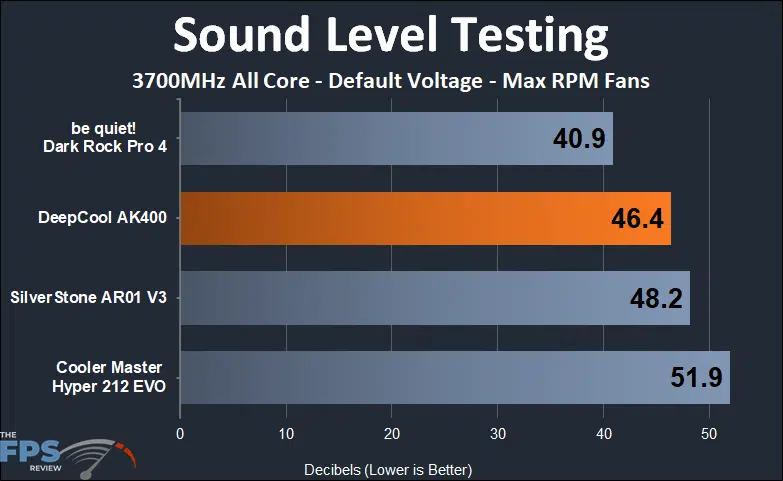
At maximum fan levels, the be quiet! Dark Rock Pro 4 was the quietest (40.9 dB(a)) while the DeepCool AK400 hit 46.4 dB(A) for second place. The Cooler Master Hyper 212 EVO hit 51.9 dB(A) and the SilverStone AR01 V3 hit 48.2 dB(A)! From a subjective perspective, the be DeepCool AK400 was about as unremarkable as the Dark Rock Pro 4, while the SilverStone and Cooler Master contestants were plainly audible.
1500 RPM Fans
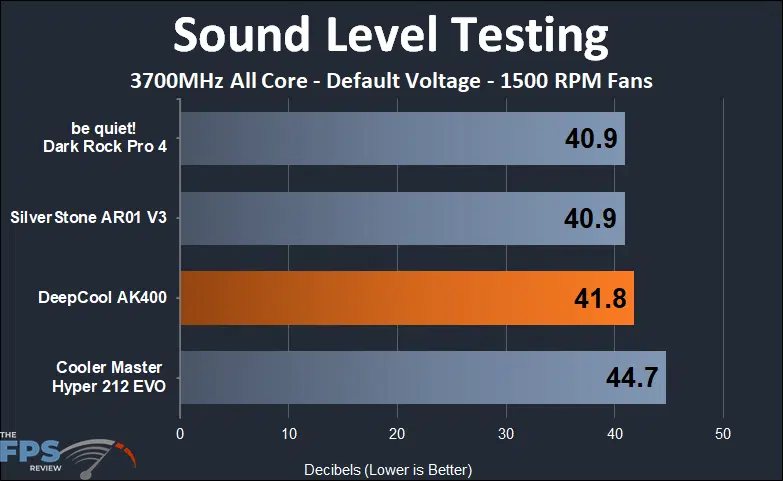
Dropping down to 1500 RPM, the be quiet! Dark Rock Pro 4 shares its lead at 40.9 dB(A) with the SilverStone AR03 V3, but the DeepCool AK400 was right behind at 41.8 dB(A). The Cooler Master Hyper 212 EVO brought up the rear at 44.7 dB(A).
Subjectively, all except the Cooler Master Hyper 212 EVO blended into the background and were inaudible.
1000 RPM Fans
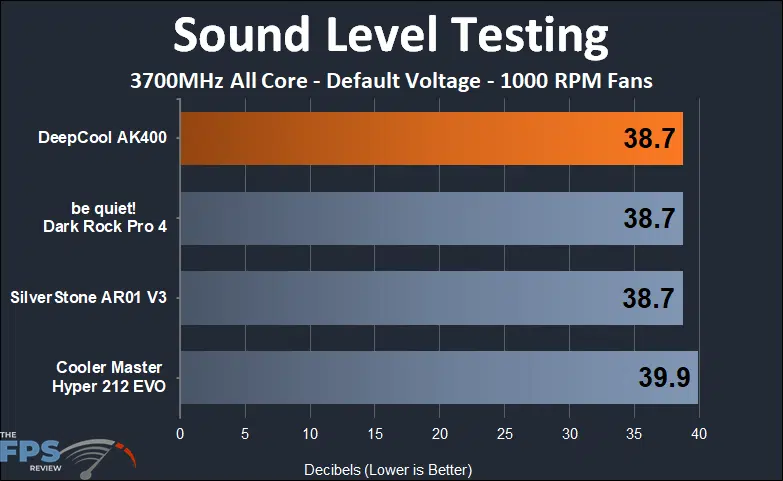
When we lowered the fans down to 1000 RPM, a three-way tie developed between the Deep Cool AK400, the Dark Rock Pro 4, and the SilverStone AR01 V3 at 38.7 dB(A). The Cooler Master Hyper 212 EVO was slightly louder at 39.9 dB(A). At this point, the noise from all of the coolers sounded like it merged with the background noise.
600 RPM Fans
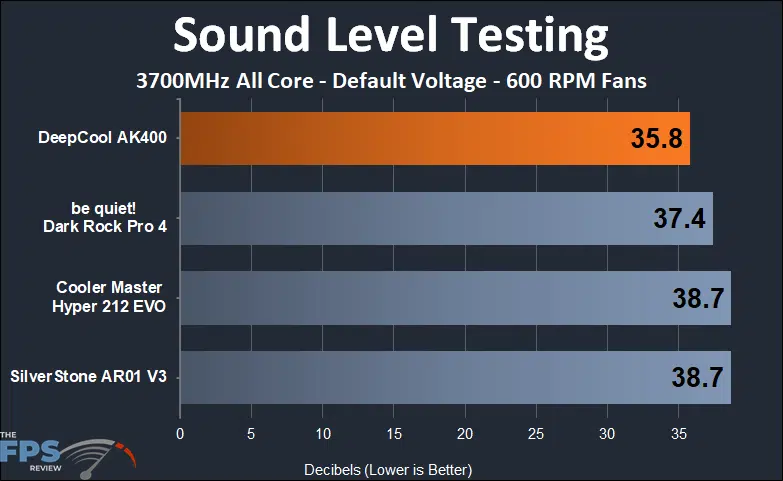
Lowering the fans to 600 RPM saw the DeepCool AK400 take the lead at 35.8 dB(A) with the Dark Rock Pro 4 just behind it at 37.4 dB(A). The Cooler Master Hyper 212 and SilverStone AR01 V3 tied up the rear at 38.7 dB(A). In this range, the sound level differences are purely academic and quite possibly influenced by the cat down the hall yelling for dinner.
With that said, let’s move on and recap all of this for you today!
Discussion (3 replies)
Join Discussion →The 212 has been out for how long now? 2007? Sure, it's showing it's age a bit with noise levels, but man... it's just become so ubiquitous and the cost was never huge, it was the go-to for a lot of my builds that weren't going for cutting edge performance.
It's very nice to see this come out and be extremely competitive against what I consider to be the de facto entry-level standard. Great writeup, looks like a decent product. It's amazing how the basic design of these coolers is essentially the same - 4 heat pipes and some fins on a copper block; but they still have so much variance. I suspect we are seeing differences associated with the fans that are provided with the HSFs moreso than anything -- if you used the same fan with each run, I bet the results would be a lot closer. I know you're testing at static RPMs, and I think that's good, but different fan blade designs are going to push different CFM and static head with various noise levels for a given RPM as well. Whichever HSF has more pipes and more useable fin area will win every time if the fans are the same. Not saying you should adjust your testing -- I think testing with the fan provided with the unit is appropriate, just commenting to hear myself talk.
Also, I really appreciate that you have a steady test bench setup. It may not be cutting edge hardware, but I don't think it needs to be - the consistency matters more, especially if you start comparing reviews done today to reviews done 2-3 years from now.
It does make me think about Alder Lake and some of the issues it's having with it's design though... a drawback to this methodology is that you aren't able to identify or account for things like that. However, this is a review of the HSF, not Alder Lake, so I think that drawback is worth the consistency it gets you.
Heh. One of the criteria for the 2700X is we're not using it for GPU reviews anymore, might as well put it to work doing something else!
The thing that's really really really challenging with cooler reviews (in my opinion) is comparability. In today's more "modern" systems, there's a ton of variables that can get tweaked that will ultimately impact the overall performance of a given cooler. There's boost optimization for the CPU, there's fan speeds, there's the overall temperature of the CPU as well.
At default in the 2700X's case, it tends to start thermally throttling itself in the low 60's and really won't let itself get up over 80 degrees Celsius under load (probably for good reason as it starts crashing around 83c). Pair with that some arbitrary motherboard fan curve, and you'll end up with results that look quite similar between good and not-so-good coolers. It took a while to take those variables out of the game - running a set voltage, set frequency and getting around the CPU fan curve to allow for higher temperatures solves that particular comparison data issue, but of course, it creates another one.
The downside now is that the testing that we do does not necessarily relate to real-world usage of the product, though, I'd like to think the data points presented would be helpful to someone that is trying to customize their fan curve for the given cooler.
I think that's perfectly ok in this case --- you are looking for something representative of the cooler and it's performance; not how well any particular platform advantages or energy profiles play to that. Those will be consistent to your particular platform, and as you say - can mask the problems that a lesser cooler would exhibit over a better cooler.
Particularly today with chips that will run with some mayonaisse slathered on a metal lunchbox -- the only difference being how long and how high it will boost --- systems will work, and often work decently well under lightly loaded scenarios, with any old cooler that is at least connected to the socket properly. But a ~good~ cooler will get you better boost speeds and for longer times. But you won't know what a good cooler is from a bad cooler without some baseline info - which is what I appreciate your benchmark system providing.
If you tried to review a HSF under those conditions - they would all look about the same, because the chip would throttle out at some temp and you'd have to look at other parameters than just temperature and/or noise to determine what was working (and what was not).