
Ray Tracing Performance
We are going to focus on Ray Tracing 4K gameplay performance with the Overclocked NVIDIA GeForce RTX 4090 Founders Edition video card. We will include DLSS and FSR performance on the same graph in the games that are supported. We will use DLSS on NVIDIA GPUs and FSR on AMD GPUs. For video card comparisons we are using an AMD Radeon RX 7900 XTX and NVIDIA GeForce RTX 3090 Ti Founders Edition video card.
F1 2022
F1 2022 was released on June 28th, 2022 on the PC and uses Codemasters Ego engine. The game supports Ray Tracing, DLSS, AMD FidelityFX, and FSR. We are going to run the game with the highest quality settings of “Ultra High” and TAA+FidelityFX. We will enable all Ray Tracing options in the game to “On.” We will enable DLSS and FSR as needed at the Quality setting for both. We will utilize the built-in benchmark in the Imola track, in dry conditions with a far-chasing cam.
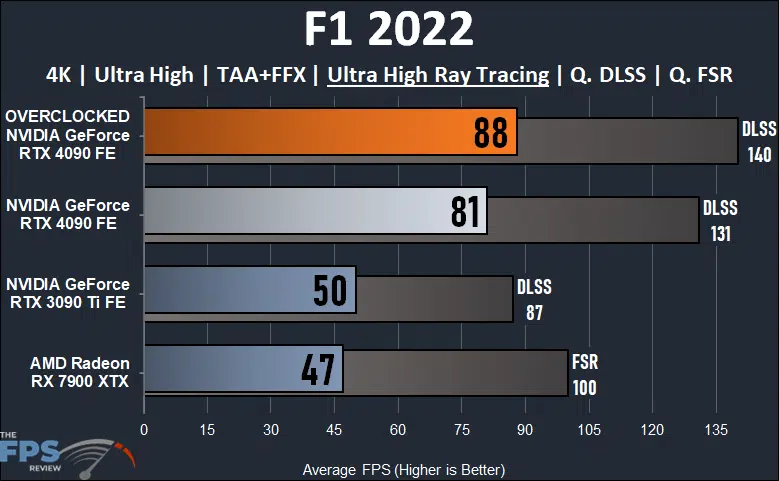
In F1 2022 we are running at 4K and have turned on all the Ray Tracing options at “Ultra High” which really pushes the game hard. The GeForce RTX 4090 FE is able to provide a very good and smooth gameplay experience at this level at 81FPS. At 81FPS the RTX 4090 FE is a large 72% faster than the Radeon RX 7900 XTX and 62% faster than the GeForce RTX 3090 Ti FE. With Ray Tracing, Overclocking the RTX 4090 FE improves performance by 9%, so the uplift is pretty decent with Ray Tracing, bringing it up to 88FPS. At 88FPS the RTX 4090 FE is 87% faster than the Radeon RX 7900 XTX and 76% faster than the RTX 3090 Ti FE. DLSS performance has also improved very well with overclocking, by 7%, bringing performance to 140FPS. The DLSS performance is 40% faster than the Radeon RX 7900 XTX with FSR.
Dying Light 2
Dying Light 2 was released in February 2022 on the PC and uses Techland’s C-Engine. The game supports Ray Tracing, DLSS and FSR2. This game supports Ray Tracing environmental effects including Ray Traced Soft Shadows, Ray Traced Ambient Occlusion, Ray Traced Global Illumination, and Ray Traced Reflections. We utilize the built-in preset option to set “HIGH QUALITY RAYTRACING” which enables the games highest graphics settings plus the environmental effects explained above at the highest values. The game is run in DX12 Ultimate mode with ASYNC Compute turned on. We use the built-in benchmark.
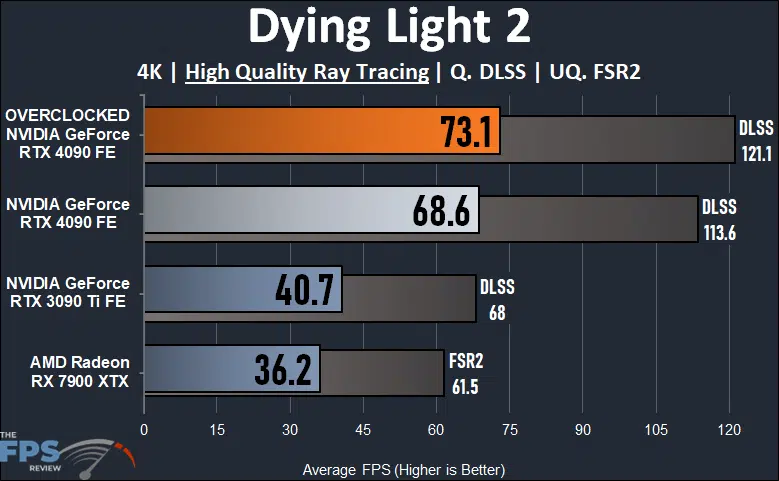
In Dying Light 2 we have enabled the highest quality Ray Tracing at 4K, and only the GeForce RTX 4090 FE is able to provide a playable gameplay experience at 68FPS. At 68FPS the RTX 4090 FE is 90% faster than the Radeon RX 7900 XTX and 69% faster than the GeForce RTX 3090 Ti FE. Overclocking the RTX 4090 FE raises performance by 7% bringing it up to 73FPS. At 73FPS the RTX 4090 FE is 102% faster than the Radeon RX 7900 XTX and 80% faster than the GeForce RTX 3090 Ti FE. DLSS performance improves by 7% and brings performance up to 120FPS in this game at 4K with Ray Tracing.
Cyberpunk 2077
Cyberpunk 2077 was released in December of 2020 and uses the REDengine 4. We have the game patched to version 1.61 and use the built-in benchmark. We test using the Graphics Preset option to set graphics settings. We use the Ray Tracing Graphics Preset of either: “Ray Tracing: Low”, or “Ray Tracing: Medium” or “Ray Tracing: Ultra” as indicated. This game supports DLSS and FSR2.
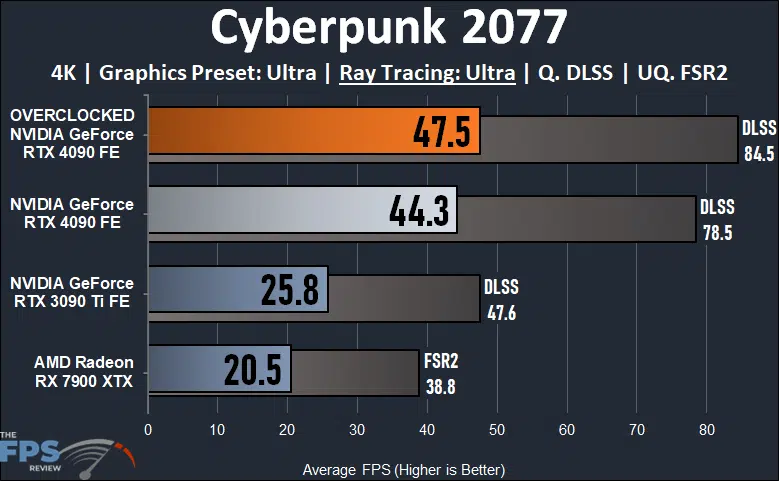
In Cyberpunk 2077 we have enabled “Ultra” Ray Tracing at 4K, and even the GeForce RTX 4090 FE is not able to provide a playable gameplay experience without upscaling. It does require DLSS upscaling in order to be playable. At 44FPS the RTX 4090 FE is 116% faster than the Radeon RX 7900 XTX and 72% faster than the GeForce RTX 3090 Ti FE. Overclocking the RTX 4090 FE improves performance by 7%, but that is still not playable at 47FPS. At 47FPS the RTX 4090 FE is 132% faster than the Radeon RX 7900 XTX and 84% faster than the GeForce RTX 3090 Ti FE. Overclocking with DLSS helps here though, DLSS improves by 8% and performance is around 84FPS and very playable with 4K and Ray Tracing.
Watch Dogs Legion
Watch Dogs Legion was released on the PC in October of 2020 and uses the Disrupt game engine. We utilize the built-in benchmark for testing. We have the HD Texture pack installed and enabled for testing. We use the built-in graphics preset of “Ultra” for testing. We utilize the “Ultra” preset quality option for Ray Tracing. This game supports DLSS upscaling.
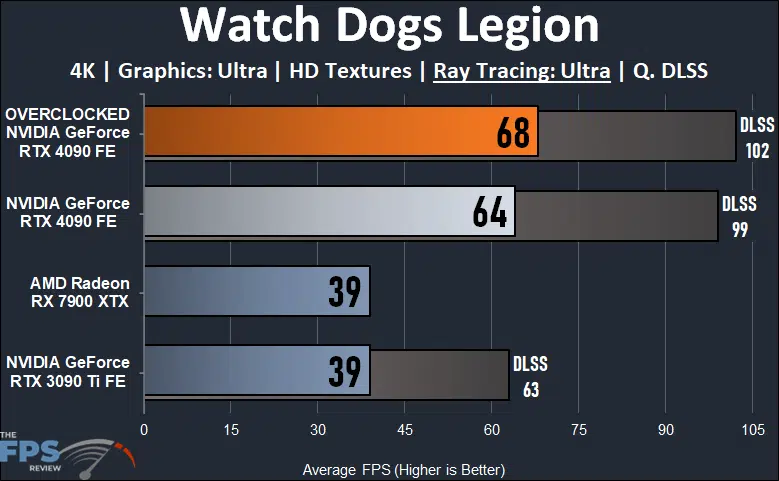
In Watch Dogs Legion we are running the GeForce RTX 4090 FE at 4K and “Ultra” Ray Tracing and the GeForce RTX 4090 FE is barely able to provide a playable gameplay experience at 64FPS. It is playable for sure, and it’s smooth, but it’s just over the line of playability. At 64FPS the RTX 4090 FE is 64% faster than the Radeon RX 7900 XTX and GeForce RTX 3090 Ti FE. Overclocking helps smooth the game out even more with Ray Tracing by improving performance by 6% up to 68FPS. At 68FPS the RTX 4090 FE is 74% faster than the RX 7900 XTX and RTX 3090 Ti FE. Enabling DLSS brings performance to 100FPS, and we get only a slight advantage with overclocking.
Metro Exodus Enhanced
Metro Exodus Enhanced is being run with Shading Quality at “Extreme” and Ray Tracing at “Ultra.” This is a demanding game, that heavily focuses on Ray Tracing utilization, including Global Illumination. We are utilizing the built-in benchmark.
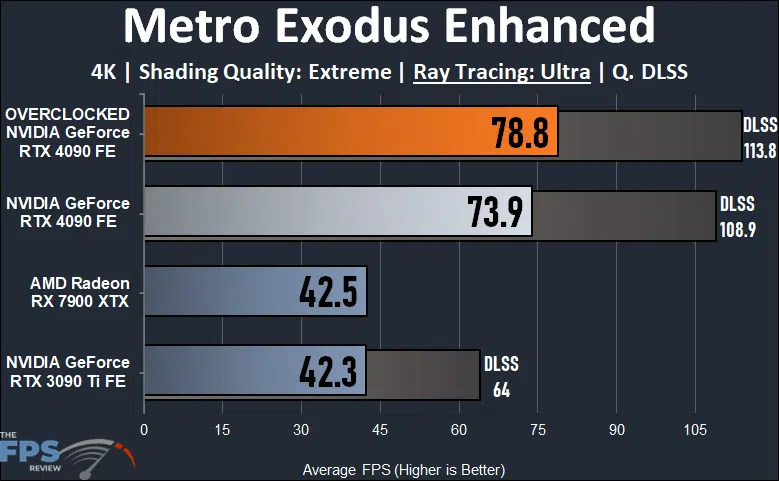
In Metro Exodus Enhanced we are running 4K and maximum Ray Tracing settings, the GeForce RTX 4090 FE is playable at 73FPS. At 73FPS the RTX 4090 FE is 74% faster than the Radeon RX 7900 XTX and RTX 3090 Ti FE. Overclocking the RTX 4090 FE improves performance by 7% up to 78FPS. At 78FPS the RTX 4090 FE is 85% faster than the RX 7900 XTX and RTX 3090 Ti FE. DLSS performance is improved with overclocking, by 4%.
Discussion (3 replies)
Join Discussion →Nice read. Thank you and job well done.
As always thanks! Can't wait to get home and try your settings.
I used some less aggressive settings with my Suprim Liquid X and had similar results but Afterburner only let me increase its power target by 110%. However, my core clock is only ~75 MHz lower (2860 to 2885) than this but the Suprim hybrid cooling solution keeps it cool and quiet (using stock fan curve and it rarely goes above 50% while keeping it in the 60s or lower. Power draw for me has mostly been in the 430s with occasional spikes just over 500W and not uncommon to even see it drop below 400. So far, the only game I've tested that kept it up there was RE3 where I cranked the IQ setting to 200%. It loaded the VRAM to 18GB and the power draw pinged 499-530W. FPS dropped to 50-55 but man it looks good. I did some testing with Metro Enhanced as well and it's so nice to finally be able to crank everything and turn off DLSS. I'm planning on doing another playthrough real soon. I did see it pull upwards of 500W at times but have only barely done some real-world play testing with it.
Well, I had a little time to experiment while dinner was cooking last night. I'm pretty sure I was hitting a power wall but I was mostly able to replicate this. I only spent maybe 20 minutes of testing but got to a seemingly stable point with +185 on the core and +1200 for mem which got me to 2940-2955 w/ occasional spikes to 2970 and mem at 11400.
The Suprim X only allows a +110 (even with X1). It was fun to see the upper limits of what this card can do but I doubt I'll use these as my gaming settings. The cooling solution was still amazing but with the stock fan settings I saw, interestingly, both the temp and fan usage go to 66-67 but at that point, it started to pull down the core clock to something like 2910. When I cranked fans to 100% temps dropped to 50-55c and the core was back to maxing. I've heard that in limited power situations it's a good idea to dial back the mem clock to free up power for the GPU hence why I had it at 1200 but I might take it back a little more just to see if it can reach 2970 more easily. However, I ran about 10 benches with Metro Exodus Enhanced, and a few with CB 2077, the same settings Brent used with mostly the same results but TBP was hanging 510-520W. My other overclock settings with core at 2860-2885 and mem at 11000 used less power and the stock fan curve was more than enough to keep it quiet too so I'll probably just stick with them. I figure I'm only losing out on maybe less than 1% of an OC gain while retaining all the benefits of why I wanted the Liquid X.
BTW I ran the SOTR benchmark and it was hilarious. At 4K, Q. DLSS, and everything but post processing stuff maxed, it ranged 185-250 FPS with some spikes upwards of 300 FPS. I still remember watching this game bringing a 2080 Ti to its knees. This a game you can play w/o DLSS at well over 60 FPS on a 4090 w/ smaa x2(maybe 4-can't remember the limit here) and looks great but it's just hilarious to see such FPS at 4K with almost everything else maxed.
On the note of a power wall, I came across this chart on TPU a couple of months back when researching this, and other cards. It could be useful for those wanting to tinker with their 4090s and wondering about power variants.
Just to add, that I was able to get mem to 11700 but at that point, I started to dial it back in favor of getting the core to max out.