
Overclocking the MSI GeForce RTX 4090 SUPRIM LIQUID X 24G
How do you overclock an MSI GeForce RTX 4090 SUPRIM LIQUID X 24G video card? Well before we begin to overclock, we need to find out the real-world in-game GPU frequency the video card is operating at by default. That way we can find what frequency we are overclocking from and how much gain we get in overclocking. Keep in mind that NVIDIA GPU Boost already adjusts the GPU frequency dynamically to utilize most of the potential that is there. This means it will already clock the GPU frequency well above the quoted Boost Clock even without overclocking.
Default Clock
The base clock on this video card is 2235MHz, which isn’t very helpful as it is the same as the Founders Edition. More importantly, it is the GPU Boost Clock that makes the difference and it is set at 2625MHz on the MSI GeForce RTX 4090 SUPRIM LIQUID X 24G. This is 105MHz higher than the Founders Edition GPU Boost of 2520MHz.
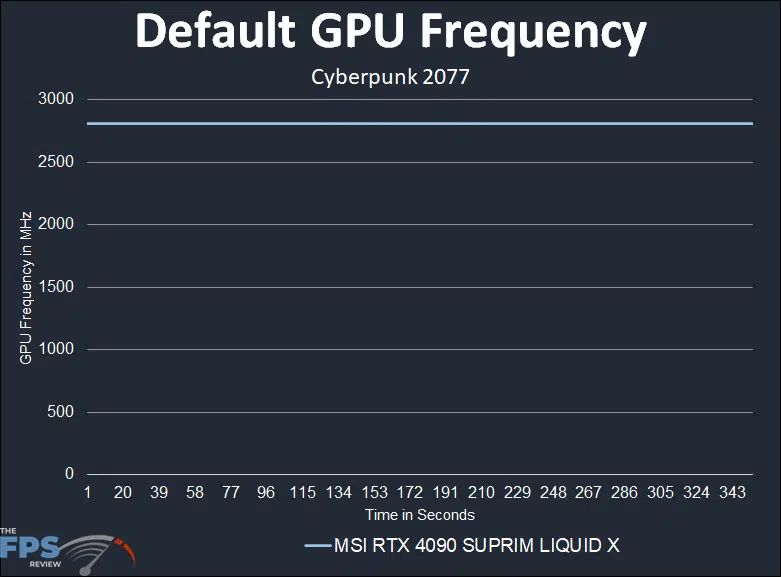
The MSI GeForce RTX 4090 SUPRIM LIQUID X 24G pegged the 2805MHz frequency during testing and maintained a temperature of 53.6 degrees Celsius. Compared to the Founders Edition which averaged 2745MHz, the MSI GeForce RTX 4090 SUPRIM LIQUID X 24G clocks 2.2% faster out of the box. Memory in both the Founders Edition and the MSI GeForce RTX 4090 SUPRIM LIQUID X 24G is set to 21GHz using GDDR6X memory.
Highest Stable Overclock
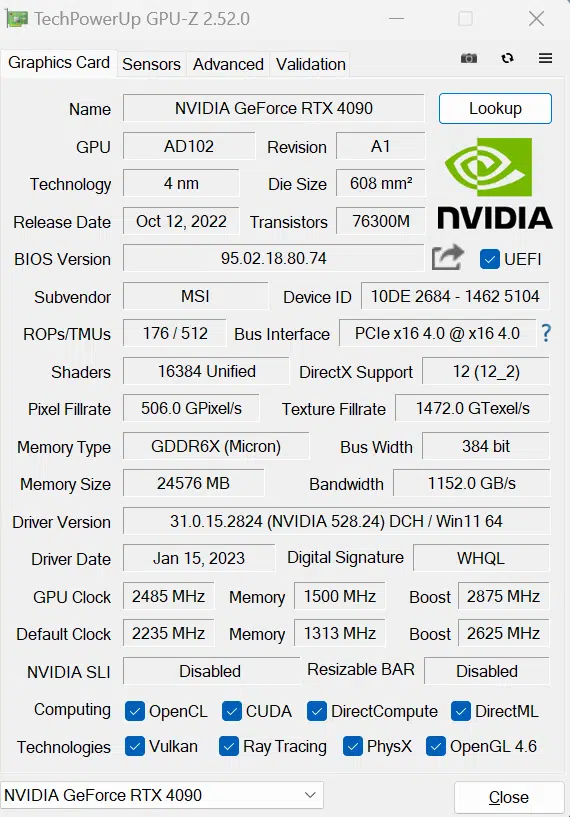
To dial in the maximum overclock for the MSI GeForce RTX 4090 SUPRIM LIQUID X 24G, we used MSI’s Afterburner software that’s well known across the enthusiast community for making lots of knobs to turn and levers to pull available for tuning enjoyment.
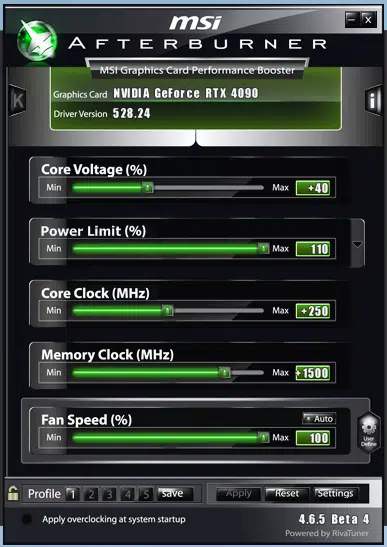
We started by maxing the Power Target out at 10% over default and cranking the fans up to 100%. During testing, we found that the power limit was not an issue with the overclock, which is the first time this reviewer has encountered such a scenario in the past decade. We found that with no voltage adjustment, the card would hover in the 80-85% of the power limit during gaming.
Given we had some power to spare, we pushed voltage up some, to +40mV, which resulted in a higher observed GPU clock and a stable gaming environment.
With the power matters settled, we started by pushing the core clock up as high as it could go without touching the memory side of the equation. We were able to pick up an extra 110MHz on the sliders before we started crashing.
Next up, we set the core back to stock and boosted the memory to see how far we could take it. Surprisingly enough, it was quite happy with +1500MHz. This is a boost to 24GHz over the stock of 21Ghz.
Putting it all together, we first tried our max individual clocks together to see how they worked. Initially, it seemed like it was going to be in the cards, but about three games into testing, we found that we had to back off just a little bit to stabilize those games. This gave us a final stable overclock of a 2875MHz core boost clock and a 24GHz memory clock.
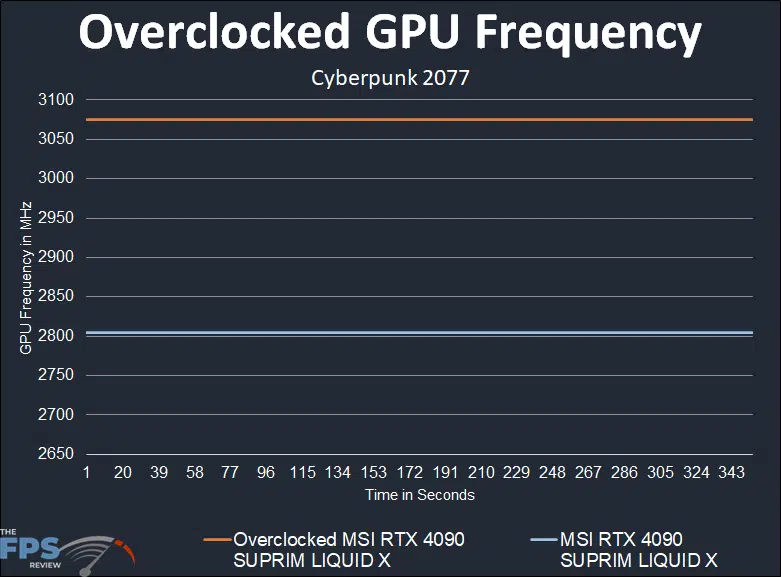
Comparing the sustained GPU frequency to the stock frequency, we see that the observed overclocked frequency pegged itself at 3075MHz. This is a 9.6% increase over the stock clocks and a 12% increase over the RTX 4090 Founders Edition. The memory at 24GHz is 14.3% faster than the stock clock as well. This overclock dunks on what the Founders Edition can do.
Discussion (19 replies)
Join Discussion →That is the 4090 that is the MOST tempting to get.
I agree
Thanks, @David_Schroth for the great review. Any plans to test DLSS 3 aka frame generation? I've recently been testing CB2077 and Hogwarts with it and then turning DLSS AA off.
I cannot even begin to say how much I love mine. Quiet, powerful, and just gets the job done. I've been dreaming of AIO graphics cards for years and am so happy to finally be lucky enough to have them. I'm also truly shocked at how well this setup works with a mere 240mm solution as well. I wouldn't have thought it possible if I hadn't seen it with my own eyes.
Following your advice, I did some voltage tweaking and was able to get to a completely stable 2910-2955 MHz, 23.2 GHz mem. I think I lost out a bit on the silicon lottery as even though I can get it a bit higher, it's just not stable 24/7 at that point. I have even been using the stock fan curves (but do max for benching and testing) while gaming with the OC settings and rarely see it go above 64c inside the Carbide. With the fans maxed it hangs in the low 50s after putting it through the rounds for a couple of hours. I did a timespy run last night with my current OC settings and got 28,651. I'm sure with that 24 GHz and higher clock you might even break 30,000, In terms of power usage I'm seeing the exact same behavior.
It's also hilarious to see the boost clock jump up to over 2800 Mhz simply by increasing the power or voltage.
I think Brent commented on it in one of the 40 series articles that he's done. I haven't had a chance to tinker with it myself - I've got a couple other reviews to knock out in the pipeline at the moment in other departments...
Is the copper water block plated? Copper block + aluminum radiator is not a good combination.
I checked the website and yeah. I'm totally aware of what you probably mean, galvanic corrosion and the things associated with it. We'll see, maybe there's something magic in the fluid to prevent, and minimize it for the long term. I expect mine to get a lot of hours and use it for years to come so I'll speak up if I see anything. I've also got a 3090 Ti Hybrid that I'm pretty sure is the same that's about 6-months older than this. I know there are nightmare scenarios but after reading some newer posts across the internet it's not always a worst-case scenario either.
If I could afford one, this is the one I would get.
I'm currently on a RTX 3070Ti, but I got a raise recently, maybe I could get a RTX 4070Ti.
At this point, I'm getting nervous about NV's generational improvements. As much as I truly love having this card I'm extremely annoyed that we're starting to see a kind of every other gen hardware addition to their cards in order to use a new feature (i.e. 20-series for RT and Tensor cores, 40-series for DLSS3-frame gen), and now there was that story yesterday about RT overdrive in CB 2077. Odds are this series will support it but I wouldn't put it past them to add yet something else for whatever comes next. I'm all for more hardware being added to cards but it's beginning to feel less innovated and more staged/scheduled for max profits.
It's a foil hat theory for sure but I'm it does seem a bit different than the 20-30% perf increase per gen we were seeing from the 700 series to the 20 series. I'm all for more hardware being added to cards. We've known for decades that a single GPU was becoming overwhelmed with everything being thrown at it and mGPU/SLI/Crossfire had its issues so whether by chiplets or designated cores, it was obvious something needed to be done to offload some of that work but I'm not into a model of piecemealing one thing at a time every other gen. It's well known that in big industry you have multiple pipelines of R&D and release schedules planned out but I have doubts about how necessary it would be to roll out a new hardware addon in this fashion. I hope I'm wrong.
$1750 o_O
That is used Honda Civic territory
haha. That used to be true but in my neck of the woods, that's now the down payment. I could definitely derail this thread but used cars out here are not happening for under $2K unless they have over 200K on them. Although I hear rumors the used car market is supposedly dropping again I'll believe it when I see it. Meanwhile, we're schlepping along in an '09 forester (142K) and '02 Grand Caravan (165K) and I'm looking to get a replacement for the van this summer. It's one of the reasons I opted to revive my 3700X build instead of doing the 7000X3D build I was considering for a while.
It's not tinfoil hat theory at all because there's an obvious pattern and nVidia does not like supporting or updating anything for cards more than a generation old. In many cases there's little or no reason for that support to be basically dropped. AMD has been managing to do very similar if not the same things with support not only for older AMD cards but most current and older nVidia cards as well as Intel's new cards. FSR has proven that. nVidia is obviously using specialized and nVidia dedicated hardware to do some of these things but that doesn't mean it must be done that way with cutting off support except for the absolute latest cards. nVidia stinks of planned and unneeded obsolescence with the goal being to force new hardware purchases and force people into a specific locked down ecosystem.
To think a company that bought 3dfx just to get the tech and then dissolved the company in an accessive manner would treat it's non business customers any other way.
They have used their influence and position in the market to abuse it's customers long enough that the bruises haven't even faded before they go for new ones. It's a reason AMD is successful in the video card market.
Make that patents, not technology. I had the chance to ask Tom Petersen when he was still with nvidia what technologies from 3dfx made it to nvidia back in the day. He said that by that time nvidia was already way beyond 3dfx technology wise so very little if anything made it into nvidia products other than SLi and that's only in the name.
I think that was mostly to squash a competitor. And for 3dfx's brass to cash out before the company went totally bankrupt.
That was a sad time, and I knew people that worked there. That was a mgmt c*ckup for the record books... right up there with Commodore.
Fair, they were a local company for me too. Wouldn't have minded working for them but they didn't need sysadmins at the time.
though I did run a pair of I believe Voodoo II cards.