

PC gamers on Windows who are seeking the highest gaming performance may want to ensure that virtualization-based security, more succinctly known as VBS, is turned off. According to benchmarks shared online, the feature, which Microsoft describes as using hardware virtualization features to create and isolate a secure region of memory from the normal operating system, reduces frame rates by as much as 10%, even on today’s flagship graphics cards, including the NVIDIA GeForce RTX 4090. Microsoft reportedly released an update for Windows 11 recently that turns VBS back on for those who had turned it off, and Windows 10 users may also be affected.
From a Tom’s Hardware report:
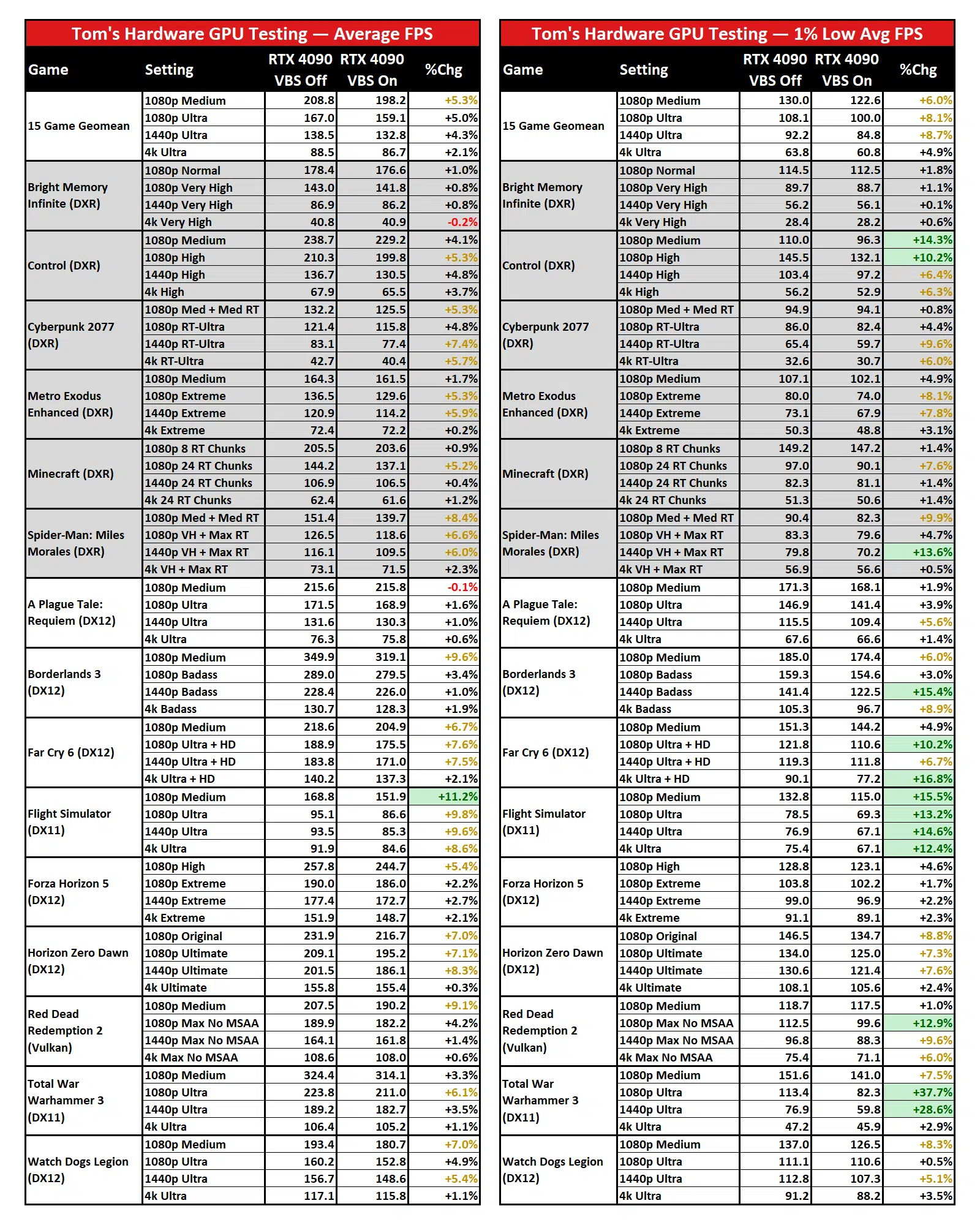
Taking the high level view of things, perhaps it doesn’t look too bad. Disabling VBS improved performance by up to 5% overall, and that dropped to just 2% at 4K ultra. And if you’re running this level of gaming hardware, we think you’re probably also hoping to run 4K ultra. But even at our highest possible settings, there are still some noteworthy exceptions.
The biggest improvement overall comes in Microsoft Flight Simulator, which makes sense as that game tends to be very CPU limited even with the fastest possible processors. Turning off VBS consistently improved performance in our RTX 4090 testing by around 10%, and the 1% lows increased by as much as 15%.
Discussion (19 replies)
Join Discussion →We have always turned VBS OFF in our benchmarks, from day 1 in Windows 11. I don't see any reason to change that.
You can make sure this is off in windows 11 pro using gpedit.msc. FYI. It's under Device guard.
Might have been nice to include how to confirm it is off in the article. :)
Is this the same as Denuvo?
No.
Huh. This is the first I've heard of VBS. When did they introduce it?
Article says it is in Windows 10 as well?
I remember it being introduced with WIn11, and at the time, people were suggesting to turn it off because it reduces game performance by about 10%.
From 2021:
[URL unfurl="true"]https://mspoweruser.com/report-windows-11-security-feature-can-cause-nearly-30-poorer-game-performance/[/URL]
Everything old is new again.
I haven't been a Toms Hardware reader since the 90's, but their article does discuss how :p
[URL unfurl="true"]https://www.tomshardware.com/how-to/disable-vbs-windows-11[/URL]
Anyone else find it amusing that they were using hardware virtualization features for security at a time when Meltdown/Spectre was circumventing hardware virtualization isolation? :p
Looks like mine was already off.
I don't think I did it on purpose. I don't recall ever hearing about VBS until today.
VBS was introduced in Windows 10. However, it was disabled by default. The difference is, Windows 11 enabled it by default now. So now suddenly everyone became aware of it, but it isn't new.
I don't have a problem with something like VBS being enabled by default in a new OS. But once a user selects to disable it it should stay off. The OS should not be like "I know better" and countermand the user.
Ehhhhh home versions... maybe they should... Pro versions or those that have unlocked 'pro like' features... agreed with you 100%.
No, OS can default to whatever they want, and warn/beg/plead someone not to make a change, but they should never override a conscious decision of the user. Otherwise, why even have the option for it? Should just make it mandatory with no switch if you are just going to override every new patch.
They already do it. Like you can't disable windows defender permanently. It will turn itself back on after 15 minutes or so, it is truly awful.
With the pro OS I believe you can set a local policy to have it permanently disabled. Not wise unless you have a better endpoint security solution.