
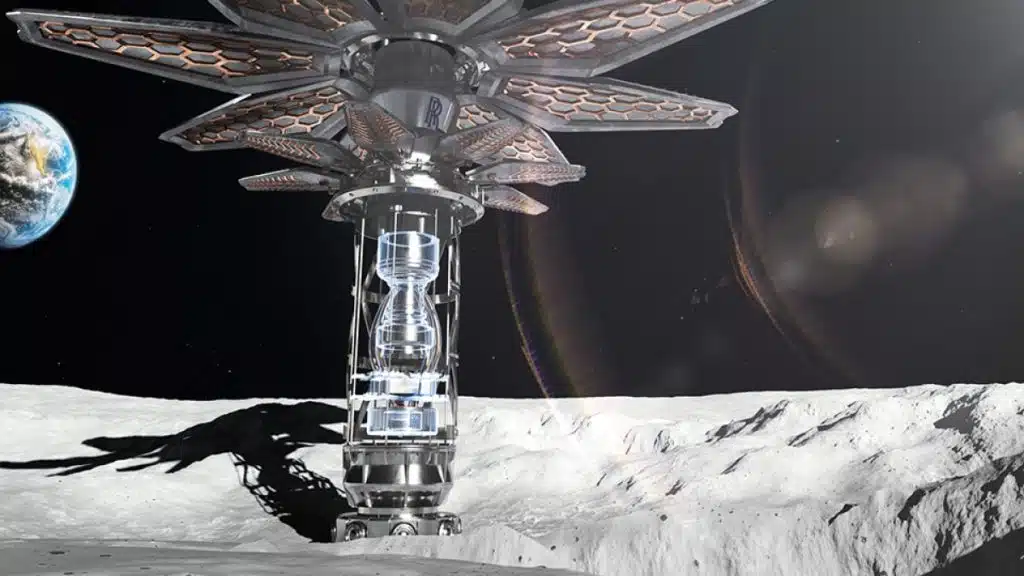
Rolls-Royce has been given £2.9 billion (~$3.52 billion) in funding for its bid to install a nuclear reactor on the moon by 2029. The funding follows another £249,000 (~$302,000) that had been provided to fund a study for the proposed project. The UK Space Agency says the micro-nuclear reactor is very small and about the size of a car and would provide power for a variety of applications. The mobile power plant could be used for generating power to create water, and oxygen, charge vehicles, provide heat and keep technology operating when solar cannot be used. Rolls-Royce and the UK Space Agency are also collaborating with a number of universities to develop communication and navigation services for missions to the moon as part of ESA’s Moonlight program that will put satellites in orbit around the moon.
We’re backing new research by @RollsRoyce that will support future Moon missions. 🚀🌕
— UK Space Agency (@spacegovuk) March 17, 2023
The funding will help develop tech that will provide power needed for humans to live and work on the Moon – from comms systems to life-support. 👩🏻🚀👨🏽🚀
👉 https://t.co/IctjqdmK5J#BSW2023 pic.twitter.com/lxb8pMfNNM
Press Release:
Scientists and engineers at Rolls-Royce are working on the Micro-Reactor programme to develop technology that will provide power needed for humans to live and work on the Moon. All space missions depend on a power source, to support systems for communications, life-support and science experiments. Nuclear power has the potential to dramatically increase the duration of future Lunar missions and their scientific value.
The UK Space Agency has announced £2.9 million of new funding for the project which will deliver an initial demonstration of a UK lunar modular nuclear reactor. This follows a £249,000 study funded by the UK Space Agency in 2022.
Minister of State at the Department of Science, Innovation and Technology, George Freeman, said:
“Space exploration is the ultimate laboratory for so many of the transformational technologies we need on Earth: from materials to robotics, nutrition, cleantech and much more.
As we prepare to see humans return to the Moon for the first time in more than 50 years, we are backing exciting research like this lunar modular reactor with Rolls-Royce to pioneer new power sources for a lunar base.
Partnerships like this, between British industry, the UK Space Agency and government are helping to create jobs across our £16 billion SpaceTech sector and help ensure the UK continues to be a major force in frontier science.“
Nuclear space power is anticipated to create new skilled jobs across the UK to support the burgeoning UK space economy. Rolls-Royce plan to have a reactor ready to send to the Moon by 2029.
Relatively small and lightweight compared to other power systems, a nuclear micro-reactor could enable continuous power regardless of location, available sunlight, and other environmental conditions.
Rolls-Royce will be working alongside a variety of collaborators including the University of Oxford, University of Bangor, University of Brighton, University of Sheffield’s Advanced Manufacturing Research Centre (AMRC) and Nuclear AMRC. The funding means Rolls-Royce can further strengthen its knowledge of these complex systems, with a focus on three key features of the Micro-Reactor; the fuel used to generate heat, the method of heat transfer and technology to convert that heat into electricity.
The potential applications of Rolls-Royce Micro-Reactor technology are wide-ranging and could support commercial and defence use cases in addition to those in space. The aim is to create a world-leading power and propulsion capability for multiple markets and operator needs, alongside a clean, green and long-term power source.
Abi Clayton, Director of Future Programmes for Rolls-Royce said:
“The new tranche of funding from the UK Space Agency means so much for the Rolls-Royce Micro-Reactor Programme. We’re proud to work collaboratively with the UK Space Agency and the many UK academic institutions to showcase the best of UK innovation and knowledge in space.
This funding will bring us further down the road in making the Micro-Reactor a reality, with the technology bringing immense benefits for both space and Earth. The technology will deliver the capability to support commercial and defence use cases alongside providing a solution to decarbonise industry and provide clean, safe and reliable energy.”
Dr Paul Bate, Chief Executive of the UK Space Agency, said:
“We are backing technology and capabilities to support ambitious space exploration missions and boost sector growth across the UK. Developing space nuclear power offers a unique chance to support innovative technologies and grow our nuclear, science and space engineering skills base.
This innovative research by Rolls-Royce could lay the groundwork for powering continuous human presence on the Moon, while enhancing the wider UK space sector, creating jobs and generating further investment.”
The partnership with Rolls-Royce comes after the UK Space Agency recently announced £51 million of funding available for UK companies to develop communication and navigation services for missions to the Moon, as part of the European Space Agency’s Moonlight programme, which aims to launch a constellation of satellites into orbit around the Moon.
This will allow future astronauts, rovers, science experiments and other equipment to communicate, share large amounts of data including high-definition video, and navigate safely across the lunar surface.
Discussion (19 replies)
Join Discussion →I can't help but think of The Time Machine 2002: The Great Lunar Cataclysm event with this or Space 1999.
Almost 4 billions before overruns for this crap.
But why?
Stinks of lucrative kickbacks.
why go to the moon, why explore marse... why know what's out there at all?
Because we can... and getting sustainable power running on the Moon long term is the first step to any sort of colonization.
This is not about exploration, it is a scheme to syphon government subsidies. It's like solar roadways, only bigger.
There is nothing of value in colonizing the moon, you'd be better off trying to colonize the bottom of the ocean, and I'm not joking.
There are no useful resources there, nothing to sustain any life. Why would you want to colonize a barren ball of dust with no atmosphere? What tangible benefit is there to it? Going back for nostalgia's sake is already a giant waste of resources, but to try and build a permanent presence?
If we at least had the technology to terraform it into something more hospitable.
As for military purposes, that's even worse, the last thing humanity needs now is an arms race in space.
That's not true. There are resources on the moon that can be converted to use as fuel for our current rockets. Oxygen and Hydrogen are two important resources for rocket fuel and they are on the moon. Escaping the Earths gravity requires a LOT of fuel and being able to refuel on the moon and then escaping it's gravity which is a lot less would be beneficial for us to explore beyond.
I have no idea why they are putting a nuclear reactor on the moon, but if I was to guess it would be to extract oxygen and hydrogen to make fuel.
Not disagreeing that they're just trying to syphon government subsidies though.
What about space stations to make other work more reasonable and easier to do for deep space exploration? And that djust the first thought off the top of my head. Just because it seems silly to you or a scheme doesn't mean it is.
Some other reasons.
Could state ships to gather resources from other celestial bodies. Have processing equipment to extract needed materials from said bodies. Learn the pitfalls of space stations and resource mining. Dozens of other options with a fixed moon base that are not doable with a smaller space station today. It is a stating ground for a tomorrow we won't see in our lifetimes.
I was responding to the colonization idea, you might be able to convince me that mining fuel on the moon would be beneficial for large scale deep space missions, except we are not there yet. First we would need to make a spacecraft that can be refueled on the fly without needing massive work on them. I read somewhere that with all the inspection and maintenance required spaceX's reusable boosters cost as much as their throw away predecessors / launch.
But you don't need a reactor on the moon for a space station. Even though so far space stations were more like gimmicks with no real use, I think making a permanent larger scale space station is a better idea than putting anything on the moon in the near future.
Resupplying a permanent presence on the moon would be a logistics nightmare. Last I checked even accessing the ISS was a big problem, and mostly facilitated through Russia. Not ideal to say the least.
Harvesting materials and processing them in space may be easier.
Its bs. Space colonization is bs. Yes it is. Arguments of doing this or the other rd are bs. Exploration, probes, sure why not here and there. Though we made enough exploration to know, its all dead, its all very inhospitable.
I agree, a million percent a more worthwhile endeavor is colonizing the sea bed, or any dead area like a very hot desert. It's right there, the desert or the sea and its very hard to do too. Yet mention this, well, its just not practical or cost effective or some such bs, yet reactors on the moon, suuure. What a joke. Plenty of nearly impossible problems here on earth to fix, but those ain't sexy or tacky enough I guess.
Who you think is going to operate the machinery to do this? Robots? Someone has to live there to make all this happen. Using the Moon as a base close to Earth to reach other planets or celestial objects will be far cheaper than just launching from Earth every time.
There should be enough resources ON the moon that it wouldn't need to be resupplied as often as the ISS.
Most of that is because of Earths atmosphere. It puts a lot of stress on things that move at super sonic speeds through our atmosphere. Once you're in space, there is no wind resistance. A rocket/spaceship that travels from the Moon to other places in the solar system wouldn't be the type of space craft that flies down to Earth.
You just said it yourself. Flying from Earth to even LEO costs a LOT of money and resources to get there. Going from the Moon to say Mars wouldn't need nearly as much fuel despite it being a LOT further away. No resistance in space, object in motion remains in motion, so once the craft gets up to speed it'll nearly coast at that speed until it reaches it's destination.
How do you think it's going to get electricity? The Space Station flies around Earth like 16 times in 24 hours. So using batteries for the short time it's behind Earth from the Sun isn't that difficult. The Moon orbits on its axis about once every ~27 days. You think it'll be easier to have enough batteries for no sunlight for ~27 days? Having Nuclear power that provides continuous energy is required.
As I said above. The objective of colonizing ANY celestial object is to make it so it doesn't rely on resupply missions for the basic necessities such as food and water. Water is on the moon. How much water can't really be determined until we go there and dig below the surface. Since most of the water is located in the shadows of the craters in small quantities. It seems reasonable to think water has seeped below the lunar surface as it has done on Earth.
If we don't, as a species, figure out how to fly out into our solar system and beyond we will ultimately die. Not only our species, but every living thing on this planet. Granted, we got ~5 billion years to figure it out.
Sure everything in our local Solar system seems to be completely unlivable in it's current state and we'll have to build ways for us to live on them. That doesn't mean that out of the ~100 billion stars in the Milkyway are all the same.
You are right, plenty of problems already on Earth, that doesn't mean everyone has to focus on those problems. Put people who are good at them on that while the others can do other stuff. It's literally how our civilization has become what it is today. Everyone does a role.
Most of it could be automated with only inspecting the equipment when someone actually goes there to refuel. I stand by what I've said: permanent human settlement on the moon is a ridiculously stupid idea.
What food is there on the moon?
This is not the point. It is obviously easier to launch from the moon than the earth, but you need to put the spacecraft on the moon first, unless you intend to build it on the moon from scratch. No way something that complex can be built on the moon from mining the minerals to actual assembly. If you are going to just take the parts from earth then you are not gaining anything. So my point stands. To make it worth to have a permanent waystation on moon first we need a spacecraft that is capable of actually refueling there between missions without necessitating a complete rebuild on earth.
As said you need to put the spacecraft on the moon first to be able to launch from there. And where do you build the rockets? On Earth. So what's the point of an additional stop?
That's not what I meant at all. I'd see benefits in a bigger permanent space station in earth orbit, not one on the moon. I did say space station, didn't I? On the moon that would be a moon base, which I think I made myself pretty clear that I think it is pointless for now.
And as I've already explained above, before you build a gas station first you need to have actual cars that can be refueled there.
I'm not against space exploration, I'm against spending taxes on pointless things while there would be much better uses for funds. And I don't think space exploration is pointless, but putting a nuclear powerplant on the moon sure seems useless.
It’s made of cheese, duh
I would say, first, you need to know how to find or make the fuel. Otherwise how do you know how to build the car?