
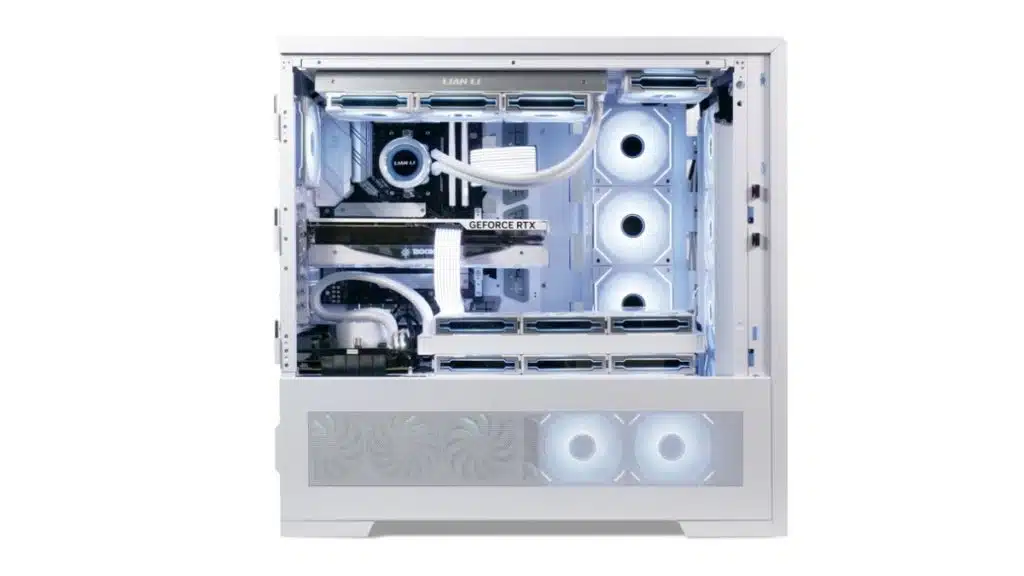
The “Legend Returns” proclaims Lian Li as it launches a new all-white version of its popular PC chassis which offers 3 configuration modes. The LIAN LI V3000 PLUS already has many impressive features giving a builder options for either a dual system configuration, rotated motherboard orientation, or the standard approach. A plethora of cooling options includes up to 3x 480mm radiators, with a 360mm, or various combinations including up to 16x fans. Cooling options don’t stop there as the case also has 2 reservoir mounting plates for D5/DD5 pump. The LIAN LI V3000 PLUS can also accommodate up to 16x SSDs or a combination of 8x HDDs and 8x SSDs.
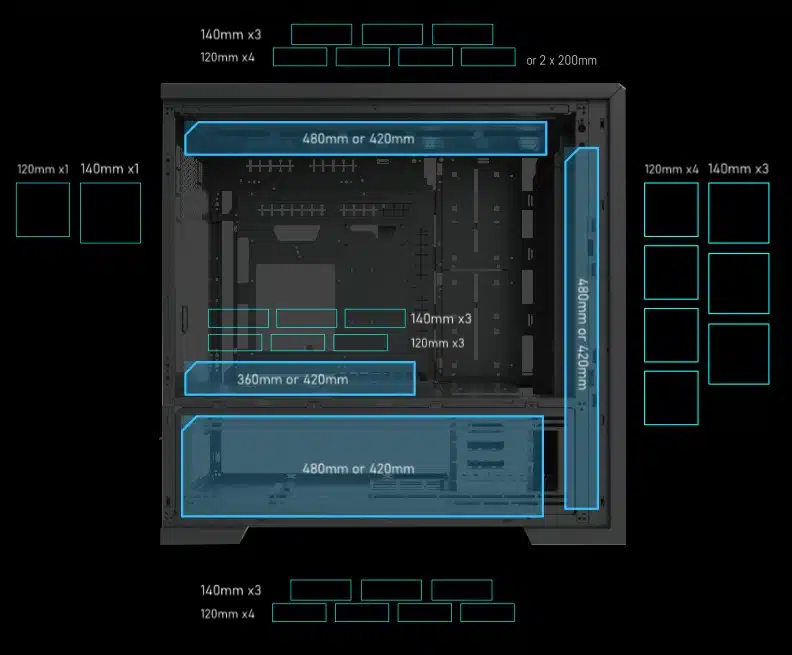
Features:
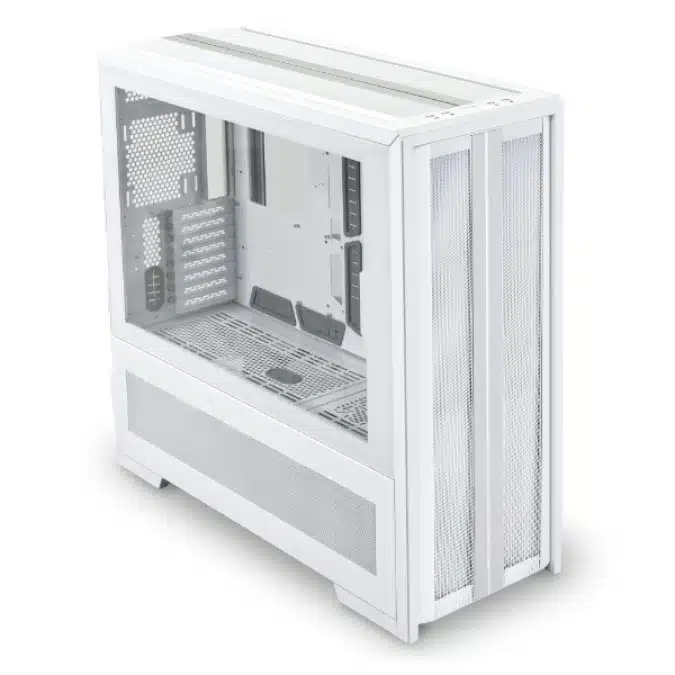
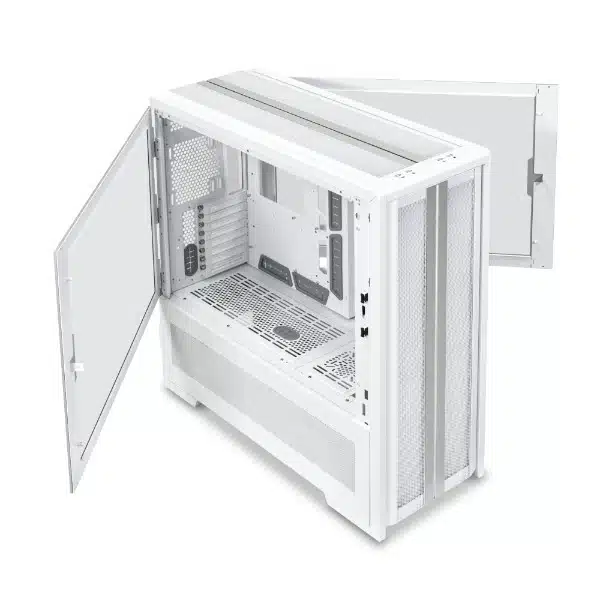
“THE LEGEND RETURNS
V3000 PLUS, the legend’s continuation, is an eye-catching full-tower chassis. Designed for enthusiasts, the V3000 PLUS offers a great building process and improved thermal control.”
- Full Aluminum Exterior
- Exterior Mesh Panel for best possible airflow
- Front ARGB Lighting
- Projected LIAN LI Logo
- Push-pull Hinged Glass Panels
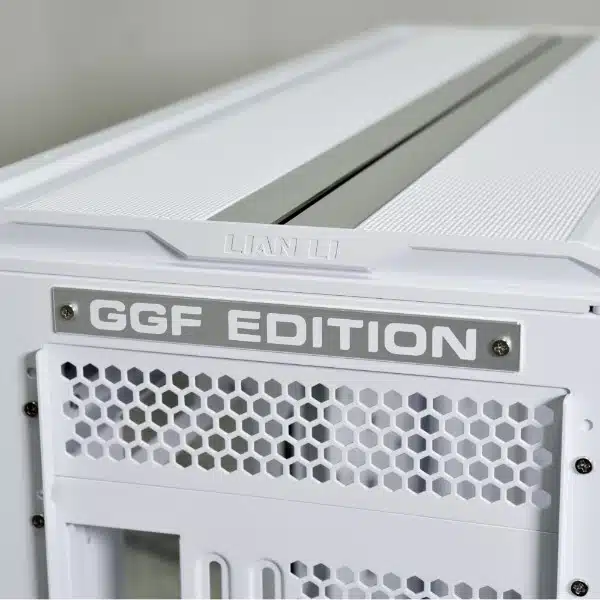
The LIAN Li V3000 PLUS GGF edition does however come at a hefty price of 549.90€ (~$616.47) and is available from CaseKing, but it could very well be the last case one would ever need given all the building options it offers.
Specifications (via Lian Li):
| MOTHERBOARD SUPPORT | Standard EEB/E-ATX/ATX/Micro-ATX/Mini-ITX Rotated EEB/E-ATX/ATX/Micro-ATX/Mini-ITX Dual System System 1 – EEB/E-ATX/ATX/Micro-ATX/Mini-ITX System 2 – Mini-ITX | |
|---|---|---|
| FAN SUPPORT | Standard Front:4 x 120mm or 3 x 140mm Top:4 x 120mm or 3 x 140mm or 2 x 200mm Above PSU Chamber:3 x 120mm or 3 x 140mm Bottom side:4 x 120mm or 3 x 140mm Rear: 1 x 120mm or 1 x 140mm Rotated Front:4 x 120mm or 3 x 140mm Top:4 x 120mm or 3 x 140mm or 2 x 200mm Bottom side:4 x 120mm or 3 x 140mm Rear: 3 x 120mm or 2 x 140mm Above PSU Chamber: 1 x 120mm or 1 x 140mm Dual System Front:4 x 120mm or 3 x 140mm Top:4 x 120mm or 3 x 140mm or 2 x 200mm Above PSU Chamber:2 x 120mm or 2 x 140mm Bottom side:4 x 120mm or 3 x 140mm (without System 2 GPU) Rear: 1 x 120mm or 1 x 140mm | |
| RADIATOR SUPPORT | Standard Front:480mm or 420mm Top:480mm or 420mm Above PSU Chamber:360mm or 420mm Bottom side:480mm or 420mm Rotated Front:480mm or 420mm Top:480mm or 420mm Bottom side:480mm or 420mm Rear: 360mm or 280mm Dual System Front:480mm or 420mm Top:480mm Above PSU Chamber:240mm or 280mm Bottom side:480mm or 420mm (without System 2 GPU) | |
| PSU SUPPORT | System 1 – ATX (Max 220mm) System 2 – SFX-L/SFX | |
| GPU LENGTH CLEARANCE | Standard Max 589mm Rotated Max 358mm Dual System System 1 – Max 589mm System 2 – Max 320mm (Width max 125mm) | |
| CPU COOLER HEIGHT CLEARANCE | System 1 – Max 198mm System 2 – Max 80mm | |
| DRIVE SUPPORT | Drive Cage:8 × 2.5” SSD or 8 × 3.5” HDD Side:4 × 2.5” SSD Behind MB tray: 4 × 2.5” SSD | |
| EXPANSION SLOT | System 1 – 8 System 2 – 3 (at PSU shroud, with optional riser cable) | |
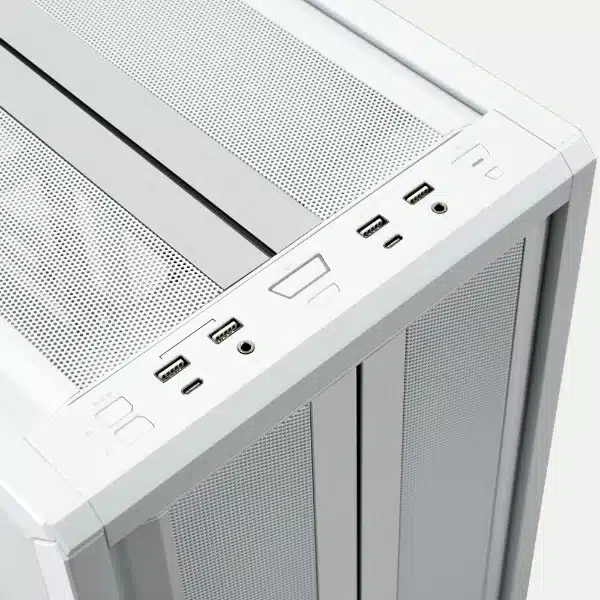
| I/O PORTS | System 1 1 x Power Button 1 x Reset Button 1 x Light Color Button (C) 1 x Light Mode Button (M) 2 x USB 3.0 1 x USB Type C 1 x Audio System 2 1 x Power Button 1 x Reset Button 2 x USB 3.0 1 x USB Type C 1 x Audio | |
| DUST FILTER | 1 x Bottom | |
| WARRANTY | 1 year | |
Discussion (13 replies)
Join Discussion →It looks pretty...
I was a die hard Lian Li guy. But the last two Lian Li cases I have bought have been crap - to the point where I had thought I had gotten something counterfeit or knockoff. Not sure I'm going to look at them seriously again.
So far I'm most impressed with a Rosewill knock-off Corsair case.
I always liked their stuff (especially their fans), but their cases lately have never been that great IMO. I jumped on the hype wagon and got the 011 Dynamic when it came out and it was a hot box with 9 fans. I also had the XL version which was better with temps, but that's about it. The V3000 is a nice looking case, but way to large for me and I usually like big cases.. If I wanted to go back to a big case again I'd go back to my 7000X case.
I've not owned a Lian Li case in 15 years or more. I miss when they had removable mobo trays. First case that has fan speed controls for the front fans, a top fan exhaust and rear and aluminum shell with side window, all back in 2004.
That is what I replaced my last Lian Li case with at the time, due to needing better airflow. Namely 120/140mm fans.
I don't get the appeal of enclosing the psu and drives into a smaller compartment. It makes builds a pain, not to mention when you just want to add a new drive or god forbid a new power cord later.
I get you there. Corsairs new Shift series power supplies help alleviate this issue you talking about though. I use NVME solely now so this isn't an issue for me at the moment.
Originally it was to help with thermal management - keep the hot components away from the cooler components, and have two air flow paths to keep both cool without having to just go brute force with bajillions of fans.
But I think a lot of the copy cat clones lost the thermal management aspect of it and don’t really design around that, which could result in worse performance rather than better
At the very least those "PSU shrouds" should be easily removable. I've worked with a few cases where that was the case, allowing me easy access to the HDD cage and the PSU hidden under there. But I have also worked with PC cases that did NOT have a removable shroud, and those cases are a real pain in the @ss.
One reason I don't like hiding PSUs in a separate compartment is because I like to be able to look right inside my PC and read the PSU label.
It was always a solution in search of a problem. The hot components are the CPU and the GPU. The PSU was seen as an additional exhaust fan that helped fresh air circulate in the case. And when the cpu and gpu fans are running at speed you won't hear the PSU fan running at a slightly faster RPM anyway, so we had a win-win situation.
But no, they "Fixed" that by isolating the PSU which necessitates adding more solo fans to the case to have airflow now in multiple compartments. It's like having the problem of cooling two cases stacked on top of each other within a single case.
I've never seriously looked at the non-XL version; the XL version I have seems to have been almost purpose built for custom water. And really, that's what these larger cases are mostly for, since we're no longer shoving stacks of spinners in them, right?
This V3000 is certainly even larger, at least longer and taller, but having room for so many fans and two systems is kind of its schtick I think. That's obviously not for most people, or even most enthusiasts, but I can see the appeal as narrow as it is.
Sure, back when generic 300W PSUs that came with cases were 'enough'; however, when it's not out of the norm to have 500W+ sustained loads, exhausting some of that heat through the PSU isn't ideal. This case, like most that put the PSU in the rear bottom position, allow you to have the PSU fan intake pull in cold external air and exhaust it out the rear, making it more or less a closed system.
A closed system for absolutely no reason. It is a made up problem. You don't need to keep the psu at room temperature. Especially not at the cost of sacrificing 25-30% of case volume with a shroud. The PSU can still have it's intake on the bottom without a separate compartment around it.
This is equally stupid to me as the cases with the side panel behind their side panel.
I mean, some cases have shrouds that aren't removable, some do - but shrouds do not have anything to do with the PSU cooling.
I used an Asus GT-501 case with a removable shroud, but the only time I removed it was the first initial build. Nice case, but the shroud being plastic was a bit of a pain to reinstall. I have used other cases with a non removable shroud, and they work as long as the case itself is well thought out. The 7000X and 5000X come to mind that I have worked with.
Outside of OEM cases for my job, I haven't personally used many other cases over the decades. Maybe a dozen, if that. Having said that I seem to remember both my HAF cases coming with removable shrouds, heck just about removable everything except the main drive cages at the front, and I took them out during their first builds. It's just nice not having to dig into the backside of a case to get access to the cables/etc.