
Power and Temperature
To test the power and temperature we perform a manual run-through in Cyberpunk 2077 at “Ultra” settings for real-world in-game data. We use GPU-Z sensor data to record the results. We report on the GPU-Z sensor data for “Board Power” and “GPU Chip Power” when available for our Wattage data. For temperature data, we report the GPU (Edge Temp of the GPU) as well as the Hot Spot (Junction Temperature) when available for our temperature data.
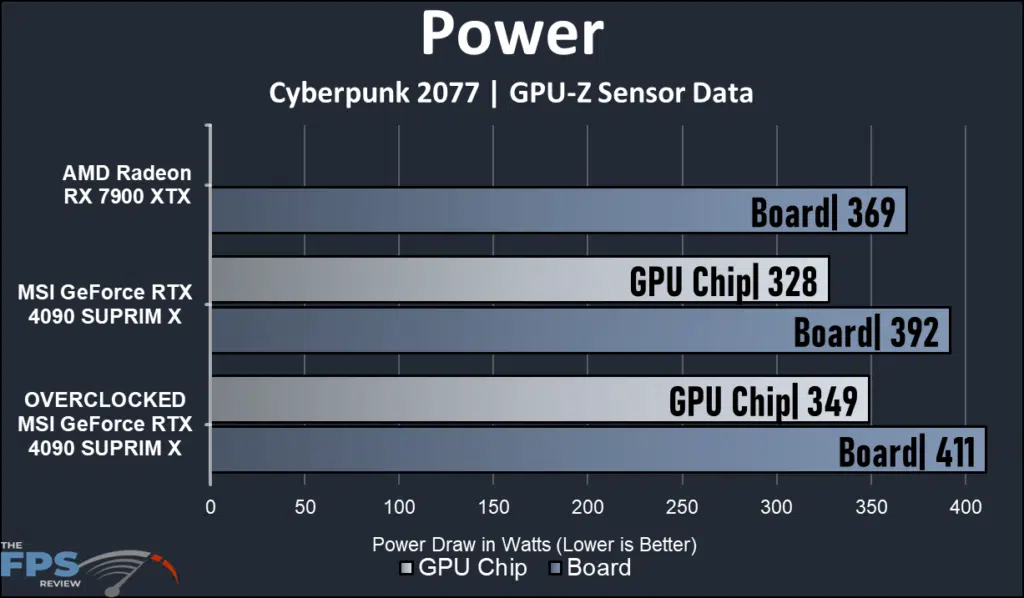
We now get a look at the cost of all that speed. The MSI GeForce RTX 4090 SUPRIM X draws 6% more wattage than the AMD RX 7900 XTX when overclocked 11% more. Is that bad? Well, it’s more. At this level, it is indeed academic.
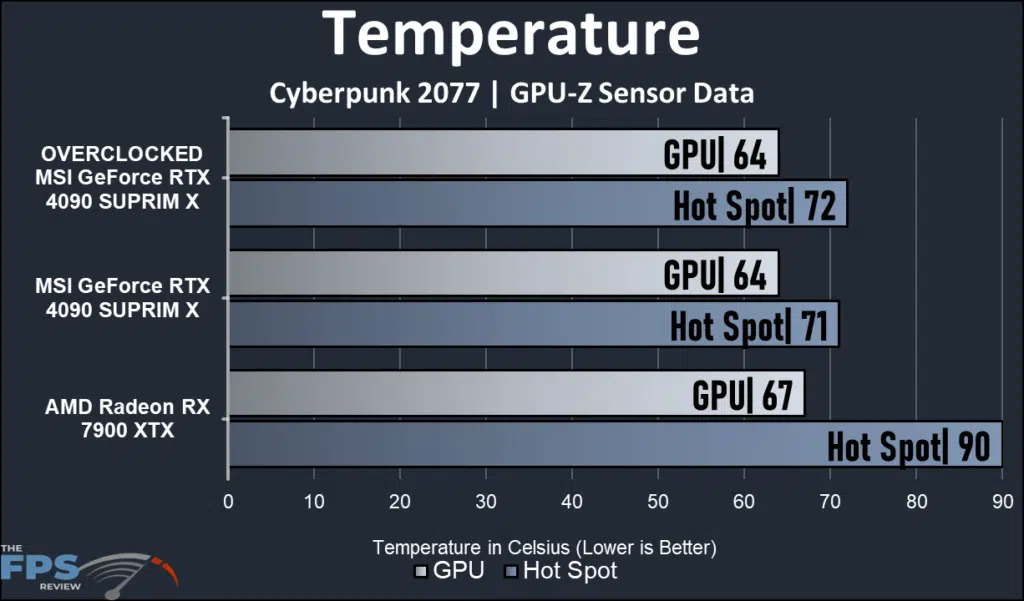
The temperature however shows just how good the MSI RTX 4090 SUPRIM X heatsink handles all the heat from that power and performance. What is remarkable is that the fan cycle was left on AUTO and the overclocked temperatures and default temperatures are nearly identical. Yes, the fans did spin up slightly in our overclocked trials, from 36 to 39%. The fans were silent, needless to say.
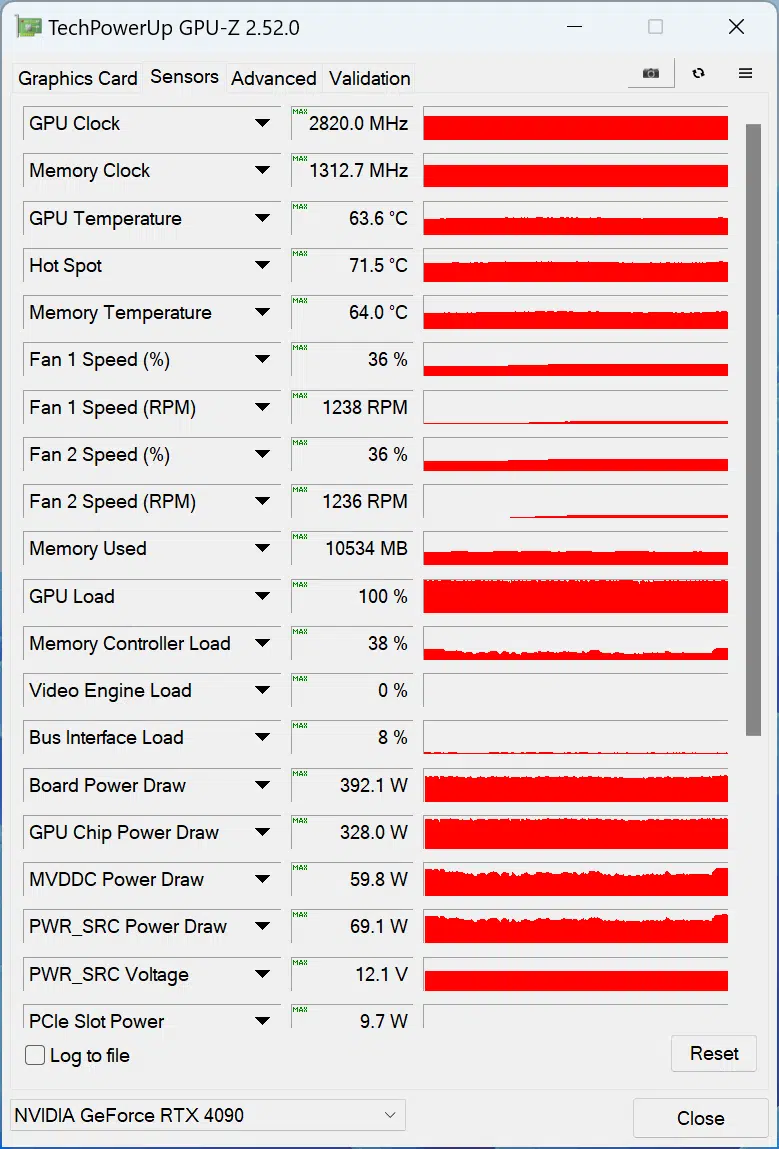
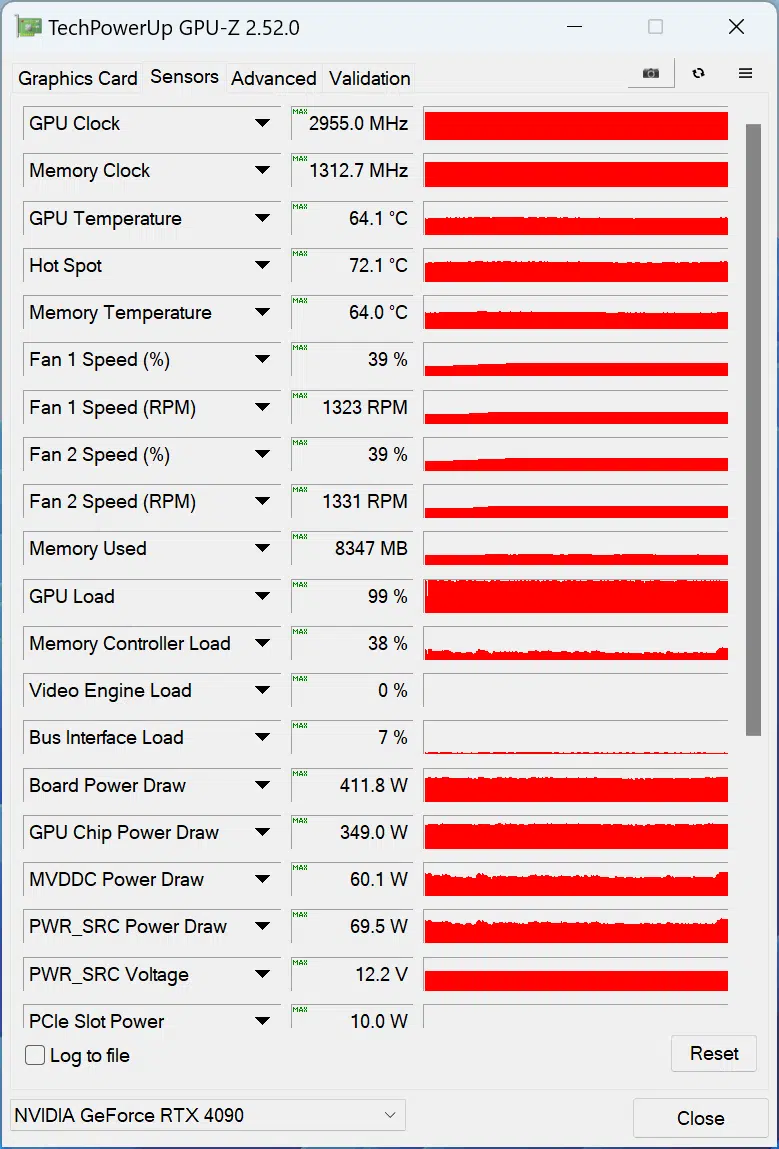
GPUZ sensor data. The default benchmark is on the left.
Discussion (4 replies)
Join Discussion →Nice review. I remember really wanting this card when the 4090's came out, but couldn't find one. I ended up with the Gigabyte card instead which was fine. Now I own the Asus card which is a great card as well, so basically you can't go wrong with a 4090 right now.
Thanks for the great review @magoo ! I know that I really love the Liquid cooled version of this card. In terms of overclocking, I mostly had the same exact experiences as you but had to dial it back a little more for complete stability for all the games I play. I think I've got something like +120 on the core, don't remember the voltage but it ends up being ~1.050V as well, and averages 2850-2925 MHz. I was able to break 3000 MHz but Witcher 3 was very cranky with it. With the liquid version, I just leave the fan profile at stock and I've never seen it go above 66c but usually hangs 62-65 during extended gaming sessions. I also found the overclocking the memory didn't seem to provide any real gains so I leave it at stock. I also have seen pretty much the exact same power draw with my system.
I got my first Suprim X card, a 3090, a couple of years back and have become a fan of the line since. The build quality just blew me away but they are huge and heavy. If I didn't already have so many great cards in the house, plus some debt to pay off, I'd consider getting a 2nd Suprim X liquid for the 3700X rig but at this point, it wouldn't really make sense. However, when the time comes it'll inherit the one in the other rig whenever I do upgrade that one.
Nice writeup! I've got the same card and it's performed admirably (and better, for what it cost).
A few super minor bits I noticed while reading - on page two, the test system lists an "Enegmax" AIO, which I assume is an Enermax. :D
Resizeable BAR is also detailed there as being enabled for all testing, but the GPU-Z screenshot on page three shows it as being disabled.
Which BIOS was used for the testing? The card has a switch that can select two profiles, silent and game. The silent BIOS has a slightly lower power limit (480W) than the game mode (520W). I freely admit that I may have overlooked this part, but the note near the end about not seeing board power higher than ~420W during testing got me thinking about it. Either way, there's virtually no difference between them if you're not hitting power limits with something like 3DMark's Port Royal test (where I have seen 500W+). The fan curves are so close in both modes - which is to say, quiet - that I couldn't tell them apart if you paid me.
Again, great review as always.
@AKBrian , ReBar is enabled on my system, double checked, I saw that too.
Gaming BIOS used throughout.
As for Enegmax.....I suck at typing.