

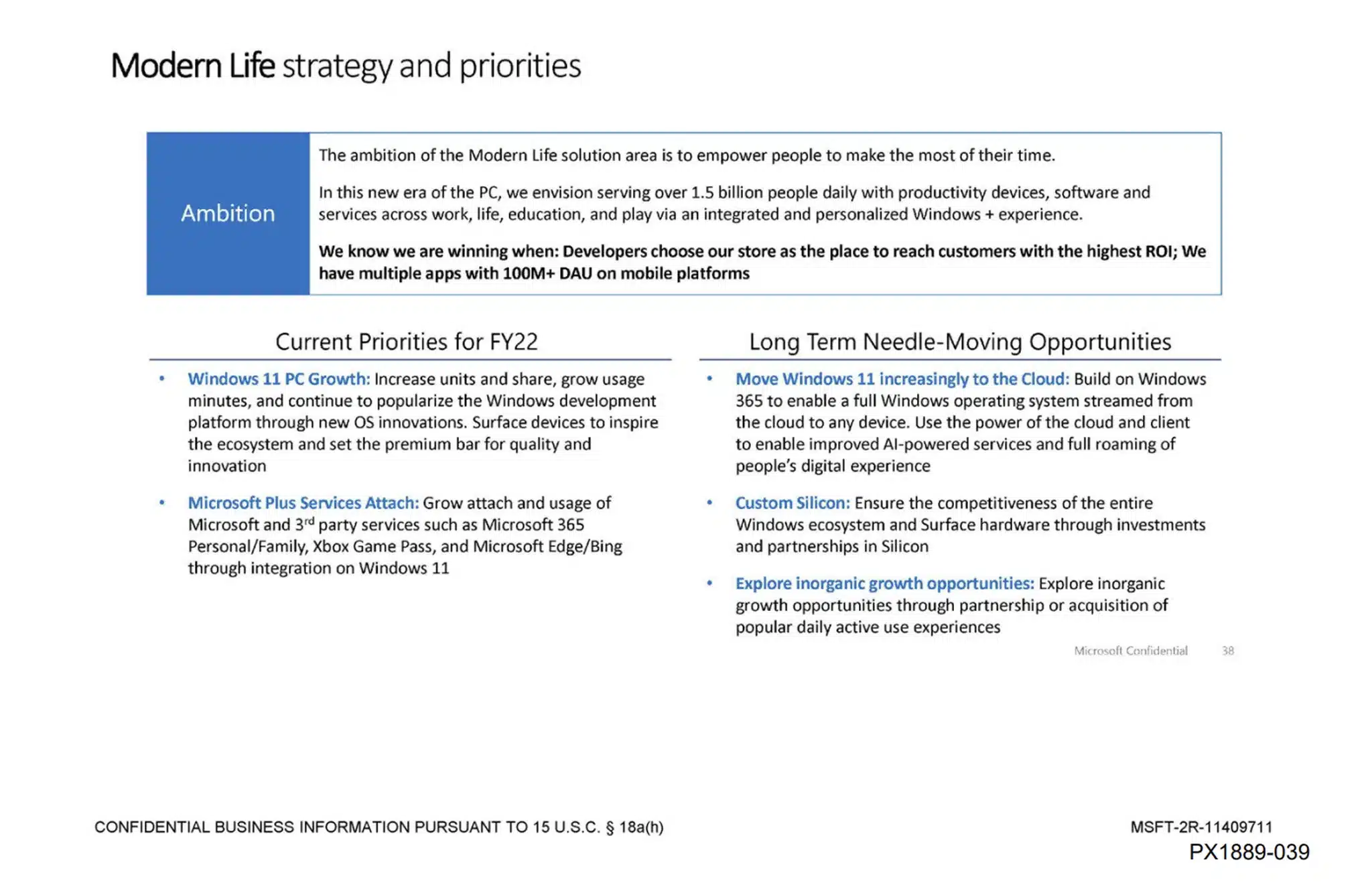
Windows 11 users who have spotty internet may be in for some real trouble in the future, as Microsoft has revealed that one of its current, albeit “long-time” goals is to move its operating system “increasingly” to the cloud. “Build on Windows 365 to enable a full Windows operating system streamed from the cloud to any device,” reads an internal presentation from Microsoft that was originally drafted in June 2022 but released to the public this week as part of the company’s ongoing legal battle with the FTC surrounding its proposed acquisition of Activision Blizzard.
- Microsoft wants to move Windows to the cloud for consumers, building on Windows 365 to enable a full Windows operating system streamed from the cloud to any device.
- Windows 365 is a cloud-based service introduced by Microsoft in July 2021 that aims to bring the Windows operating system to the cloud.
- Microsoft plans to use “the power of the cloud and client to enable improved AI-powered services and full roaming of people’s digital experience.”
- Microsoft has already begun introducing AI-powered services to Windows 11, such as Windows Copilot, an AI-powered assistant that can summarize content and more.
From The Verge:
The presentation has been revealed as part of the ongoing FTC v. Microsoft hearing, as it includes Microsoft’s overall gaming strategy and how that relates to other parts of the company’s businesses. Moving “Windows 11 increasingly to the cloud” is identified as a long-term opportunity in Microsoft’s “Modern Life” consumer space, including using “the power of the cloud and client to enable improved AI-powered services and full roaming of people’s digital experience.”
Windows 365 is a service that streams a full version of Windows to devices. So far, it’s been limited to just commercial customers, but Microsoft has been deeply integrating it into Windows 11 already. A future update will include Windows 365 Boot, which will enable Windows 11 devices to log directly in to a Cloud PC instance at boot instead of the local version of Windows. Windows 365 Switch is also built into Windows 11 to integrate Cloud PCs into the Task View (virtual desktops) feature.
Discussion (19 replies)
Join Discussion →So they can turn off my computer too if a courier mishears an automated doorbell?
So, shall we take guesses on the day that Windows died? The day of a ddos attack perhaps. Though my favorite would be the more mundane problem that someone at Microsoft forgot to update a security certificate and now Windows365 is declared a virus risk.
Do not like this idea.
I dont like office 365 either.
What exactly would be moved to the cloud? The boot code? Or do we have just enough on the hd to boot then the gui is cloud based? I am not seeing this ending well - but who knows, I could be in for a surprise. All this to save 32 gb on disk?
Looks like I'll be on Windows 10 for the rest of my life
So what the f*ck does this mean, we'll need an Internet connection just to use the f*cking OS? Exactly how much of the OS will require cloud functionality of some kind? If I can't use an OS completely offline, and with an offline admin account, then that is not the OS for me.
HAHAHAHAHAHAHA
I said the same thing about Win7! I did eventually move to Win10, but at the same time I also moved to Linux being my main OS. I have Win11 installed in a VM, can't stand it. I used Win7 way past EoL, and the same will happen with Win10. Hoping I can just skip Win11 outright, and that Win12 will actually be decent. Not holding my breath though. At this point Windows is basically my "game console" because 99% of the time I boot into Windows is just to play a game.
To with the enterprise version of the os. Never ever the home version... St least not any more.
I wonder if what they are really trying to say is something like One Drive for your entire system.
When I needed to reinstall Windows a bunch of times on my laptop it was kinda handy to restore from it - then it started nagging me about space and wanting money so I disabled it.
They really want to allocate 22tb for me? How about the ppl that hoard movies (of various types and ratings) and have 100's of tb's or more -- then do we get MS policing our files? Would MS be able to be subpoenaed/hacked and our entire digital lives stolen/exposed? Does a DDOS stop us from playing Skyrim and other single target games or apps?
Or do they mean something more like a mini-os that gives us Citrix like access to an os run off their server?
None of these sound good to me - or safe/secure.
That's going to be a big no for me.
The day I can't have a completely offline Windows experience (no Microsoft account, no cloud integration, with local accounts only) is the day I cease using windows.
In fact, just about every word on that slide is a negative.
Sounds more like Azure and a streamed virtualized client
I had a friend say the same thing about DOS 6.22 when Windows 95 came out. Unfortunately, its just not feasible to stay in the past.
no computer if internet goes down? and how will it rund for peeps on shoddy internet? I don't see this happening for general use but who knows.
I'm imagining a cloud version that is actually running on a cloud hosted VDI for most everything other than basic functionality.
RMR is the magic money maker for companies.
I don't see this working well for professionals or laptop users to be honest. Those would continue to need full fat OS's.
Systems that are always at a house always running on a specific wi-fi will be more of a target for this. Honestly if you have good connectivity, don't care about DIY, and have a older laptop, no reason you wouldn't cloud game today, and that generally has a OS on the backend anyway that you're using like a VID so might as well go VDI for everything.
VDI = Virtual Desktop Interface.
Unfortunately I can see very clear a future of 100% cloud, and companies will be absolutely 100% in. As a consequence this will be so for normal users also in time. I can talk about how much I don't like it, and we can talk about certain , now very minor limitations, it doesn't matter. They only thing really holding this back is likely server capacity, which will be overcomed.
Ive played streamed video games on my ps4, other than looking a little weird, as it looks a bit like a youbtube video of sorts, well I can't say that it didn't work and games are famously intensive. There is none of the issues with your desktop, and your web surfing, and anything that will not present a difficulty at all for technology already available, if anything its may less intensive and suitable for higher latency and slower connections.Anything really, video encoding, photo editing, doesn't matter, it can be done in the cloud, and it can put your 64core desktop to its grave with ease, as you can simply call upon what amounts to a super computer to work for you for fractions of a second at a time. In reality your computer is mostly sitting on its butt waiting for your input, which means you don't need the equivalent horse power in a server for each user, but a minuscule fraction of it in fact. Again, games, way more intensive, and that has been solved. I don't know how ready the software is, but I don't see ms and Google etc having too much issue creating virtual intances of desktops that come on when you log in from any compatible device, and go right back to frozen state when you are off line.
Get you linux warmed up and ready, this is coming no question, there will be a period of both things obviously, but in time, things will be 100% cloud, and tiny access devices. Every company will eat it up, and every joe and jill schmoe won't care one bit. Limitations do not really exist any longer technology wise, perhaps some minuscule, and if there's any in boondocks USA connectivity wise, well they will either be overcome or will simply be ignored and good luck!
The problem with cloud for any type of productivity, is that you have no local access to any of your files. Imagine windows running on one cloud, but the application you run on it is in another cloud server, plus you have a thin client running the UI. Where are your files in this equation? It can't be on the thin client, that barely has enough to store the frontend. Is it on the windows cloud? Then how does the application get access to it?
Or do you install the application on the cloud windows like it is a local PC? Then you are basically running remote desktop on MS's PC. And you need a dedicated instance on the cloud server reserved just for you storing your apps and settings and files. It would either be prohibitively expensive for the user, or a money pit for MS.