
Synthetic System Benchmarks – Ryzen 5 7600
We are going to start with synthetic system application benchmarks on this page. Note that the graphs are arranged from fastest to slowest. We have also highlighted the Ryzen 5 7600 and Ryzen 5 7600 with PBO ENABLED to give you a better visual comparison to the Ryzen 5 7600X. The label “PBO ENABLED” indicates the Ryzen 5 7600 with PBO ENABLED in the BIOS.
PCMark 10
PCMark 10 Express
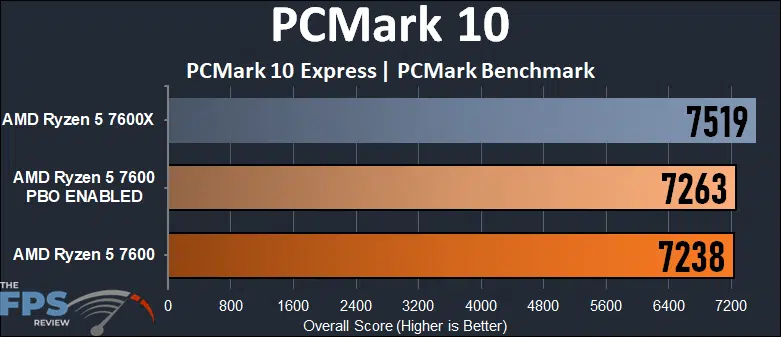
Our goal today is to find out the difference in performance between the Ryzen 5 7600 and Ryzen 5 7600X. In addition, we want to see how turning on PBO affects performance and if the Ryzen 5 7600 can come close to Ryzen 5 7600X performance with the automatic overclocking.
Starting off in PCMark 10’s Express system benchmark, we find that the Ryzen 5 7600 is only about 4% slower than the Ryzen 5 7600X in PCMark 10’s express benchmark. This benchmark focuses mainly on more lightly threaded office application types of workloads. In this scenario, you don’t have a big difference between the CPUs for performance. Adding PBO did not provide this system test with a lot of performance, about 0.3% performance gain.
Geekbench 6
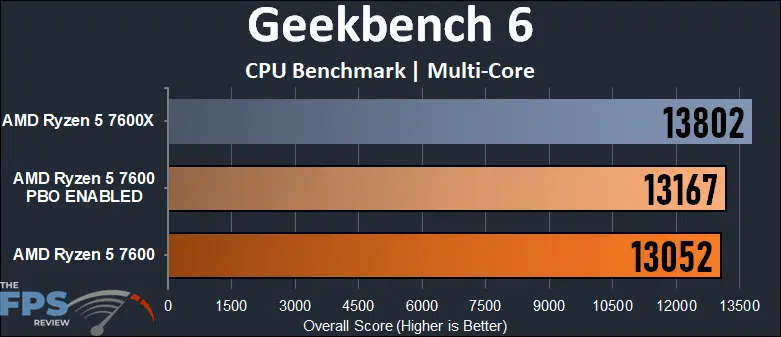
In Geekbench 6 Multi-Core performance we are now looking at multi-core performance, where the benchmark pushes all the cores harder. The Ryzen 5 7600 is now 5% slower than the Ryzen 5 7600X. Therefore when all cores are being used, we see a greater hit on performance, since it runs at a lower frequency, but it’s still only 5% in total. Turning on PBO helped claw back a little performance by 1%.
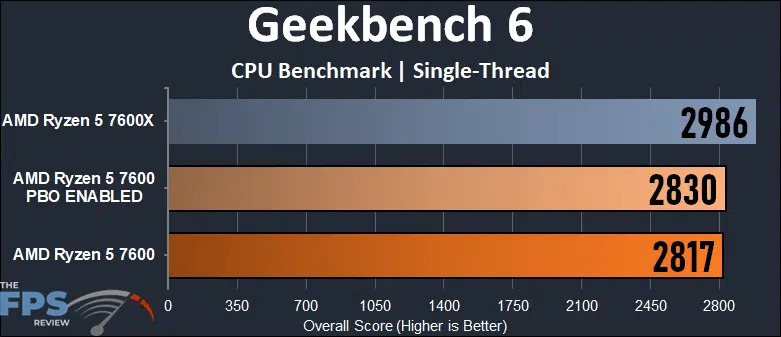
In Geekbench 6’s single-thread performance, we find that the Ryzen 5 7600 is 6% slower than the Ryzen 5 7600X, which is greater than the multi-core performance. The clock speed likely is not near the 7600X. Enabling PBO did not help much, and added only 0.4% performance to the 7600.
3DMark CPU Profile
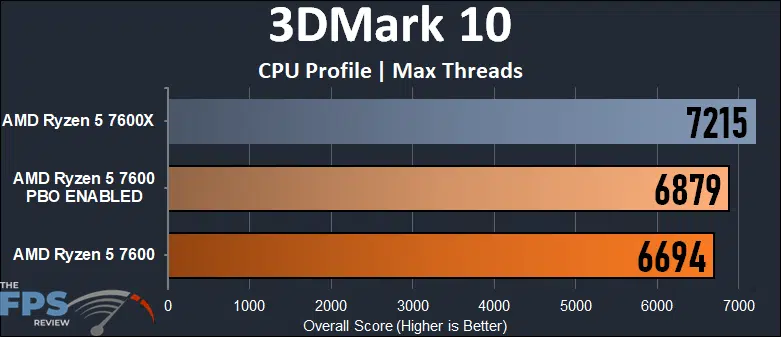
In 3DMark’s CPU Profile test, we are running the “Max Threads” test and looking at overall performance. This benchmark really shows the difference between the CPUs in maximum thread performance. The Ryzen 5 7600 is now 7% slower, overall, compared to the Ryzen 5 7600X. As you can see, as more threads are used, and more cores, the difference can widen to a difference that is noticeable. Enabling PBO claws back more performance, adding 3% more performance, and coming closer to the 7600X.
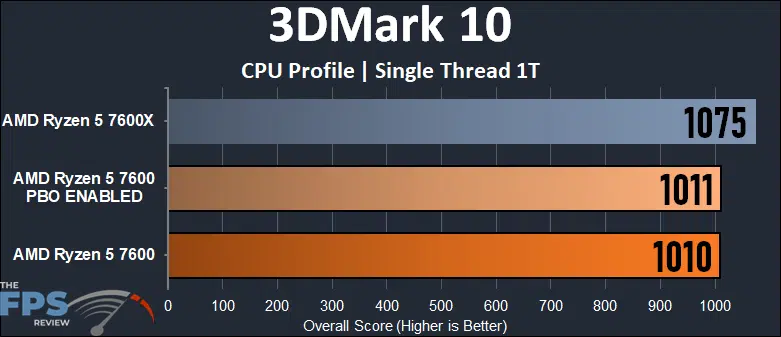
When it comes to single-thread performance though, we find the Ryzen 5 7600 is 6% slower than the Ryzen 5 7600X. Again, frequency is the key point here. PBO does not help performance in single-core performance for the most part.
Discussion (1 reply)
Join Discussion →Hey this was an interesting article to read, and it had me asking myself about my 5900x CPU.
How would my 5900x CPU compare in gaming workloads to the 7600x CPU. Would I have the same throttle point at 4k and sometimes at 1440p gaming? Would the newer generation with it's overall higher single thread be able to feed a modern GPU more efficiently than my 5900x?
Clearly the raw speed isn't making a big difference for gaming at all at the higher resolutions. Seems like if you're doing CPU based rendering it's clear more threads is better. But for gaming in specific I wonder at the differences.
I guess if you guys end up with SO MUCH free time to do a retrospective on CPU performance that would be awesome.
Only issue really here is the PITA it will be to swap platforms due to difference sockets.
Huh... remember back in the... was it 486 or early Pentium days when Citrix would make socket adapters. Sigh... the good ole days... Around the same time that Nvidia made motherboards for AMD CPU's.