
Power and Temperature
To test the power and temperature we perform a manual run-through in Cyberpunk 2077 at “Ultra” settings for real-world in-game data. We use GPU-Z sensor data to record the results. We report on the GPU-Z sensor data for “Board Power” and “GPU Chip Power” when available for our Wattage data. For temperature data, we report the GPU (Edge Temp of the GPU or Package Temp) as well as Hot Spot (Junction Temperature) when available for our temperature data.
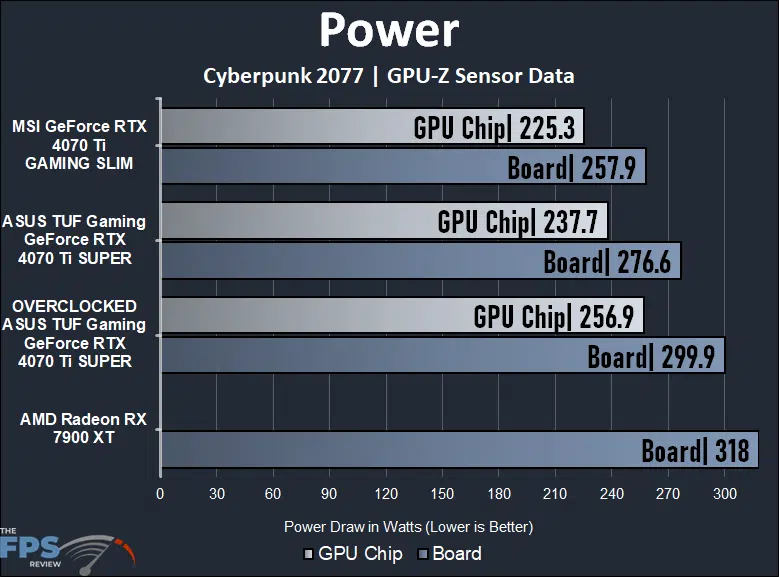
The TGP for the GeForce RTX 4070 Ti SUPER and ASUS TUF Gaming GeForce RTX 4070 Ti SUPER is 285W by the spec. This is the same TGP as the GeForce RTX 4070 Ti. However, due to board differences, chip differences, VRAM capacity differences etc.., we actually expected both video cards would have differing amounts of power draw, and that is exactly what we are seeing above.
The ASUS TUF Gaming GeForce RTX 4070 Ti SUPER is pulling 7% more power than the GeForce RTX 4070 Ti video card we are using. Now this is a great number actually because the performance difference we experienced was 12% over the GeForce RTX 4070 Ti. That means the ASUS TUF Gaming GeForce RTX 4070 Ti SUPER is achieving more performance with less power, it is in fact incredibly efficient, and not power-hungry. This is a greatly efficient GPU and board, even with 16GB of VRAM.
When we overclock it, board power rises by 8%, which is exactly the performance uplift we also got from overclocking! It’s a linear 1:1 ratio here, we are getting the exact performance increase from the exact percentage of power draw increase, and that’s amazing.
The Radeon RX 7900 XT by comparison, uses 15% more power than the ASUS TUF Gaming GeForce RTX 4070 Ti SUPER. In fact, it’s even drawing 6% more power than our Voltage-increased and overclocked ASUS TUF Gaming GeForce RTX 4070 Ti SUPER! Yeah, efficiency is not the Radeon RX 7900 XT’s strong suit.
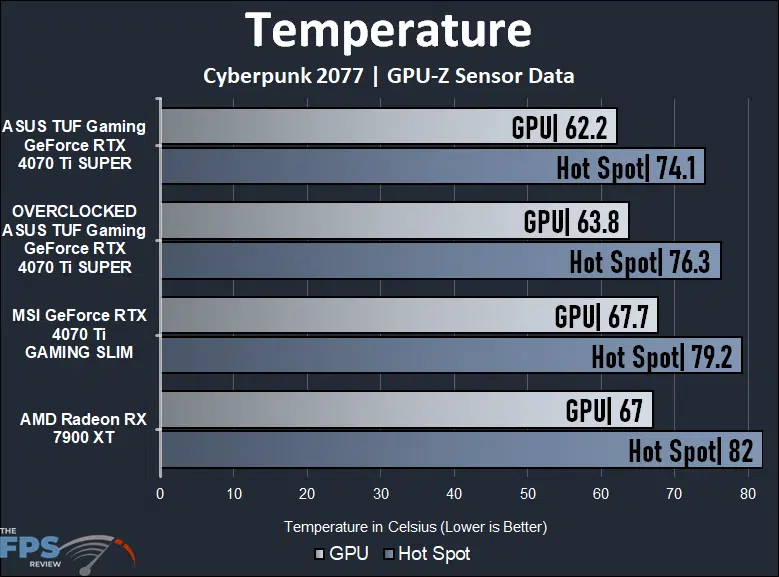
The ASUS TUF Gaming GeForce RTX 4070 Ti SUPER is the coolest running video card on this graph at 62.2c GPU temp and 74.1c Hot Spot temperatures. It’s running cooler than the GeForce RTX 4070 Ti video card we are using, which is a slimmer build mind you. When we overclocked the ASUS TUF Gaming GeForce RTX 4070 Ti SUPER with automatic fans the GPU temperature and Hot Spot did not increase much, and keep in mind this is also with a Voltage bump of +100mv, so that’s incredible. The Radeon RX 7900 XT has a very hot Hot Spot temperature by comparison.
GPU-Z Sensor Data

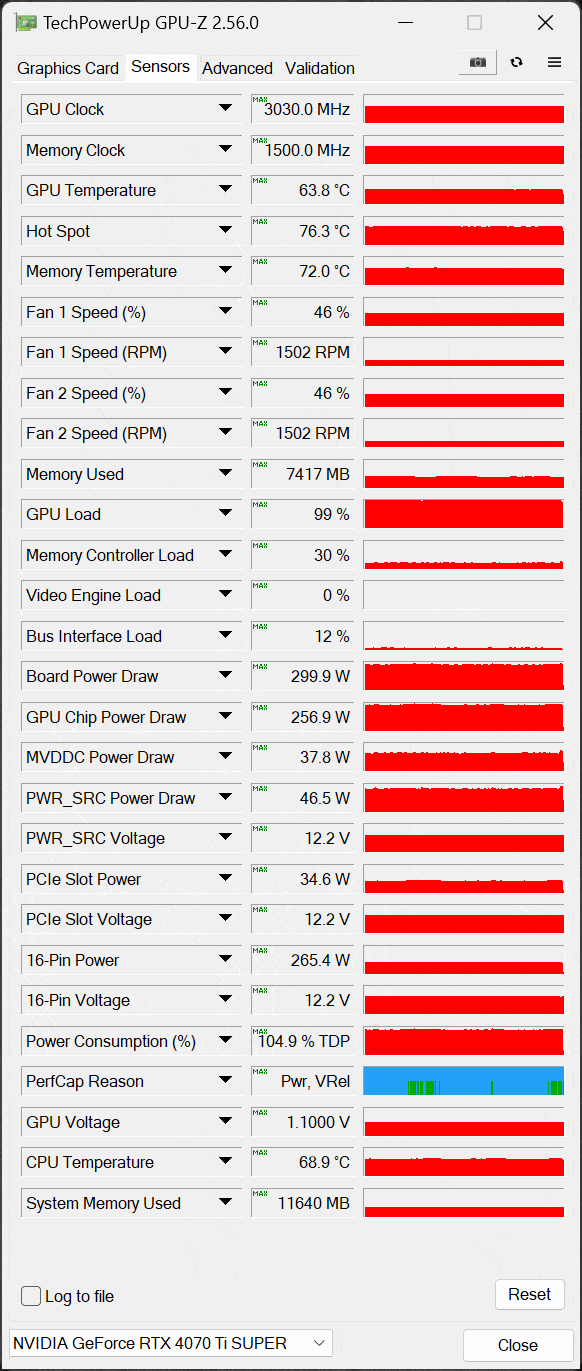
In the GPU-Z screenshots above, we are comparing the Default (Left) with the Overclock (Right) to see the differences. We do have the Voltage bumped up remember, and we can see it is at 1.1000V when overclocked compared to 1.0850V by default. With the fans on automatic, they operated at 42% by default and 46% when overclocked, and you can see the temperatures. The memory temperature is also not changed much with overclocking.
Discussion (3 replies)
Join Discussion →Nice review. Interesting that there is still interplay between the AMD lineup and Nvidia's lineup. Seems like some of that AMD fine wine is still a factor.
This leaves me a much better taste than the RTX4070Super. I was considering getting a RTX4070Ti for a while, this makes it much more tempting.
I'm surprised on how many titles it can run at 4K even without DLSS
This is the card that I think stands out the most of the bunch. Basically just a cut-down 4080 at the price many were saying a 4080 should've launched at. I'm glad to see it performed so well and that it really had a knock down / drag out fight with the 7900 XT, at least until ray tracing came into play, as both are good cards. I'm also pleasantly surprised to see the trend continue with some newer cards where you can apply your power/voltage increases and over clocks while leaving the fans at auto. If I didn't have 3090 Ti's in my other two rigs I'd order one.