
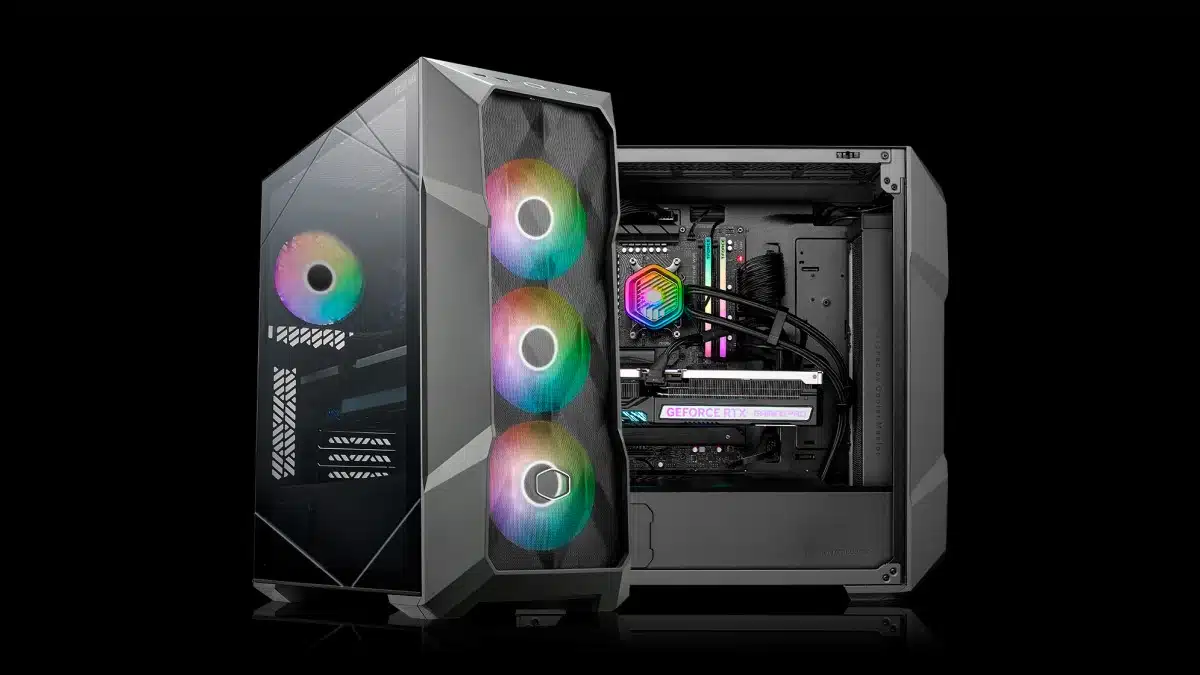
PC building is about to get a bit easier as Cooler Master announces its TD500 MAX PC chassis which includes an AIO, PSU, and 2-stage connectors. Cooler Master previously revealed the TD500 MAX back in January but appears to be readying an imminent launch as review embargos have lifted and have begun being posted.
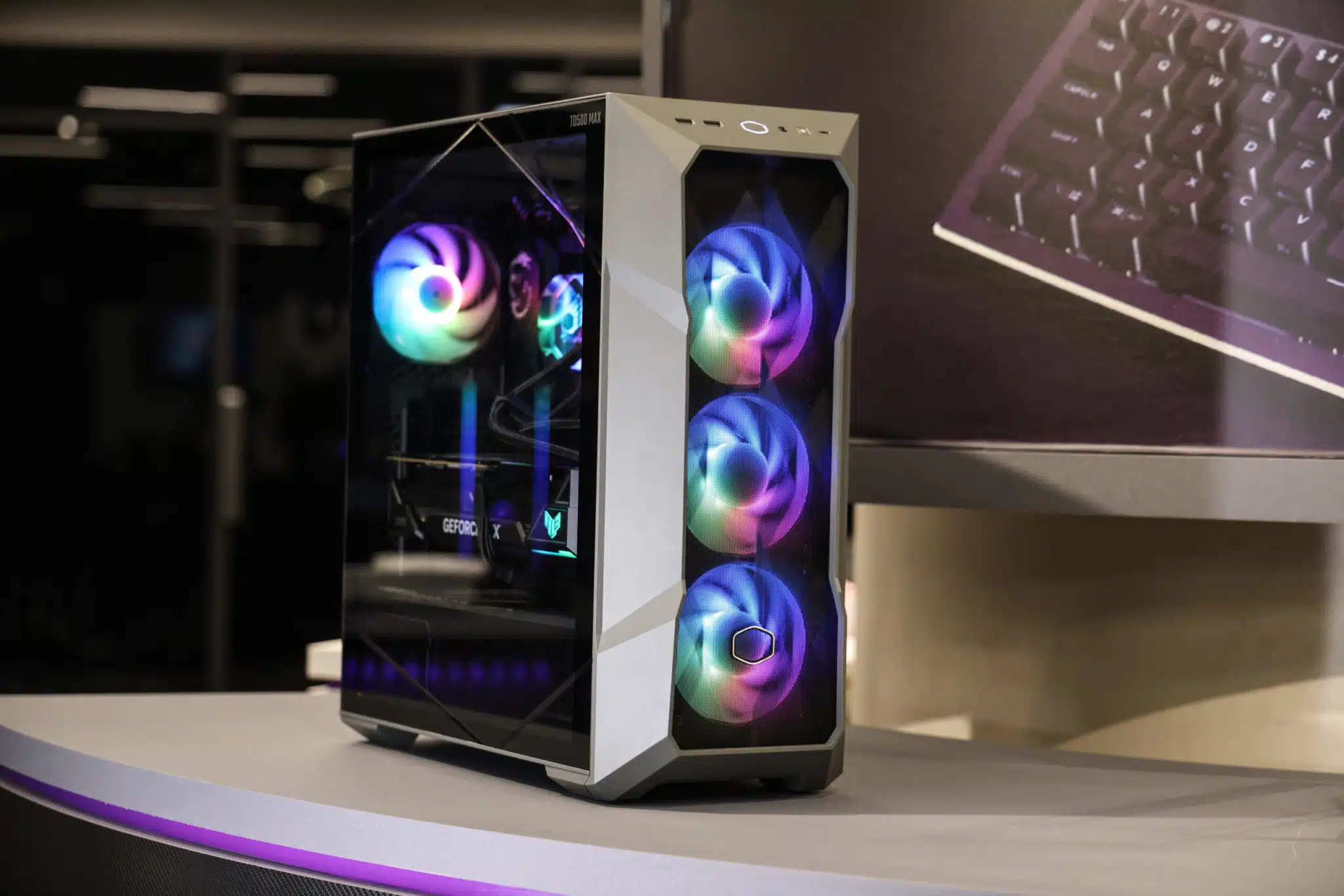
The TD500 MAX has been designed to meet the cooling demands of most high-end components with its 360mm Atmos AIO (we have a review of the MASTERLIQUID version here) featuring a 38mm radiator and 3x Mobius 120P ARGB fans, 1x 120 ARGB fan on the rear, and capable of supporting up to three more fans on the top of the case. Cooler Master also includes a GX II Gold 850W ATX3.0 PSU, plus a 2-stage cable connecting system and storage area for screws.
Key Features (per original announcement):
- Advanced Cooling System: Equipped with a 360x38mm Atmos radiator and Mobius 120P ARGB fans for top-tier thermal performance.
- User-Friendly Building Experience: Pre-installed and pre-routed components for a straightforward assembly.
- Two-Stage Power Connector: Patent technology for seamless cable management.
- Exclusive Design and Color Scheme: Unique grey color and custom components for standout aesthetics.
- High-End Power Supply: GXII 850W ATX3.0 Max version PSU for peak performance and easy installation.
- Innovative Screw Stock Storage Pad: A simple solution for storing screws during builds and maintenance.
Owners of modern graphics cards, some of which have grown to gigantic proportions, may want to consider the TD500 Max as it is capable of fitting cards up to 380mm in length. The included PSU could be a great pairing for someone with a mid to high-end processor and an NVIDIA GeForce RTX 4080 Super (which we also have a review of here). Pricing and availability have not yet officially been revealed by Cooler Master, yet, but according to one reviewer the TD500 MAX will retail for $399.99. While that potential price may seem high the reviewer noted that if trying to source like-for-like similar parts, it would be just a bit higher.
Specifications:
- Product Number: TD500V2-MGNN85-SL0 / TD500V2-MGNN85-SL1
- Exterior Color: Gun metal
- Materials: Exterior Steel, Plastic, Tempered Glass, Left Side Panel Tempered Glass
- Dimensions (L x W x H): 499 x 210 x 500mm (incl. Protrusions), 482 x 210 x 477mm (excl. Protrusions)
- Volume: 48 Liters
- Motherboard Support: Mini-ITX, Micro-ATX, ATX
- Expansion Slots: 7
- Drive Bay: 2x 3.5″ HDD, 3x 2.5″ SSD
- I/O Panel: 2x USB 3.2 Gen 1 (USB 3.0), 1x USB 3.2 Gen2 x 2 Type C, 1x Audio Combo (Audio In / Out 3.5mm)
- Included Accessories: ARGB Hub
- Pre-installed Radiator: ML360 Atmos MAX ver.
- Pre-installed Power Supply Unit: GX II Gold 850W ATX3.0 MAX ver.
- Pre-installed Fan(s): Front 3 x 120mm (AIO Mobius120P ARGB fan), Top N/A, Rear 1 x CF120 ARGB fan
- Fan Support: Front 3 x 120mm / 2 x 140mm, Top 3 x 120mm / 2 x 140mm, Rear 1 x 120mm
- Radiator Support: Front 360mm / 240mm, Top 360mm / 240mm, Rear 120mm
- Clearances: CPU Cooler 165m, Power Supply 200mm (Pre-installed PSU Length 160mm), Graphics Card 380mm (with pre-installed AIO on front), Cable Routing – Behind MB Tray 19mm
- Dust Filters: Top, Bottom
- Warranty: 2 years (Case), 5 years (Thermal Solution), 5 years (Power Delivery)
- Form Factor: ATX
Discussion (6 replies)
Join Discussion →So you can get a mediocre power supply paired with a mediocre AIO, but at least you don’t have to assemble it?
Wake me up when it comes included with a 1000w Seasonic Titanium, a D5, and a 420mm rad. Bonus points for ZMT or primochill tube pre installed as well with QDC for processor / vid card
I also would've preferred a 1000W, or higher PSU but if you don't have a demanding setup then it won't matter. Same goes for 360 vs 420 w/ the better pump. Now granted, if I was aware of a major manufacturer offering a product like that I'd probably jump on it in an instant but it would also come down to the price.
Beyond that though my only real complaint for this is that I don't like the fans on the external side of the radiator. Sure if your wanting rainbow brite that's great but I prefer the radiator fans on the inside to exhaust the heat through the radiator and I didn't read anything about them being reversible to the inside but maybe you reverse them on the outside to pull the air through. I have never tried that but it could work I suppose. It'd be nice if the price was just a tab bit lower as well, say $350 or maybe even $300 but I know that's not being realistic either.
Otherwise I kind of like the case. Having just got a humongous GPU (355.5mm) it would be nice to have something I didn't have to worry about and still have room for bigger things later on.
850W and a 360MM rad for the CPU is absolutely enough for any standard stock gaming desktop, and that's if you go for a 4090 / 7900XTX and 14700K+ rather than a power-sipping 7800X3D.
Now, with the Intel CPU and overclocking both CPU and GPU, you absolutely can pull more than 850W if you run a power virus load on both processors. Both would be thermally throttling very quickly though and that's not a sustainable or representative workload.
Unfortunately mediocre seems to explain their customer service as well from what I've read.
I’m not 100% sure on the 850. I had an OC’d 3080ti and a 5950 with PBO enabled randomly rebooting on a Seasonic 750w Plat. I jumped up to a 1000w PS, so I can’t directly say if 850 would have been enough, but the line was somewhere between 750 and 1000.
We had a similar issue with a 10900K and a RX5700XT - at full (power virus) tilt, the system would reboot with a Seasonic-built Phanteks 750W unit. This was while respec'ing the case review rig, and the load was designed to test case cooling.
I briefly used a refurb Corsair 850W TX unit (not fully modular, basically entry-level) without issue, before upgrading to the final Seasonic 1000W Gold unit. A second example is my own; with a 12700K and a 3080 12GB FTW3 (EVGA's 450W board for that GPU SKU), I was able to get an 850W Corsair RX Gold unit to start complaining but did not experience instability.
That's personal experience with 750W, 850W, and 1000W units with power virus loads, but I'll say that the math also adds up: once you pull 300W through the CPU socket and 450W through the GPU, well, you're at 750W, and you still have the motherboard, storage, RAM, fans, RGB lighting, USB peripherals, and whatever else loading the PSU.
So that's how I get to the '850W is enough' determination, since your average user shouldn't be running simultaneous power virus loads, and how I get to '1000W and be done' for folks that are a little too adventurous for their own good :).
(and that assuming that they're using top-shelf parts - a recent upgrade I did for a buddy who had a ~5 year old system didn't even consider the PSU used, since power draw went down!)