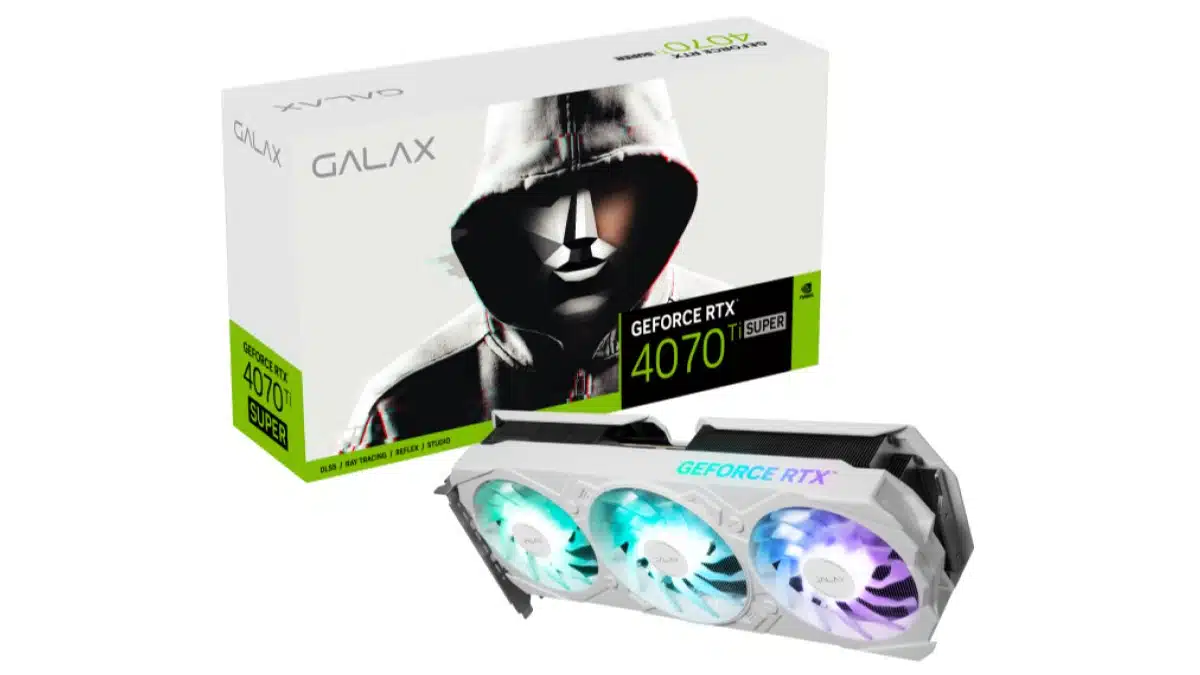
Modified GeForce RTX 4070 Ti SUPER Manages to Outperform RTX 4080 SUPER

The FPS Review may receive a commission if you purchase something after clicking a link in this article.

Image: Galax

A modified GeForce RTX 4070 Ti SUPER has managed to best an RTX 4080 SUPER benchmark score after getting its memory upgraded. Recently two teams from Brazil, Paulo Gomes and TecLab, competed with each other to see who could push NVIDIA’s RTX 4070 Ti Super to its fullest potential. An interesting detail of note in this competition is the RTX 4070 Ti SUPER and the RTX 4080 SUPER both use the same AD103 die. The ladder features all cores enabled while the former is the most cut-down version of that die. Despite the name difference, the RTX 4070 Ti SUPER was in essence a cut-down RTX 4080 with slower memory but unlike its $1,199 (original MSRP) predecessor, it could be found at $799, or lower, making it the most affordable version of that lineup.

A trio of AD103 specs

The team TecLab used a GALAX GeForce RTX 4070 Ti SUPER EX Gamer White Edition while team Paulo Gomes used a Manli GeForce RTX 4070 Ti Super Gallardo. Both cards feature 21 Gbps GDDR6X memory on a 256-bit bus and by comparison, the GeForce RTX 4080 SUPER, and non-SUPER come with 22.4 Gbps GDDR6X. In terms of core counts, at the top of the AD103 stack, we have the RTX 4080 SUPER with 10,240, the RTX 4080 at 9,728, and trailing at the end is the RTX 4070 Ti with 8,448 cores. One might think that with 1,792 fewer cores the RTX 4070 Ti SUPER would have little to no chance of ever overcoming the RTX 4080 SUPER but it turns out that is not necessarily the case.

Both teams used their hardware expertise, and inside information, to replace the stock memory modules on their respective cards with faster memory. While team Paulo Gomes managed an impressive 24 Gbps overclock with their efforts team Teclab hit it out of the park at 26 Gbps. That speed allowed the cut-down AD103 to really show its potential where it overcame a Superposition 8K benchmark score set by the RTX 4080 SUPER. Now to be fair, both modified GeForce RTX 4070 Ti SUPER cards were overclocked and competing with the stock scores of an RTX 4080 SUPER.

  • GALAX GeForce RTX 4070 Ti SUPER EX Overclocked – 9,133 points
  • Manli GeForce RTX 4070 Ti Super Gallardo Overclocked – 8,870 points
  • GeForce RTX 4080 Stock – 8,525 points

Join the discussion in The FPS Review Forums...

Discussion (9 replies)

Join Discussion →
m
magoo 👍 2

Well......if I supercharge my Explorer V6 it would go faster than a stock Explorer.....not really unexpected. But I will say, the RTX 4070 Ti Super I reviewed was a pretty good overclocker. https://www.thefpsreview.com/2024/03/11/gigabyte-geforce-rtx-4070-ti-super-windforce-oc-16gb-gpu-review/3/#ftoc-heading-4

Niner51
Niner51 👍 1

This reminds me of way back when people would flash if I remember right their ATI cards to a model ahead. Anyone else remember that and am I correct on them being ATI cards?

LazyGamer
LazyGamer 👍 4

"Niner51, post: 85645, member: 106" wrote:

This reminds me of way back when people would flash if I remember right their ATI cards to a model ahead. Anyone else remember that and am I correct on them being ATI cards?


Absolutely. Obviously it was a gamble - the reason for the upper die being binned to a lower SKU being variable and unknown. Could be that yields were much better than expected or required by the market - could be that there was an actual hardware reason that the die wouldn't validate higher.

Folks also did this with Athlon X3 CPUs to unlock the fourth core as another example, and there are certainly more.

Rarely are downsides thoroughly explored though. I'd agree that stability is a slope, not 'stable' and 'not stable', so if it's stable for your workload, it's "stable", but longevity also comes into play. Having a system that's been rock solid for years suddenly not be because it was pushed too hard can bite at inconvenient times!

Peter_Brosdahl
Peter_Brosdahl

I have to say that I'm continually impressed by the potential of the AD104/103 dies vs their Ampere counterparts. Ampere to some extent is like a hulking powerhouse and ADA refined that significantly while adding more performance. It is what you would expect from generational releases but not always to such a degree as this.

This experiment does make me wonder though if NVIDIA might do another release of some RTX 40 series GPUs after Blackwell launches featuring faster memory. On one hand, it would seem overkill given the Ti and SUPER variants but on the other NVIDIA is known to continue some refreshes even after a new-gen launch.

On that note, GN did an interesting report about NV's release strategy over the years which has resulted in a near-total market saturation point. Their report is neither here nor there but does point out some notable facts regarding new launches including overlapping launches along with a seemingly stagnating AMD release schedule.

Edit: Forgot to put AMD in "seemingly stagnating . . ."

[embedded media]

Grimlakin
Grimlakin

"LazyGamer, post: 85649, member: 1367" wrote:

Absolutely. Obviously it was a gamble - the reason for the upper die being binned to a lower SKU being variable and unknown. Could be that yields were much better than expected or required by the market - could be that there was an actual hardware reason that the die wouldn't validate higher.


Folks also did this with Athlon X3 CPUs to unlock the fourth core as another example, and there are certainly more.


Rarely are downsides thoroughly explored though. I'd agree that stability is a slope, not 'stable' and 'not stable', so if it's stable for your workload, it's "stable", but longevity also comes into play. Having a system that's been rock solid for years suddenly not be because it was pushed too hard can bite at inconvenient times!


I would say that lost folks doing these sort of mods aren't keeping their cards for more than 5 years regardless.

LazyGamer
LazyGamer

"Grimlakin, post: 85656, member: 215" wrote:

I would say that lost folks doing these sort of mods aren't keeping their cards for more than 5 years regardless.


Likely not in their primary gaming system, but going to other personal / family / friend systems, or selling?

In any of those cases, longevity is desirable, no?

Riccochet
Riccochet 👍 2

"Niner51, post: 85645, member: 106" wrote:

This reminds me of way back when people would flash if I remember right their ATI cards to a model ahead. Anyone else remember that and am I correct on them being ATI cards?


Yup. I had an X850 Pro that I flashed to a X850 XT PE, then overclocked. Back when you could overclock them from like 500 Mhz to right around 700 Mhz. The performance gains were massive.

Niner51

"Riccochet, post: 85668, member: 4" wrote:

Yup. I had an X850 Pro that I flashed to a X850 XT PE, then overclocked. Back when you could overclock them from like 500 Mhz to right around 700 Mhz. The performance gains were massive.


Thank you for verifying. I thought it was something along those lines.

Brian_B
Brian_B 👍 2

"LazyGamer, post: 85662, member: 1367" wrote:

selling?


In any of those cases, longevity is desirable, no?


My guess:

Most of these influencers --- Selling, with a maybe signature, for a huge upcharge I'm sure to the lucky winner

And no, they don't give a damn how well it works once the check is cashed.

Peter Brosdahl
As a child of the 70’s I was part of the many who became enthralled by the video arcade invasion of the 1980’s. Saving money from various odd jobs I purchased my first computer from a friend of my dad, a used Atari 400, around 1982. Eventually it would end up being a lifelong passion of upgrading and modifying equipment that, of course, led into a career in IT support.

Recent News