
System Storage Benchmarks
For our SSD comparisons today, we are including the Netac NV7000 and Netac NV7000-t as they are direct relevant comparisons to see how the new Netac NV7000-Q compares. Keep in mind that the Netac NV7000-Q is the only QLC drive listed on these graphs, all other drives are TLC.
3DMark
We are using 3DMark’s Storage Benchmark which tests common gaming workload traces. The benchmark tests loading Battlefield V, Call of Duty Black Ops 4, and Overwatch. It tests moving games by copying a Steam folder for CS:GO, and installing Outer Worlds from the Epic Games Launcher, and saving game progress in The Outer Worlds. It tests recording a 1080p gameplay video at 60FPS with OBS while playing Overwatch. We will graph the Overall Benchmark Score, higher is better.
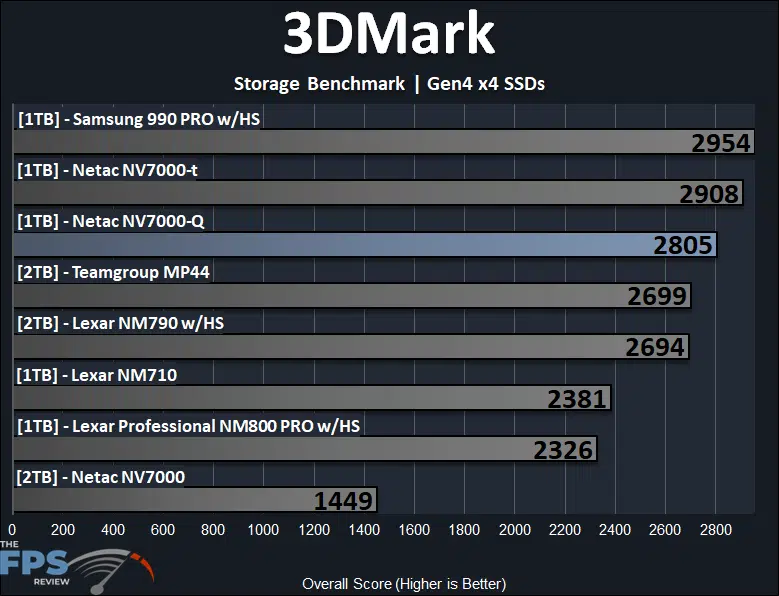
In our review, in the 3DMark Storage Benchmark, the Netac NV7000-Q 1TB PCIe Gen4x4 NVMe SSD performs quite well in 3DMark’s storage gaming-based benchmark. At a score of 2805 the Netac NV7000-Q is an impressive 94% faster than the Netac NV7000 2TB SSD, showing a big difference in these game-oriented benchmark traces. The Netac NV7000-Q is also beating the Lexar SSDs, and even the Teamgroup MP44 by 4%. The Netac NV7000-Q seems to be 4% slower than the Netac NV7000-t, sitting just under it, which isn’t too far off. The Samsung 990 PRO is the fastest SSD, but also the most expensive.
PCMark 10
We are using PCMark 10’s Full System Drive Storage Benchmark. It outputs an overall score (higher is better) that is derived from the Bandwidth (higher is better) as well as access time (lower is better) results.
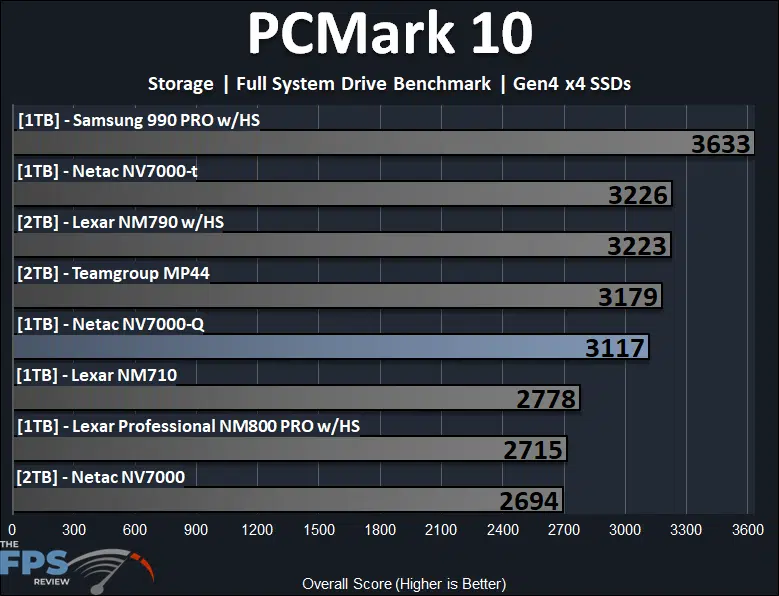
In PCMark 10’s full system drive storage benchmark, the Netac NV7000-Q 1TB PCIe Gen4x4 NVMe SSD is still faster than the Netac NV7000, this time by 16% in PCMark 10’s storage test. It is also faster than the Lexar NM710 and Lexar NM800 PRO, however, the Teamgroup MP44 does edge it out. The Netac NV7000-Q is only 3% behind the Netac NV7000-t, which is very close in performance, just slightly faster.
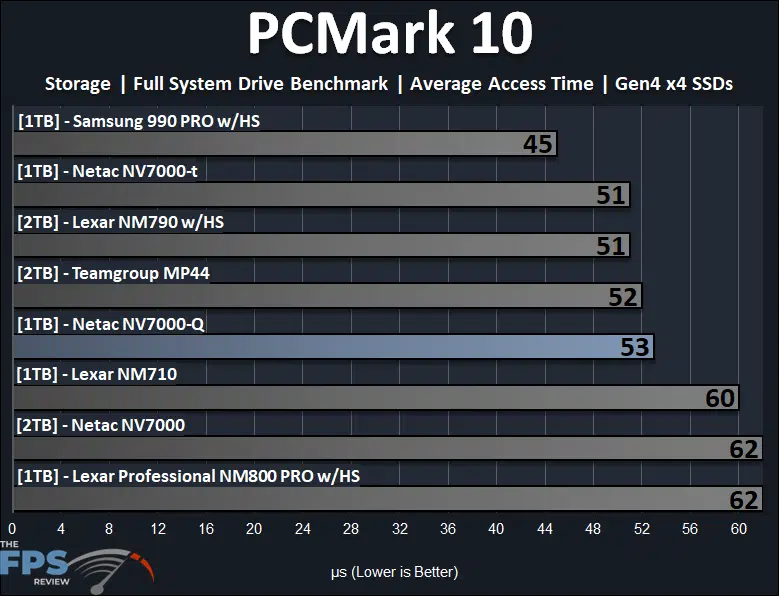
The average access time test in PCMark 10’s Storage Benchmark shows you a closer look at where things line up. The Netac NV7000-Q 1TB PCIe Gen4x4 NVMe SSD doesn’t have the fastest access times, but it is still very competitive and remains in the lower 50’s which is average and on par with many drives like the Teamgroup MP44, Lexar NM790, and Netac NV7000-t. The Netac NV7000-Q and Netac NV7000-t are once again very close in performance. We also see a nice improvement in access time compared to the Netac NV7000. The Netac NV7000-Q has a 15% decrease in access time compared to the Netac NV7000, improving upon that drive quite a bit.
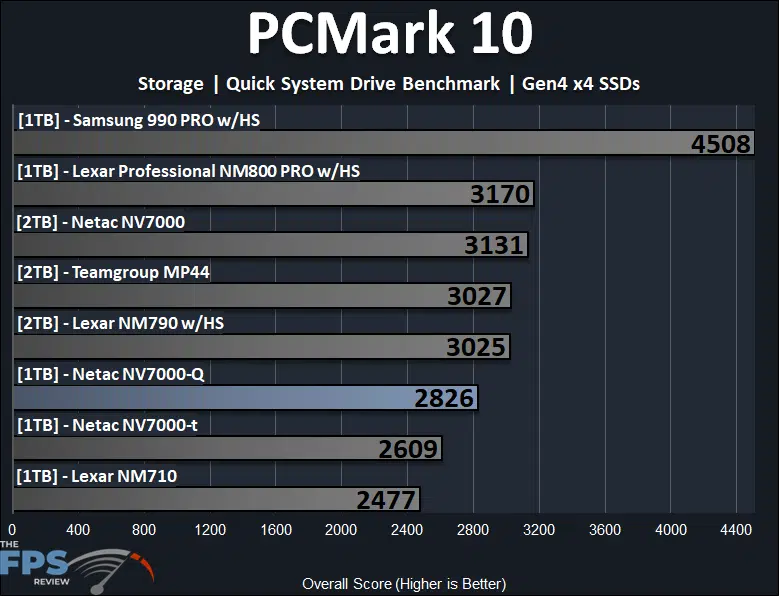
If there is one area where the Netac NV7000-Q 1TB PCIe Gen4x4 NVMe SSD falls behind, it is in the PCMark 10 Quick System Drive test which stresses small workloads that benefit from a DRAM-cache lookup table. The SSDs that lack a DRAM cache, rely on Host Memory Buffy, and this is where we see that realized. This is why the Netac NV7000-t and Netac NV7000-Q are trailing.
However, what you will notice is that the Netac NV7000-Q is ahead of the Netac NV7000-t in performance! That is the important part to note here, as the Netac NV7000-Q has a larger buffer for the controller, and with improvements, the Netac NV7000-Q is 8% faster than the Netac NV7000-t despite both not having a DRAM cache. Though, you can see SSDs that do have DRAM-cache are much faster, the Netac NV7000-Q is 10% behind the Netac NV7000.
PassMark PerformanceTEST
We are using PassMark’s PerformanceTEST Disk Mark benchmark only. This test benchmarks Disk Sequential Read, Disk Sequential Write, IOPS 32KQD20, IOPS 4KQD1 tests and outputs an overall score (higher is better.)
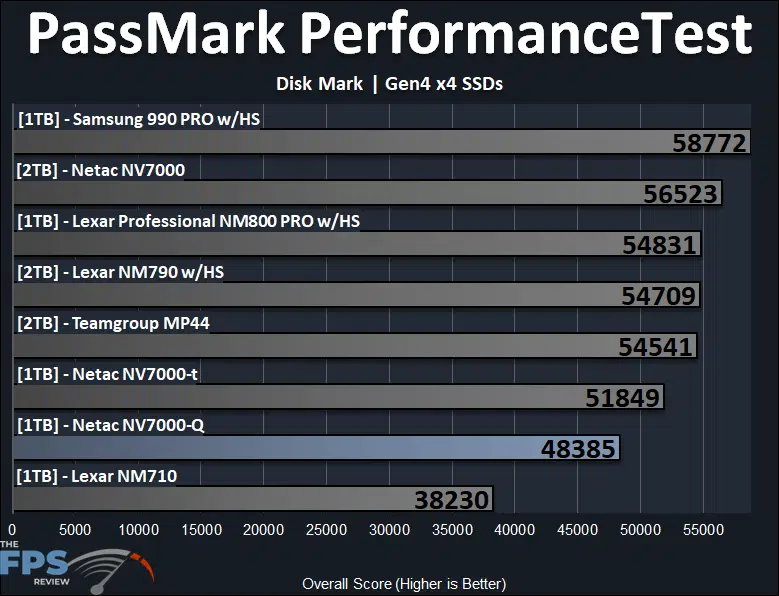
In PassMark PerformanceTest Disk Mark this benchmark takes everything into consideration, small workloads, large workloads, access time, and DRAM cache, and here the Netac NV7000-Q is behind the Netac NV7000-t by 7%, which is not a large amount. However, the Netac NV7000 is ahead by 17%.
Discussion (2 replies)
Join Discussion →More options are obviously great, but I have to admit, I am a little bit paranoid about losing my data, which is why I view drives from new brands with a lot of skepticism.
Heck, even more established brands have problems sometimes.
I mean yes, I backup all of my non-replaceable data. At least most of it, but it is still a real pain in the ass to have to re-install windows and reconfigure things when things go wrong.
I periodically dump drive images to my NAS, but realistically this does not happen every day, every week or even every month. When my 2TB Sabrent Rocket 4 died, I didn't lose any files (those were all on the NAS) but I had to revert to an 8 month old drive image. I had done some config changes since, and had some game progress in my user folder that I ultimately lost.
The biggest annoyance was the downtime. I decided to not wait for Sabrent's RMA, and just went and bought a Samsung 990 Pro at Microcenter to get myself going again immediately. When I got the Sabrent Rocket 4 back, I had some trust issues, so I only used it as a Steam library drive, figuring that if it died, worst case I'd leave my machine on overnight and download everything again. That was a good call, as that RMA drive started failing as well, and is no longer in use.
Which brings me back to Netac. Maybe they are good, maybe they aren't. This review isn't bad, but who knows what will happen after 2 years of use? I don't know. Some might trust them just because they use established Phison reference drives, but so was the Sabrent Rocket 4....
Back before I bought eh Sabrent Rocket 4 I had a philosophy of only trusting two SSD brands. Samsung, and Intel. Every other drive from every other brand I had tried (especially OCZ) had failed on me within two years. This was back in the SATA era though. The companies and controllers have changed since then, and this dataset is likely no longer relevant. Especially since Intel sold its SSD brand to SK Hynix, and Samsung has had some high profile firware bugs in its 980 Pro and 990 Pro drives causing extremely premature drive ware. (Some have also had some real problems with Samsung NVMe drives in Windows Server for some reason)
This requires establishing a new rule of thumb, which is still maturing for me.
If I require a drive that is high performance, I will probably stick to a brand that designs, develops and uses their own controllers.
Crucial/Micron, SK Hynix, WD/Sandisk, and yeah, Samsung (though with less confidence than in the past).
Samsung drives still perform better than anyhting else out there on the market (other than discontinued Optane drives) likely in large part due to very high 4k random read performance.
If Intel's Optane DC 5800x drives ever come down in price to more sane levels, I'll be snapping up one of those too.
I have yet to test any Crucial/Micron or SK Hynix drives, though I want to at some point. I have been putting a pair of 4TB WD Black SN850x drives through their paces, and they seem very reliable and perform well. This may become a go-to brand for my NVMe buying in the future.
As for these budget brand engineered Phison reference design drives, they have their place.
I've actually had really good luck with my twelve old Inland Premium drives ranging in size from 256GB up to 2TB. I have absolutely hammered them without ever having a bad issue, and no eexcessive drive wear. They appear to be reference Phison E12 drives manufactured by Team for Microcenter (Inland is Microcenters in house brand) The Inland Premium drives had a very good reputation out there on the forums though, which is why I was willing to give them a chance. Sadly, while there are other rebadged Inland branded reference drives, the "Inland Premium" models which were well regarded seem to ahve been discontinued.
As for other budget unknown brand reference Phison design drives, I'd probably only use them as a Steam library drive on a cheap gaming system. At least unless associated with the large volume of positive long term reviews from actual users on forums I trust the Inland Premiums got. That minimises risks.
Brent, this looks like both the flash and the controller (and its firmware) are produced in China by a Chinese company, correct? They've got the whole stack in house, a la Samsung?
Also nice to see QLC flash being mostly competitive outside of sustained high-speed write scenarios, which is useful for most consumers when price is a factor.