

The Ryzen 9000 Series, a new lineup of desktop processors powered by the Zen 5 architecture that is now available to gamers, creators, and other users at a starting price of $279, may deliver substantially higher performance in Windows under a system administrator account, according to new gaming benchmarks that have surfaced online. News of what’s been described as a “potential bug” arrives on the heels of some advice that AMD has reportedly sent reviewers, one that suggests reviews of Ryzen 9000 Series processors should be performed on clean Windows installations to ensure proper provisioning.
One user has warned:
- “I cannot stress this enough, you don’t want to use the system administrator account as your daily driver.”
- “You become significantly more vulnerable to malware for even having that account enabled, and if you do somehow get infected with malware, it becomes easier for said malware to affect protected system files.”
- “If you do anything important on your PC, it’s not worth the performance gains.”
That said, a look at the potential performance gains in one popular game:
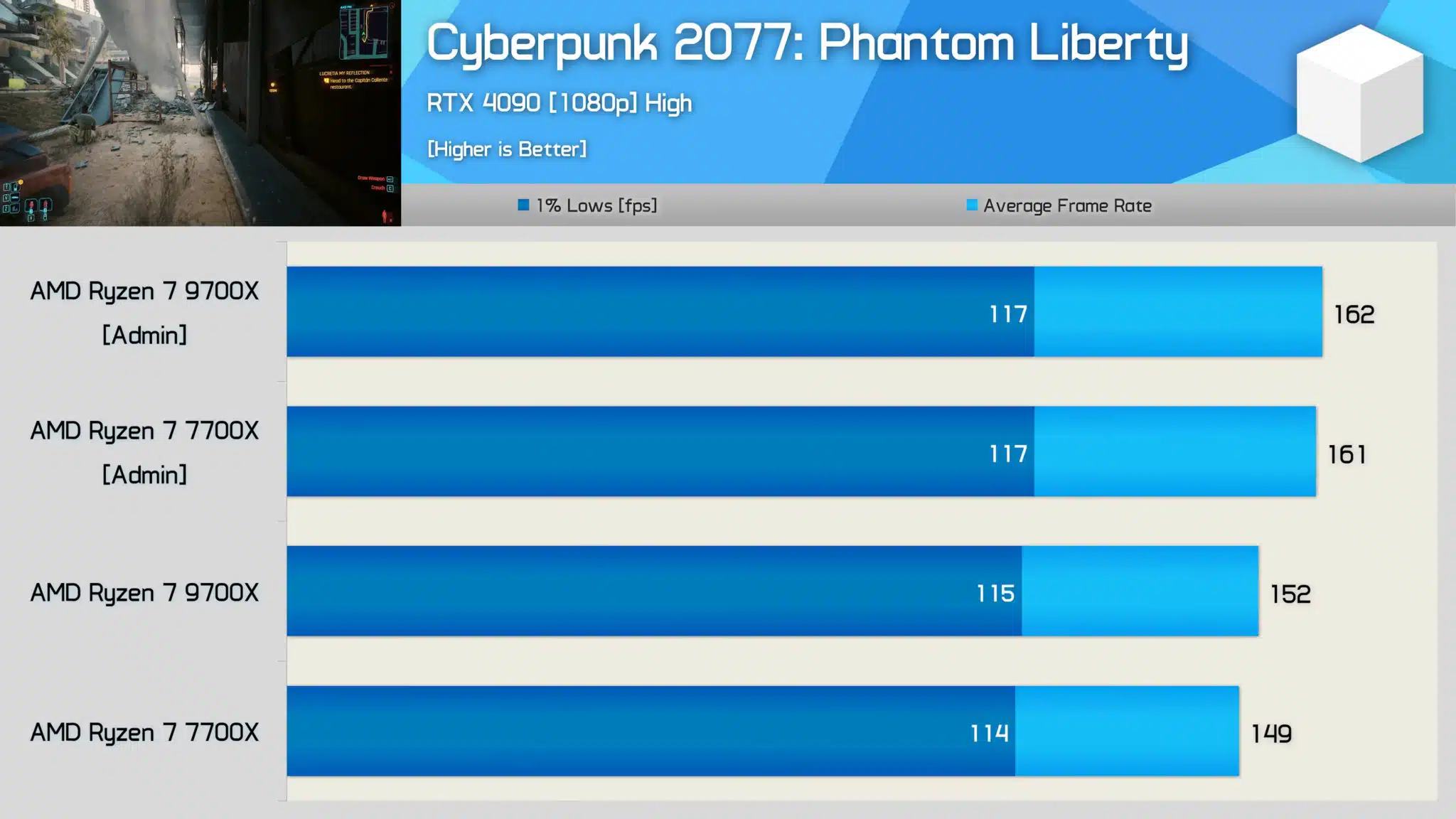
The original word from Hardware Unboxed:
A note from AMD:
- “Unfortunately, sometimes Windows does not apply the correct provisioning after the CPU installed has changed. You can try uninstalling then re-installing the AMD Chipset Driver as a workaround, but a fresh install of Windows is ideal.”
- “Please make sure to restart then wait for the system to idle so that the provisioning installation may complete. For the review purposes we highly recommend performing a clean Windows installation to ensure the provisioning is applied correctly.”
- “It may save time to have a separate SSD/image for the 9950X/9900X, and 9700X/9600X, so you don’t have to reinstall windows every time you switch between a single CCD and dual CCD configuration while benchmarking.”
- “We recommend using Cyberpunk as a sanity check. Using a 4090 you should be getting -210FPS with the 9950X and -200 FPS with the 9900X.”
The original word from @aschilling:
For some testers an incorrect provisioning might have hurt performance of the Ryzen 9 9900X and 9950X. @AMDRyzen gave the following advice to tester: pic.twitter.com/wagUlanW9y
— Andreas Schilling 🇺🇦 🇮🇱 (@aschilling) August 15, 2024
AMD on its new CPUs:
For avid gamers seeking the ultimate competitive edge, AMD Ryzen 9000 Series desktop processors deliver unrivaled performance, enabling smooth gameplay and high frame rates across a wide range of titles, from AAA blockbusters to esports favorites. Moreover, professional content creators can now harness the full potential of their creative workflows with AMD Ryzen 9000 Series desktop processors. From 3D modeling and design to animation and product visualization, these processors offer exceptional single-threaded and multi-threaded performance, enabling users to design, render, and iterate faster than ever before. Put simply, the flagship Ryzen 9 9950X CPU is the fastest consumer desktop processor.
Discussion (8 replies)
Join Discussion →WTF? How does that even work?
Are people actually doing stuff on their personal PC's with accounts that don't have administrator rights?
Sounds like they're trying to find any performance excuse they can with these new processors.
Sounds to me like drivers are being installed by a non administrator and permissions are borked. But that's just 30+ years of it experience. I could be wrong.
Yeah I agree with you there. It just seems one thing after another with these new AMD processors that hinder performance is all I was pointing out. I haven't paid too much attention to them myself, but a lot of negative press out there.
I think the negative press is being highlighted but from the technical perspective these seem really solid. And my gut tells me the new chipsets will really unlock them. Not sure why.
Lackluster performance is at least somewhat related to Windows. Linux is seeing better numbers pretty much across the board. I'm talking about software which runs under both OSes and can be directly compared. This isn't a surprise to me as quite a bit of software over the years has shown to run better on Linux.
During the cooler months of the year I run distributed computing programs and most of them run better under Linux and often to the amount of 10%-20% faster than Windows for the exact same hardware. This is for CPU and GPU work.
Much of it has to do with people not understanding a few things. The 9000 series is more power efficient and better IPC. Any decent review should have pointed out that the 9000 series doesn't boost as high as the 7000 series when under a multi-core load and yet is able to meet or beat the 7000 series. If memory serves the clockspeed difference tends to be around 10% lower for the 9000 series. Yet most people don't understand that or refuse to take it into account. We know we've basically hit the limits of what they can do with silicon with regards to clockspeed and I suspect Zen 5 is a sort of soft reboot to address that.
I wouldn't count on seeing any new performance with the new chipset. Based on everything I've read there's nothing new and is basically a re-badged x670. Maybe there's some better engineering with new boards but it's unlikely they'll have much of an effect on performance.
It's mostly due to the lwered TDP numbers, AMD is supposedly working on an update where they increase the base TDP from 65W to 105W which should improve their numbers somewhat, I seen benchmarks where they unlock PBO and they boost to 135W which get's good results, but is obviously bad for temps, the 105W seems to be a decent middleground.
Will see how it turns out, though I have to admit I'm all for lower temps and will take similar performance for better temps.