
6G, a sixth iteration of the long-standing technology standard for cellular networks, may be fast enough to allow users to download more than 20 movies in a single second, according to a recent test conducted by researchers at University College London, one in which the team managed to send data at speeds as high as 938 Gbps over a 6G network. This level of performance is reported by some to be 9,000x faster than 5G, which launched eight years ago, in July 2016. An abstract for the research that can be found in Journal of Lightwave Technology, including a diagram of the bands involved, can be found below.
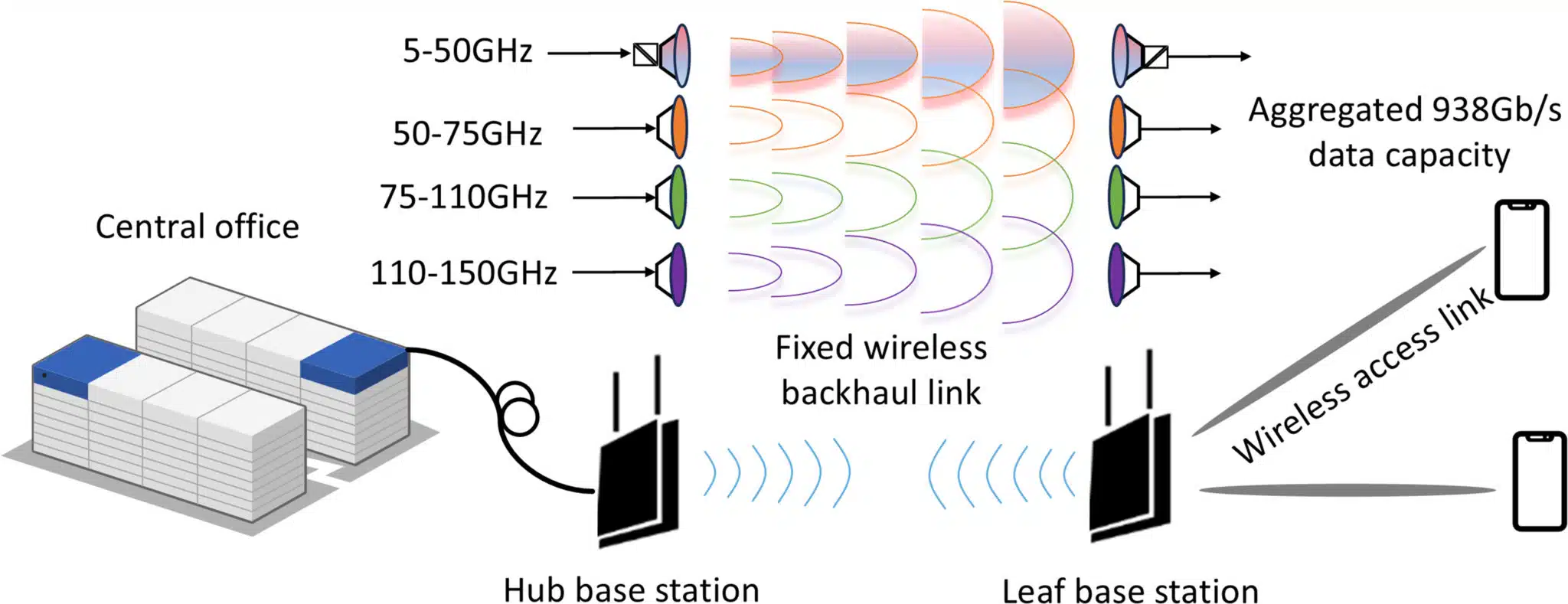
…we demonstrate an ultra-wide 145 GHz bandwidth wireless transmission of orthogonal frequency-division multiplexing (OFDM) signals over the air, covering 5–150 GHz frequency region. This is achieved by combining the merits of high-speed electronics and microwave photonics technologies. Specifically, the signals over 5–75 GHz are generated using high speed digital-to-analog converters. The high frequency mm-wave band signals, including W-band (75–110 GHz) and D-band (110–150 GHz) signals, are generated by mixing optically modulated signals with frequency-locked lasers on high-speed photodiodes. By frequency-locking two pairs of narrow linewidth lasers and referring to a common quartz oscillator, we generated W-band and D-band signals with stable carrier frequency and reduced phase noise compared to free-running lasers, maximizing the use of spectrum. By using OFDM format and bit loading, we achieve 938 Gb/s transmission data rate with less than 300 MHz gap between different RF and mm-wave bands.
Discussion (7 replies)
Join Discussion →Good for them, that's awesome. I will herald the day 6G rolls out only to be greeted by LTE on my damn phone. ?
938 Gbps from like 1 meter. The range and throughput drop off significantly over distance with these higher frequency standards.
That write up is for fixed point to point using focused lasers to transmit data... that in no way applies to peoples friggen cell phones.
it's not like we have devices that could handle that amount of data anyways, but always nice to see a new proof of concept, ket's just hope it leads to something that is usefull.
If this could be rolled out within 5 years it could be a game changer but I severely doubt that will happen. I wonder what the latency would be.
I'm with @Shotglass01 -- still on LTE in most places, if I even get signal at all. 5G was nothing more than a big buzz word to go sell new phones - hasn't really done anything for me.
It's kinda like new WiFi standards. Nice... but not really relevant until it's very old news and the next standard is the new buzzword.
5G coverage is spotty, at best, where I live but it's nice when I do have it. I forget the exact #'s but somewhere in the 20-40 Mbps range.