
Power Testing
On this page, we are going to investigate the Intel Core Ultra 9 285K and Intel Core Ultra 5 245K power draw. We are going to do this multiple ways, we are going to look at both the CPU Package Power, as well as the Total System Wattage (from the Wall). In addition, we are going to look at full-load Wattage and temps in Cinebench R23, pushing all cores, and we are going to look at Wattage and temps while Gaming, measuring CPU package power. The Total System Wattage tests (from the Wall) are run with a KILL-A-WATT meter. CPU package power and temps are read with HWiNFO64.
CPU Package Power – Cinebench R23
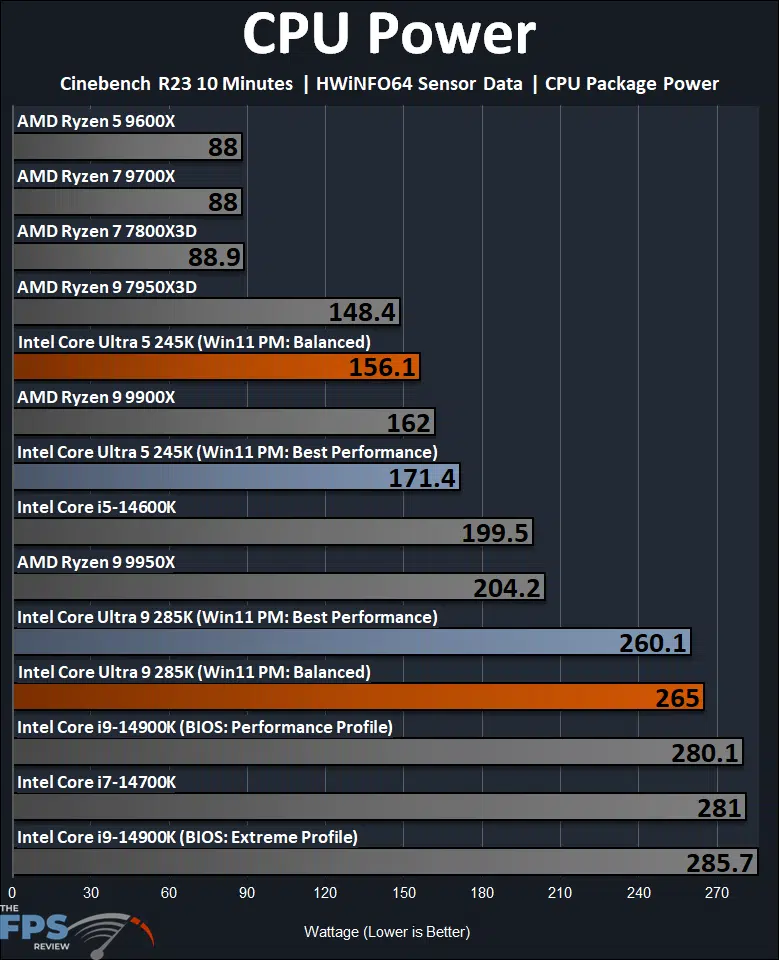
In this first graph, we are running a stress test, pushing each CPU to its maximum potential in all-core load in the Cinebench R23 multi-core test for 10 minutes. CPU package power is being read from HWiNFO64. In this graph, we can see that the Intel Core Ultra 9 285K and Intel Core Ultra 5 245K do show a package power difference between “Balanced” Power Mode profile and “Best Performance.”
The Intel Core Ultra 9 285K does seem to be consuming less power than the Intel Core i9-14900K, however, it isn’t a massive difference. We see around a 20-25W power difference with this full-load, all-core stress test. This shows that there is an efficiency improvement, but it isn’t enough to compete with the AMD Ryzen 9 class CPUs. The AMD Ryzen 9 9950X, in this same power test, uses 55-60W less power than the Intel Core Ultra 9 285K.
The Intel Core Ultra 5 245K does show an improvement over the Intel Core i5-14600K, with about a 28-43W less power demand depending on the Win11 Power Mode profile. This is, however, more power than the Ryzen 7 9700X and 9600X by 68-83W higher power demand. Therefore, the Ryzen 7 9700X and 9600X are more power efficient, even the 7800X3D and 7950X3D for that matter.
CPU Package Power – Gaming
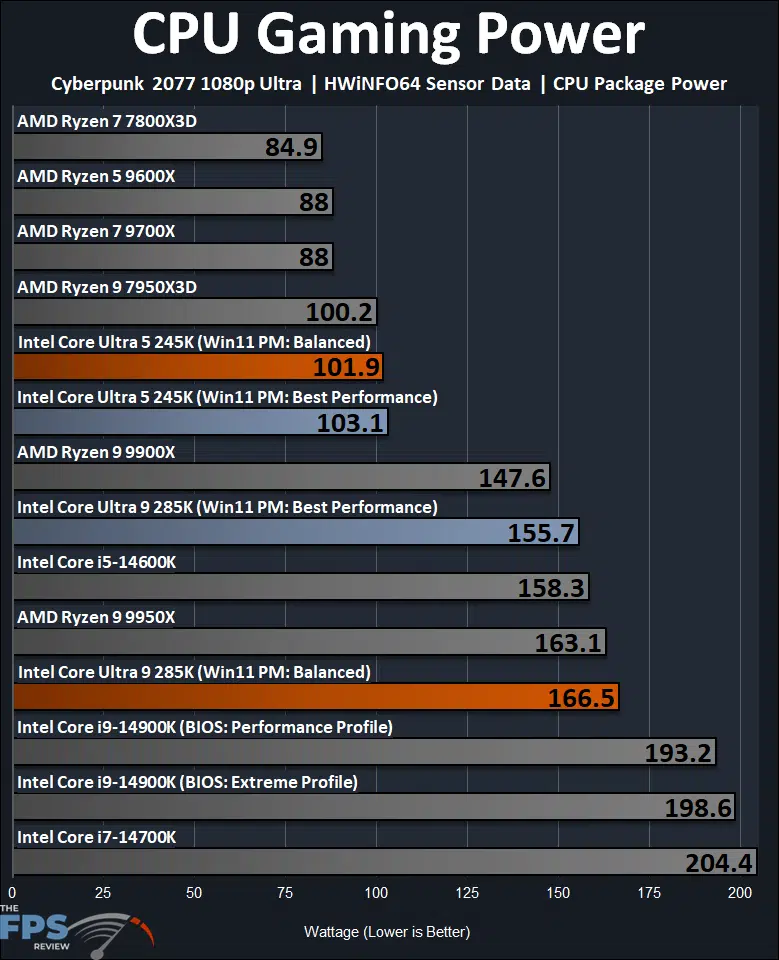
For this one we are running a game, in this case Cyberpunk 2077 with a manual in-game run-through. This is CPU package power reported by HWiNFO64. Once again, we see a difference in power usage depending on the Win11 Power Mode profile on the 285K, but not the 245K as much. The Intel Core Ultra 9 285K does use less power than the Intel Core i9-14900K, about 30-40W less power, so that is an improvement in power utilization, but as we saw in the benchmarks a much lower performance also.
The Ryzen 9 9950X used about the same power as the 285K in the Balanced profile, so those are almost on par with gaming power usage, the 9950X is a little less. The Intel Core Ultra 5 245K does use about 55W less power than the Intel Core i5-14600K when gaming, but again we also saw its performance. This is on par with the 7950X3D in power, but the 7950X3D is way faster in performance. The Ryzen 7 9700X and 9600X also use way less power while gaming.
What’s more impressive though is the Ryzen 7 7800X3D and 7950X3D, which just smash the power savings, and provide the highest performance in the game.
Total System Power – Cinebench R23
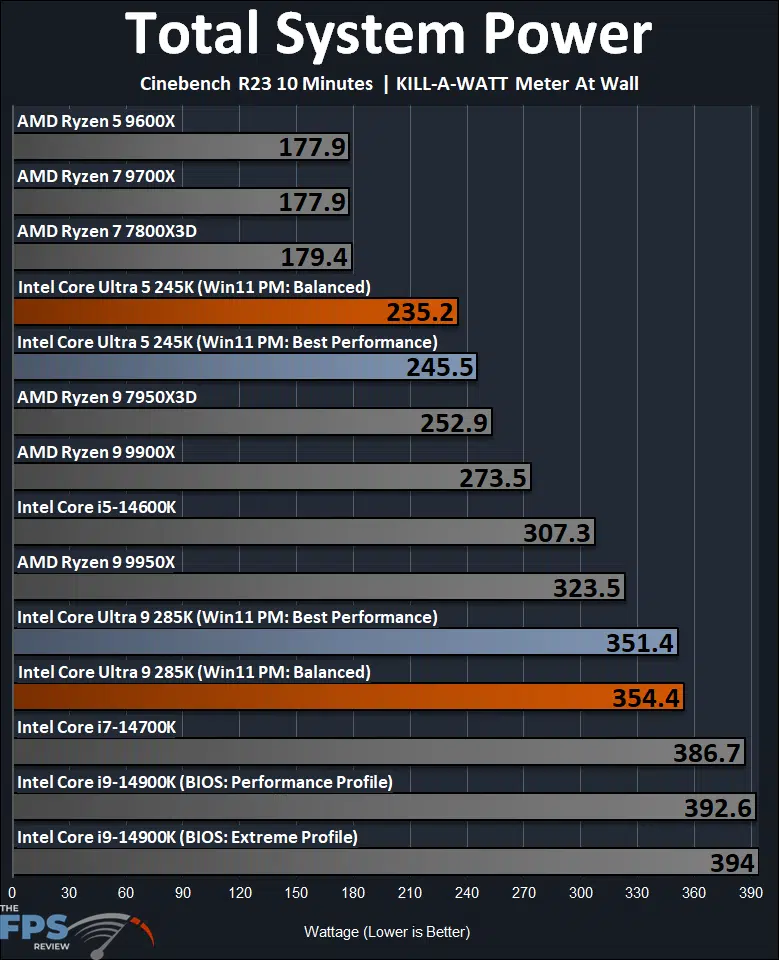
This one is interesting because we are measuring total system power, taken at the wall with a Watt meter. This is the total system Wattage running a stress test in Cinebench R23, therefore pushing all cores, full-load. If you were say, rendering all day long, this would show what the system Wattage would be pulling.
We can see that the Intel Core Ultra 9 285K results in less total system Wattage, with 39W less power than the Intel Core i9-14900K, which is about a 10% difference. The AMD Ryzen 9 9950X uses even less power than the Intel Core Ultra 9 285K saving 28W more power. This is about a 10% difference as well.
The Intel Core Ultra 5 245K does have a pretty big savings over the Intel Core i5-14600K at 60W less power, or a large 31% difference. However, the AMD Ryzen CPUs clearly take the lead in efficiency with the Ryzen 7 9700X and 9600X, or 7800X3D.
Idle Power
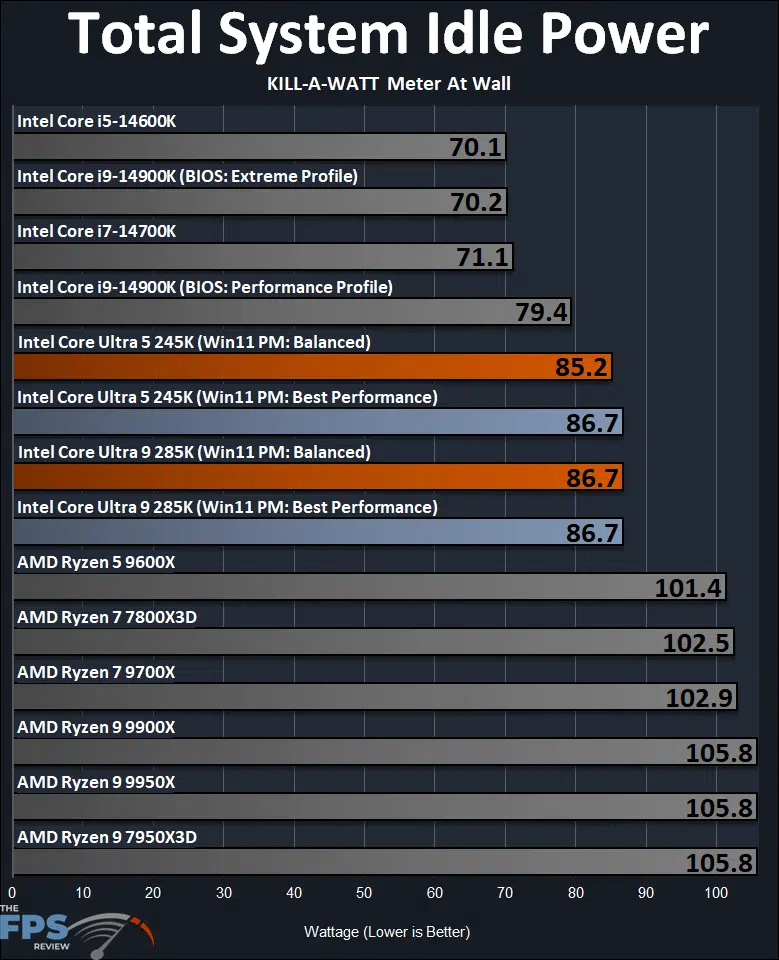
We also wanted to show total system Wattage at idle, because we did find the results interesting, so we are just passing this along. It seems the AMD Ryzen platform/CPUs did run at a consistently higher idle Wattage just upwards of 100W from the Wall, with the system just idling, doing nothing. This is much higher than the Intel Core i9, i7, and i5 which used the least amount of power idling at just around 70W. The Intel Core Ultra 200S series was somewhere in the middle, idling with higher Wattage than the previous generation, but still much less than the AMD Ryzen platform. This is perhaps something AMD needs to work on.
Discussion (19 replies)
Join Discussion →Those are some dissapointing results for gaming, kinda leaves me at an annoying point, 9800X3D is only an 8 core providing it launches when it's rumoured to (early november) rest is early next year and I don't realy want to go previous gen.
Also like I said in the other thread, the ultra 9 and 5 are already sold out at some outlets around here. intel still going strong (or no stock to speak off)
There are people who will buy Intel even when they have no logical reason to do so. I work with a guy like that. He won't buy anything else because of the reputation non-Intel CPU's had in the 1990's.
Gotta know supply to gauge demand...
My take: This is a transitional product that lays the ground work for future releases. This isn't remotely the first time Intel has done this. The Wilamette Socket 423 Pentium IV's were such a product. It introduced RAMBUS memory and they were often out performed by their Pentium III counterparts, especially Tualatin CPU's. The socket Northwood Socket 478 stuff was a lot better. The Prescott core CPU's were also kind of transitional as these were built with even deeper pipeline stages to ramp the clocks up even more. Their EM64T extensions were present on the core but weren't enabled (excluding one model) until the transition to LGA sockets.
Unfortunately, the only real benefit to these is that they shouldn't have any degradation and stability issues in games where as the 13th and 14th generation CPU's did prior to microcode updates and BIOS updates were created to mitigate them. Assuming your CPU wasn't degrading to start with.
Not competitive, high price, a short lived platform and Win 11 is a mess. Nothing ever works as intended at launch. What is wrong with these companies? Fumbling the ball at the 1-yd line seems to be the norm. Bush league overall...
@Brent_Justice - what I'm seeing about is that by decoupling the memory controller from the compute die, Intel has added latency to main memory access. Do we know if this is reflected in say AIDA64?
@Dan_D - looks like we're going to have to see if Intel can overcome the above latency issue the same way AMD did when they went to chiplets with Zen.
I think they can. How they would be able to mitigate this is unclear to me but this is the type of thing Intel is typically good at engineering their way through historically. Generally speaking, Intel's CPU's have not been effected by latency to the same degree as AMD's. AMD for one reason or another has always dealt with that to some degree. AMD's answer for the most part was simply to throw L3 cache at the problem which doesn't work in all scenarios.
Though throwing L3 cache at the problem is a simple fix, but its a costly one.
AMDs use of stacking for the L3 cache on a CCD, which in turn they can use for gaming SKUs as well as enterprise (which they originally created them for), is genius.
Imagine slow(er) Zen 3 and Zen 4 cores (both clockspeed and IPC vs. Alder/Raptor P-cores) not only outrunning them but also doing so at 1/2 the power draw for gaming.
Now imagine Intel P-cores backed up by enough L3 cache to make memory latency irrelevant.
I think Intel needs to copy AMD here (or emulate? imitate?) and find a way to get that cache in a die with broader market appeal (i.e. also usable in Xeons). Their chiplet setup should enable them to do so.
One thing that's been sticking in my mind with the Arrow Lake release is that this is the first time Intel has decoupled their memory controller from their compute dies since... Core 2? At least in the consumer space (so not talking about buffered DIMMs). AMD did with Zen 2 IIRC. Intel has been using IMCs since Lynnfield in the i7 870 from 2009, 15 years ago!
I'm not sure that this is even possible. I think there are probably scenarios where simply adding cache doesn't help.
Well, AMD had an integrated memory controller since the Athlon 64 days. However, Intel's Core 2 Duo/Core 2 Quad were the last CPU's to have an off-die memory controller. Though it was in the chipset at the time and not anywhere on the CPU itself.
I believe its two things:
1. Consumers buy products that suck on the promise that they will be fixed later
2. Development practices that involve the term: MVP (Minimum Viable Product)
Number 2 combined with number 1 just continuously lowers the bar for number 2.
Thanks, @Brent_Justice for the very detailed review of these CPUs and extra testing with both power modes. It's a shame that APO isn't supported for the games reviewed, especially since they are popular titles that users are likely to have in their libraries. I wonder if Intel will be able to provide updates later on which might improve those results. Really interesting how CB2077 has a prioritize P-core option that only further proved there are other potential gains to be had.
A lot to unpack with these and obviously Intel is experimenting with a number of strategies with them.
I will have more information in an upcoming review, but installing some DDR5 CUDIMMs 8400, but running at 8200 MT/s currently, AIDA64's Cache Mem latency result is 88ns this is at 8200MT/s CL40-50-50-128 CR2. I will have some memory comparison data in an upcoming article at 6400, 8200, 8400 and 8600 on this motherboard with this RAM kit, so stay tuned. But my first reaction is that this isn't bad latency, I think it was worse at the beginning of all this, but as new BIOS's have come out, latency has improved. MSI's fix notes state XMP and memory performance optimization with the new BIOS releases I'm using.
I really want an all P-Core option, an 8-Pcore only or 12-Pcore only CPU would be a great option for gaming.
I am NOT a fan of big.LITTLE / hybrid architecture on x86 desktops. Intel please give us P-core only options!
I would prefer only p-cores too, but due to the lack of HT would we not require like at least a 10 or12 core if you need 8 for games already.
I mean testing conditions is one thing, but a real everyday use system usually has more running in the background then just the bare minimum.