
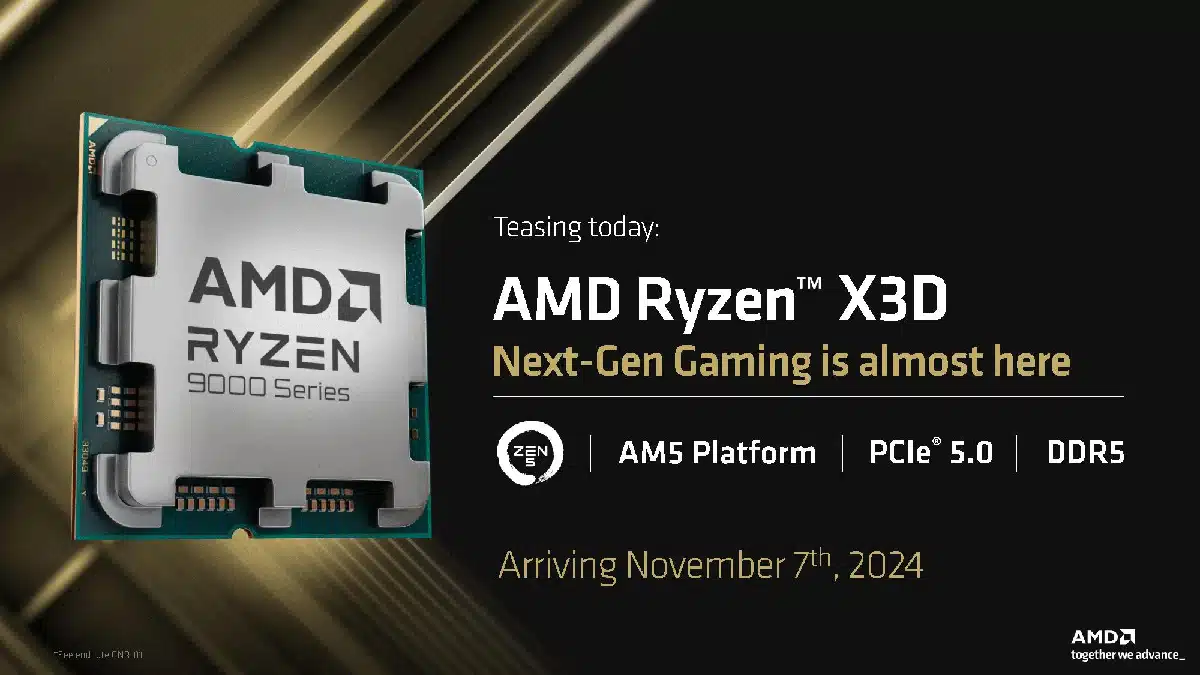
Despite only two weeks until release, the rumor mill continues, and it appears the AMD 9800X3D has yet more tricks to reveal. The AMD 9800X3D has been widely talked about over the last couple of months while rumors for the 9000X3D series continue to pile up this particular processor continues to have more spec leaks leading up to its release. The Rzyen 7 processor featuring Zen 5 technology is set to arrive on November 7 and while official pricing has yet to be announced, just about every other detail has seemingly been leaked.
3D V-Cache is now underneath?
First up is a rumor regarding the package design for the 9800X3D. In what could arguably be a facepalm moment for some it is rumored that AMD has re-engineered the 9800X3D by reversing the layering of the CCD and 3D V-Cache (aka L3D). By placing the CCD back on top, and directly under the heat spreader, it once again becomes easier to cool the CCD and opens the possibility for another rumor that has just surfaced. This rumor regarding the redesign comes via HXL, who has been nearly spot on in leaking many details regarding both the 9000 series and the 9800X3D in particular.
RPL-X
— HXL (@9550pro) October 26, 2024
L3D
—–
CCD
GNR-X
CCD
—-
L3D https://t.co/eaYCrB7qdV
Possible Full Specs Leaked
Next up are the potential full specifications for the AMD Ryzen 7 9800X3D. These come via overseas pricing aggregator Geizhals and while these do appear to be legitimate, we won’t truly know until the CPU is officially released. One very important thing to note, as it could relate to the above rumor regarding the CCD being on top of the L3 cache now, is that at one point the online pricing aggregator was spotted (via VideoCardz) as listing processor with having an unlocked multiplier which would allow for overclocking. This is something that has not been available for X3D processors thus far. However, a recent check of Geizhals website shows that detail is now removed.
The other detail that seems odd is the pricing which originally put it at ~$267 and then dropped to ~$258, something that seems nearly impossible given the launch prices for the 5800X3D and 7800X3D, and recent rumors have also suggested that consumers should prepare for an increase and not a nearly half-off discount. In fact, while this story was being put together an overseas etailer has just listed it at ~$448-$558 (with or without VAT after the current rate conversions).
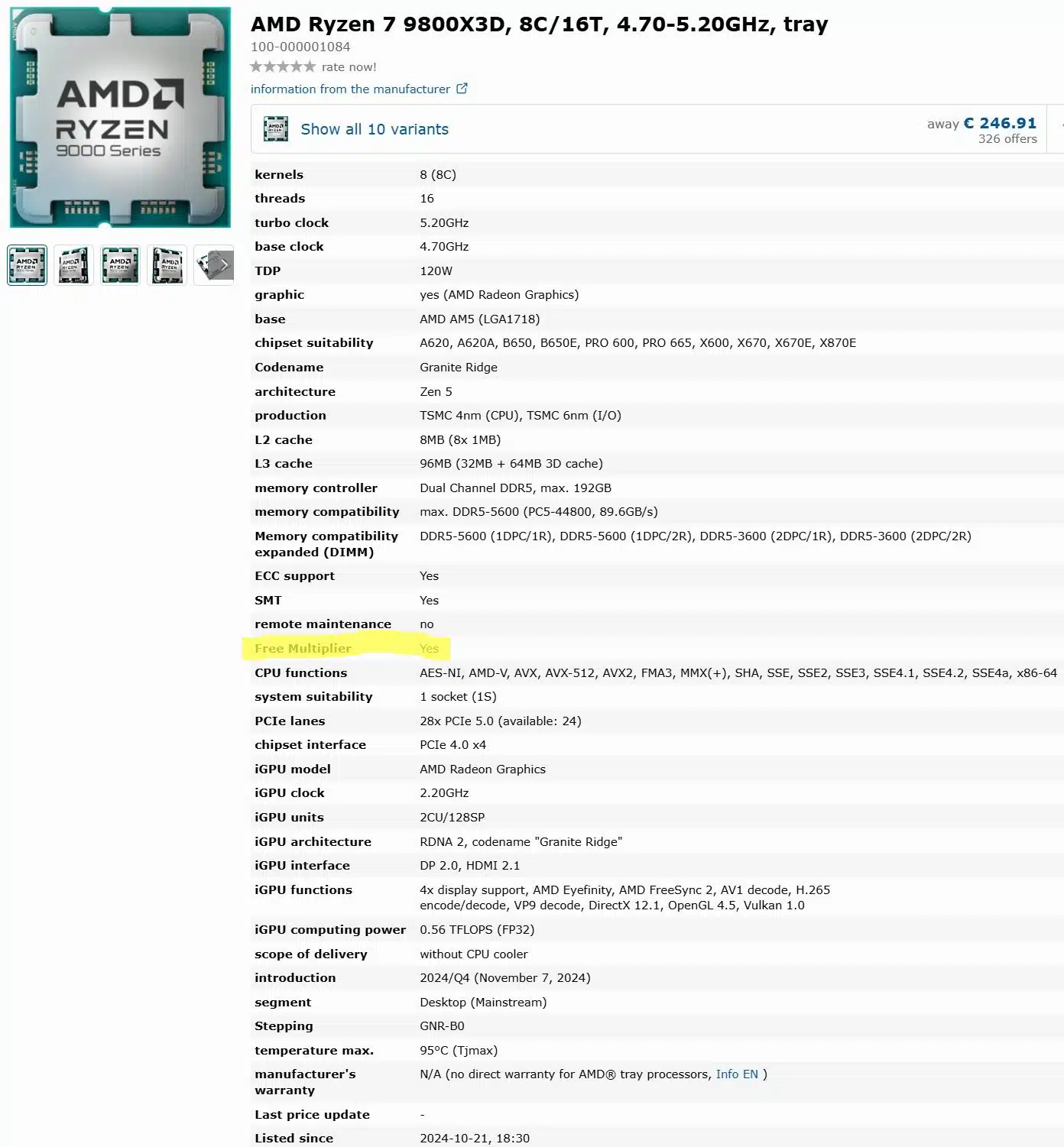
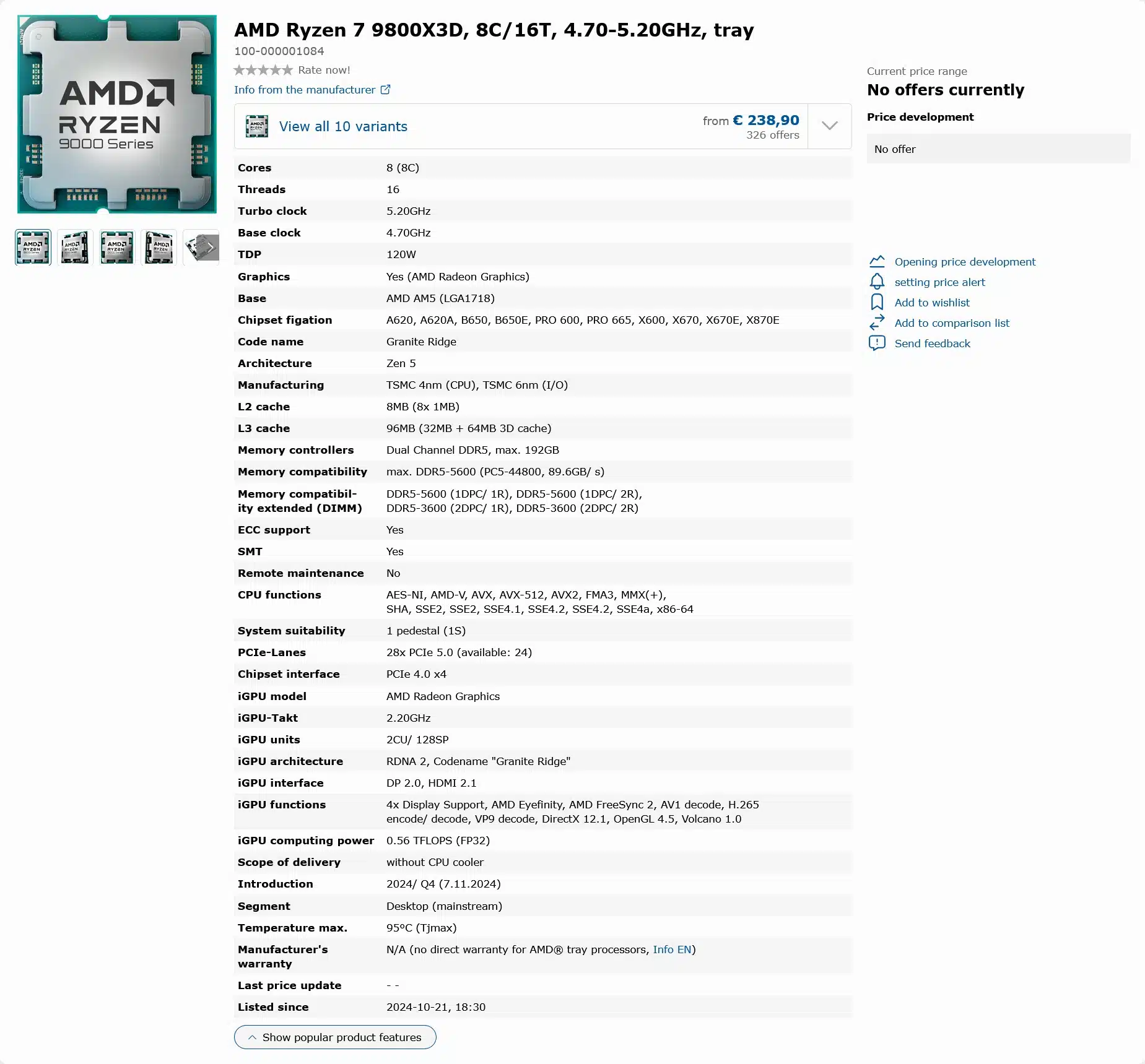
While an unlocked multiplier does remain a possibility there are some other interesting specs to look at. A 120W TDP with max thermal of 95°C seems reasonable as does recommended DDR5-5600 memory, and then support for 24 PCIe lanes. Motherboard support including A620 through X870E seems a given as well. An RDNA 2 iGPU feature 2 CU/128 SP clocked at 2.20 GHz is interesting for those who might not pair this with a dGPU, although that is hard to imagine given what the processor is designed for. Regardless, enthusiasm for the launch of the next-gen 8c/16t part is strong among the PC community who eagerly await its launch, as well as the 9900X3D and 9950X3D processors.
Discussion (19 replies)
Join Discussion →Yes the 3d vcache being below the main compute to allow clocks to not be throttled down is very interesting. I wonder if it impacts mounting pressure tolerances. Especially for those that delid.
Could be better, could be worse, right?
I'd hope for better (safer) personally :)
As mentioned in the other thread, there were serious hints that changes to the 3d Vcache were coming (combination of Zen5 chip layout making old layout unworkable, TSV (chip interconnect) mount points looking radically different in Zen5, and the fact that every leak about Zen5 X3D parts suggesting drastically improved performance over Zen4 X3D, despite regular Zen5 only having very minor performance improvements over regular Zen4, suggesting a large clock speed increase was coming.
I had guessed some new heat spreader design was incoming, but if these rumors are true, the actual solution is a big "duh" moment.
The old X3D design with the 3D Vcache on top made no sense at all. The Cache chips generated comparatively very little heat, whereas the main core (integer/FPU) silicon has very bursty high heat loads. It made no sense to bury the hottest part on the bottom further away from the cooler, and have the cool part near the top.
In my mind I'm picturing a meeting where some new guy (or gal) to the team raises his hand in a meeting about the issue of heat dissipation in stacked designs and is like "why don't we just switch the order, putting the hot one on top, and the cool one on the bottom?" followed by everyone smacking themselves on their foreheads wondering why they didn't think of that two generations ago.
I hope that person got a promotion :p
I'd assume that the 'hat' position was the easiest (safest?) to implement electrically / mechanically; it's a risky thing to do from a yields perspective I'd think.
Moving it to the bottom, then, is more a refinement that lets AMD sell higher-clocked stacked CPUs. Keeping in mind that these dies are going to Epyc SKUs first, there likely had to have been a market for such products for enterprises to make this change happen.
Not that I'm complaining!
Yeah, AMD has sold Epyc "X" SKU's with up to 800MB of total cache since Zen2/Milan.
[embedded media]
Well, only 2 weeks until they're out in the wild and we'll get to see real reviews. Can't wait but even doesn't matter if I want this or a 9900/9950X3D since there are no mATX boards out yet for the 800 series. I'd really like to get an 870 mATX but ASUS has a nice ITX already out.
Aren't the differences between the 800 series and 600 series chipsets mostly academic?
I vaguely remember reading that the only difference was that the added a 40Gb/s USB requirement?
Maybe I am not remembering that right, but it was something like that.
I remember reading that pretty much everyone had the take that X870E wasnt ready for the AM5 launch, but that didn't matter because X670E was pretty much identical apart from the 40Gbps USB requirement.
The Realtek USB4 chipset that they're using now wasn't ready; those that had USB4 or TB4 were using the Intel chipset for the 600-series boards.
Pretty much. USB4 and PCIe 5.0 for the GPU. Currently not a big deal but this is likely going to be a rig I'll be using going into retirement (6 years on the horizon) so making a solid choice now will have long term positives down the road.
also forgot PCIe 5 x 4 drive slot
So who has any experience with these mobo's that you can flash without CPU installed? If I go the 9800X3D route I need to get it working too.
Atm mostly leaning rowards Gigabyte > Asus > Asrock/MSI but Gigabyte's seems spotty at best.
[URL unfurl="true"]https://www.phoronix.com/news/AMD-Ryzen-7-9800X3D[/URL]
So it is true after all: "This uses 2nd Gen AMD 3D V-Cache where the 64MB of cache is now underneath the processor cores so that the CCD is positioned closer to the heatsink/cooler. The intent is that the new 3D V-Cache processors will run cooler than prior generation 3D V-Cache processors."
Is that possible? Interesting. I know AMD used to ship out a bios upgrade kit if you requested but that was a while back
More premium motherboards have had this for a long time.
The actual steps to make it work vary, but usually you have to format a USB stick a particular way, and put the intended bios update on it in the exact location, with the exact filename specified in the instructions, and then stick the USB stick in the exact USB port the manual tells you to, and then you fire it up.
I can't remember how you know when it is done. Maybe some LED indicators on the motherboard? I havent done this in a long time.
Here is the Asus page on the topic, but each manufacturer will differ.
Here is what the manual says for my Asus ROG Zenith II Extreme Alpha:
As for which one to buy, I have no idea. I have very clear memories of doing this once, but I can't for the life of me remember where or when, what system it might have been on or what motherboard it may have used.
I would definitely download the manual for the board you are considering and read it before buying, as it is hit or miss which boards support this.
I think it is slightly expensive to add it, as they need to add a secondary small embedded CPU to the board to handle the flash process. These tiny embedded CPU's are not expensive, but costs add up, so at least traditionally these things have only been offered on Server and Workstation boards that have IPMI/BMC and very high end consumer boards.