
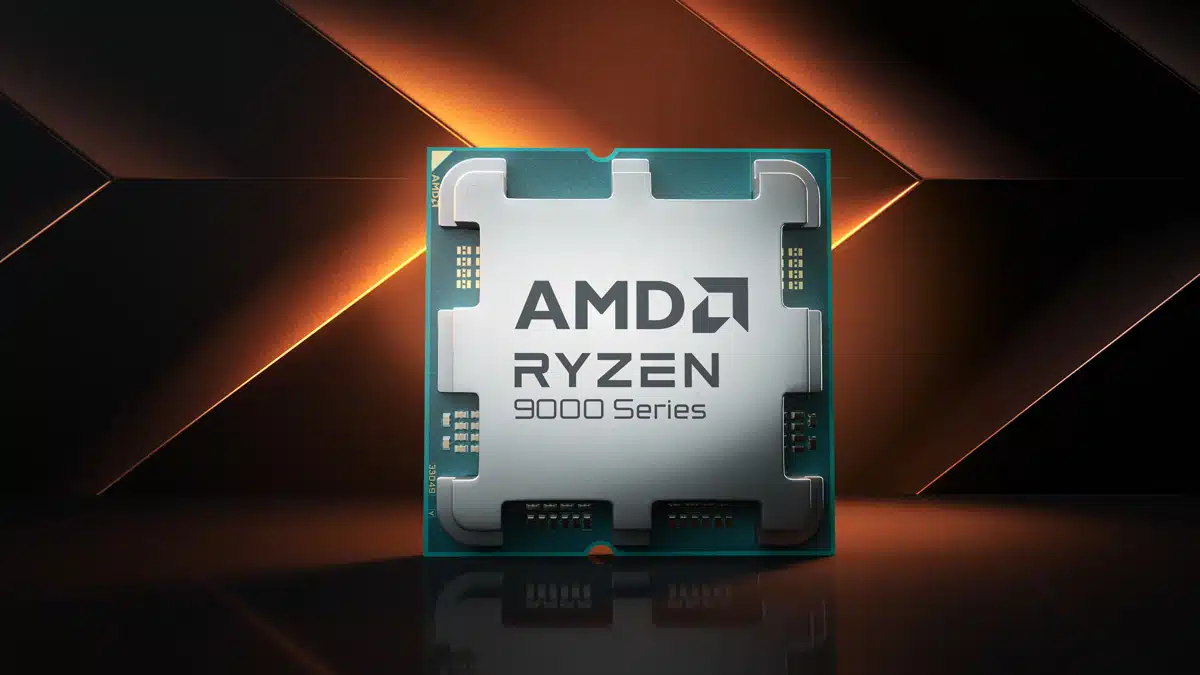
Reviews for the AMD Ryzen 7 9800X3D have been rather positive, with our own Brent Justice calling red team’s first “Zen 5” desktop processor with 3D V-Cache “the definitive gaming CPU”—but some parties don’t seem to be nearly as excited. UserBenchmark, for one, has posted a small write-up for the 9800X3D, telling people not to spend money on gaming CPUs because that’s “often pointless,” reasoning that “games are generally limited by the GPU in real-world scenarios.” The website, which describes itself as one that is run by an independent team of scientists and engineers, has recommended CPUs like Intel’s 13600K and 14600K instead, in that they deliver “almost unparalleled real-world gaming performance” for a significantly lower cost.
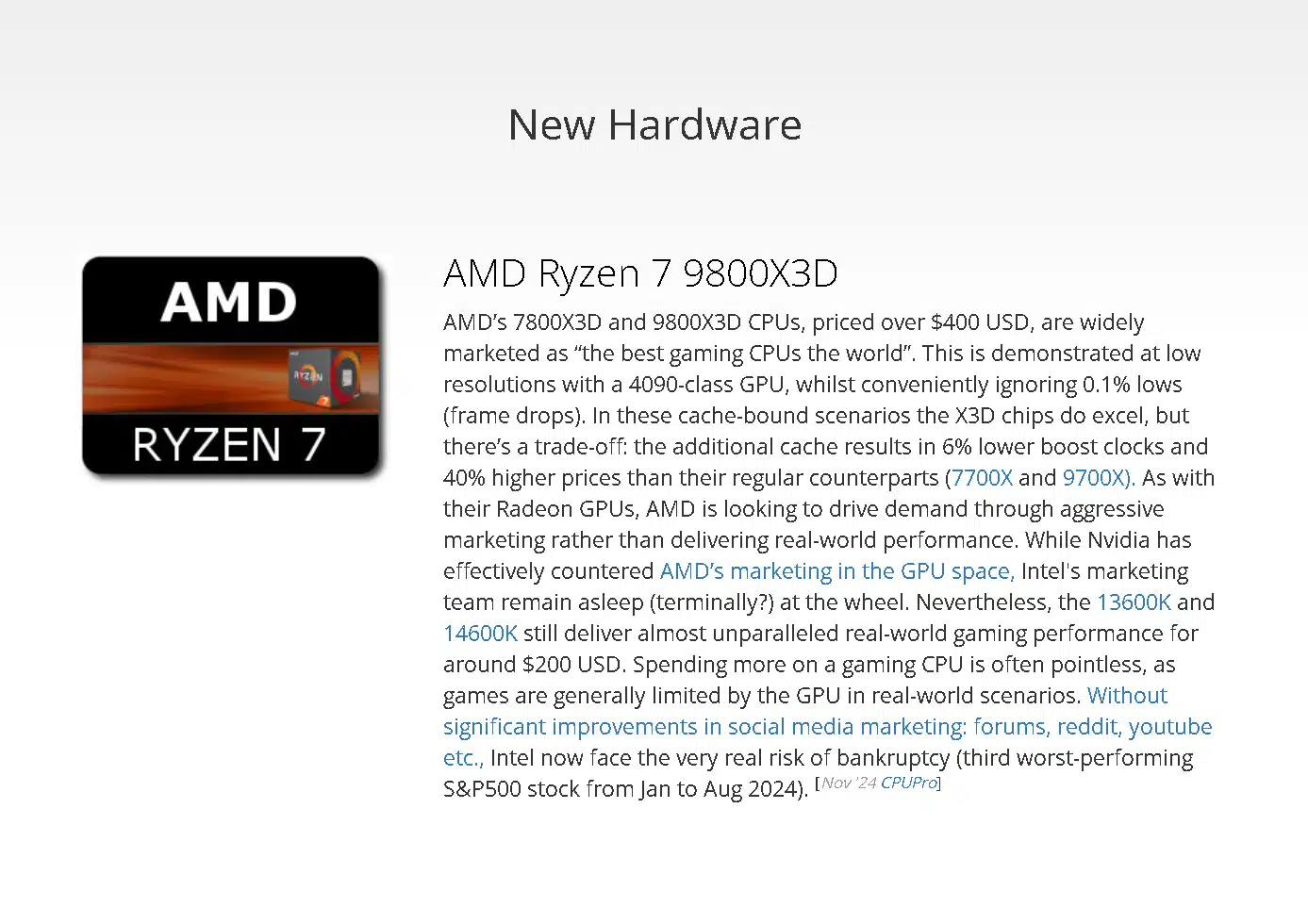
AMD’s 7800X3D and 9800X3D CPUs, priced over $400 USD, are widely marketed as “the best gaming CPUs the world”. This is demonstrated at low resolutions with a 4090-class GPU, whilst conveniently ignoring 0.1% lows (frame drops). In these cache-bound scenarios the X3D chips do excel, but there’s a trade-off: the additional cache results in 6% lower boost clocks and 40% higher prices than their regular counterparts (7700X and 9700X). As with their Radeon GPUs, AMD is looking to drive demand through aggressive marketing rather than delivering real-world performance. While Nvidia has effectively countered AMD’s marketing in the GPU space, Intel’s marketing team remain asleep (terminally?) at the wheel. Nevertheless, the 13600K and 14600K still deliver almost unparalleled real-world gaming performance for around $200 USD. Spending more on a gaming CPU is often pointless, as games are generally limited by the GPU in real-world scenarios. Without significant improvements in social media marketing: forums, reddit, youtube etc., Intel now face the very real risk of bankruptcy (third worst-performing S&P500 stock from Jan to Aug 2024).
Discussion (1 reply)
Join Discussion →Look,
They are not wrong that right now, most people who play at sane settings are going to be GPU limited, and won't notice a difference between almost any CPU, i5 or Ryzen 5 or higher, manufactured in the last two - three generations.
The competitive eSports kiddies are the exception. They already turn down settings and resolution as far as they can to get every last bit of "edge" in a game...
Technically these are probably the only people who "need" a high end CPU for games.
But these CPU's are great for longevity as well.
The system you build today will not only play today's games, but also the games of the next 2-5 years, maybe even close to 10 if you really like stretching things.
I mean, the difference between a high end "gaming" CPU and an alternative is - what - about $200? Whats $200 for a little peace of mind that the CPU won't hold you back for a good long while?
Interestingly, in April 2022 when the 5800x3d launched, you'd pay about $449 for it. At the same time an Intel Core i9-12900KS would run you $738.
That 5800x3d is looking way better today than the 12900KS, and that assessment only grows if you compare the 5800x3d to a more pedestrian $249 CPU from 2022, like a Core i5-12600.
The truth is, you can spend $200 more, and just keep your motherboard and CPU for years, and drop in a GPU upgrade when you need it. It makes life easier.
The future-proofing argument used to be a losing one in computing 20 years ago, but these days these things are more durable, and it really does work. At least on the CPU side.