

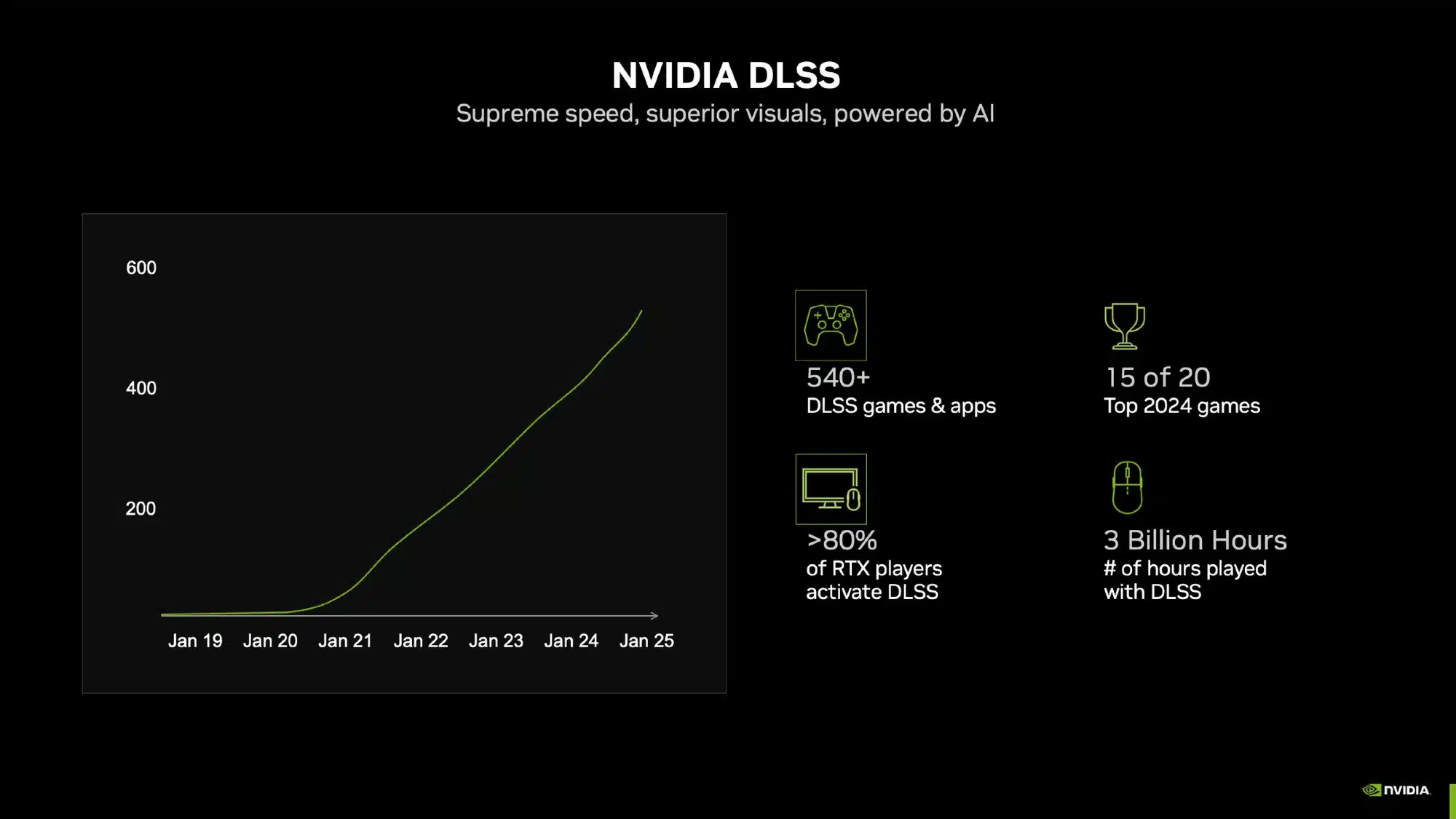
Deep Learning Super Sampling (DLSS), a suite of neural rendering technologies that NVIDIA continues to describe as being “revolutionary,” using AI to boost FPS, reduce latency, and improve image quality since its introduction alongside the GeForce RTX 20 Series in 2019, is now used by over 80% of players with GeForce RTX GPUs (i.e., the GeForce RTX 20/30/40 Series), according to new statistics that NVIDIA has shared as part of a new slide deck that provides fresh insight into one its premier gaming technologies.
“Over 80% of RTX players activate DLSS,” NVIDIA said for its technology that is advertised as offering “supreme speed” and “supreme visuals,” complemented by some other positive stats that include there now being over 540 games and apps that support DLSS. “15 of 20” of last year’s top video games also feature support for DLSS, NVIDIA added, while “3 billion hours” have been spent by gamers playing titles with DLSS enabled.
“We’re advancing DLSS once again with the introduction of DLSS 4, featuring Multi Frame Generation for GeForce RTX 50 Series graphics cards and laptops; 75 games and apps will have support for Multi Frame Generation when they’re released,” NVIDIA wrote earlier this month to promote its latest GPUs, which are built on the Blackwell architecture and are on track to begin rolling out at the end of January.
“DLSS Multi Frame Generation generates up to three additional frames per traditionally rendered frame, working in unison with the complete suite of DLSS technologies to multiply frame rates by up to 8X over traditional brute-force rendering,” NVIDIA explained. “This massive performance improvement on GeForce RTX 5090 graphics cards unlocks stunning 4K 240 FPS fully ray-traced gaming.”
Discussion (5 replies)
Join Discussion →While I think the figure may be correct, I think it only applies to DLSS not Frame generation.
I always use DLSS in pretty much all my games that support it and it has gradually evolved over time. Supposedly DLSS4 has even better IQ, (some people say IQ with DLSS performance mode rivals DLSS 2 quality mode) and a slight performance increase.
I would guess, since we are using random percentages from invested sources, that over 70% of players on GeForce RTX GPUs just roll with whatever settings the game defaults to, or whatever GeForce Experience/GeForce App sets for them, and don't make any adjustments -- and that they wouldn't know if they are using DLSS or not.
I almost never use DLSS. I only use it when I absolutely can't get decent performance in a game. The only time I've really had to do that was Portal RTX, which ran like @ss on my 3090, and only the crappiest-looking DLSS Ultra Performance mode got me to playable framerates. Now to be fair, my primary display is 1440p, so that's probably why I don't use DLSS much. What I use instead is DLAA. If I'm playing a game and it supports DLAA, then I'm turning that sh1t on. I f*cking looooove DLAA.
Is... is that true?!?!?!
Believe you me, it's not out of preference but necessity. nVidia hand in hand with Epic are ruining game optimization, and we get games that look worse or at least no better than 6-8 year old titles but require upscaling even on the latest HW to get acceptable frame rates.
This is what happens when you try to transition to technology doing the work that artists used to do then trying to layer artistry with technological solutions that people are still learning to understand.
Just give it to the Final Fantasy XIV team, they will digest it and figure out how to make it work... hell they might make it work on a freaking PS2.