
NVIDIA’s upcoming PC processor has been appearing in various benchmarks, and the RTX 50 series could be released around the holidays. The N1 and N1X processors are being co-developed by NVIDIA and MediaTek with the goal of offering a Windows-based CPU to compete with the latest generation of mobile processors, such as Apple’s M-Pro and M-Max series SoCs, Qualcomm’s Snapdragon Elite, and AMD’s Ryzen AI Max “Strix Halo” offerings. The N1X, in particular, has been said to crossover into both desktops and laptops, and could be the rival product NVIDIA needs to gain a foothold as it attempts to enter the PC/mobile sectors.
It appears that the N1X has been getting multiple tests with Geekbench, rumored single/multicore scores leaked last month, with the latest being for OpenCL. These benchmarks seemingly confirm certain specs for the still-to-be officially announced processor. This particular chip has 20 Arm CPU cores evenly split into two clusters and paired with 48 iGPU Blackwell SMs (similar to an NVIDIA RTX 5070).
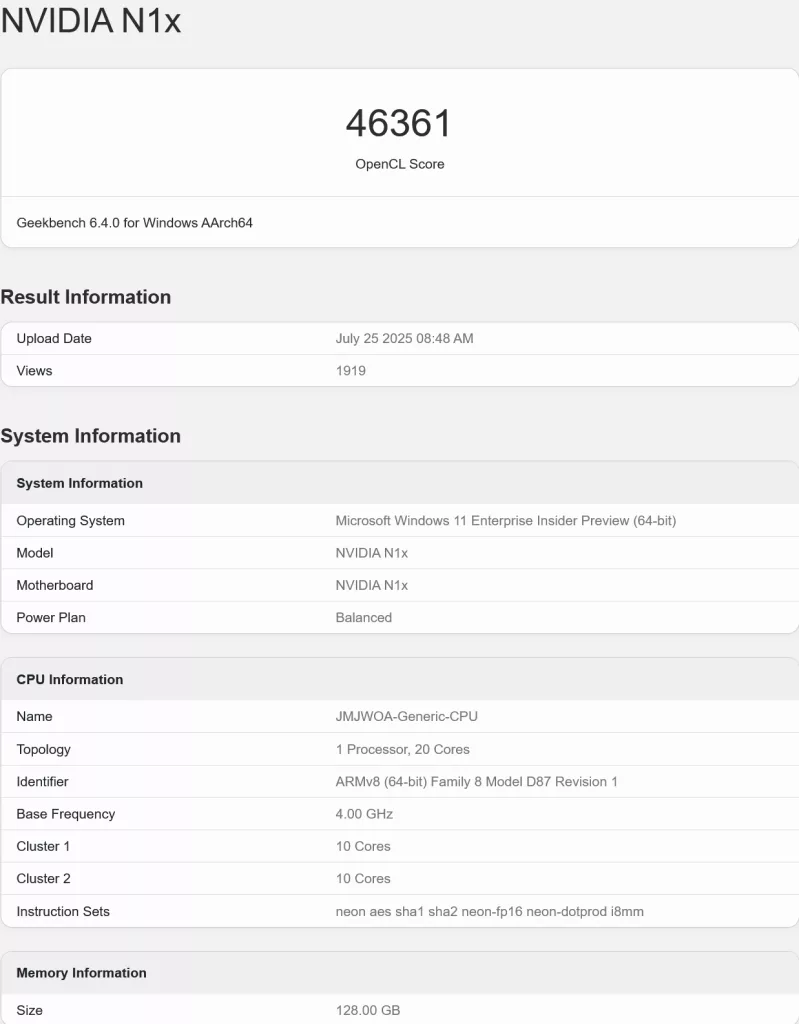
While the streaming multiprocessor count might be similar to a GeForce RTX 5070, another benchmark, also reportedly for the N1x, paints a totally different picture regarding performance. The good news is that NVIDIA appears to be integrating its latest drivers and has successfully managed to use the new processor in Windows. The first leaked benchmarks from June were on Linux, but now the above OpenCL test and a new OpenGL test (via VideoCardz), both show it working on Windows 11. However, according to the following FurMark test and using the NVIDIA 590.22 driver, it has only just managed to reach roughly half of the score for a GeForce RTX 5060 at 720p, but was reported at only using 63% of the GPU in the test. The iGPU is identified as a Tegra, but its generic name is identical to the one in the OpenCL test.
GeForce RTX 50 SUPER series
It’s unknown whether the following are the same rumors making the rounds and getting validated by different sources, as the latest via Tweaktown, appears to confirm those that surfaced last month. If true, folks hoping for more powerful upgrades to NVIDIA’s top-tier cards are out of luck, as only the mid-grade GeForce RTX 5070 looks to be getting upgrades beyond a memory increase. Both the RTX 5070 Ti and RTX 5080, which use variants of the same GPU die, are said to get a VRAM increase to 24 GB, and likely the reason for the added TDP ratings of each. Strangely enough, though only the RTX 5080 appears to be getting faster memory, which could potentially give it a slight performance uptick. Meanwhile, in a similar decision to what was done with the RTX 4070, the RTX 5070 sees a slight increase in CUDA Cores along with added VRAM and a modest 25W TDP bump. The latest rumors suggest that these GPUs could launch as early as the 2025 holiday season.
| Model | GPU SKU | CUDA Cores | GPU Boost Clock | VRAM Size-Type | VRAM Bus | Bandwidth | TGP |
| GeForce RTX 5080 SUPER | GB203-450 | 10,752 | TBD | 24 GB GDDR7 | 256-bit | 1,024 GB/s | 415 Watts |
| GeForce RTX 5080 | GB203-400 | 10,752 | 2,617 MHz | 16 GB GDDR7 | 256-bit | 960 GB/s | 360 Watts |
| GeForce RTX 5070 Ti SUPER | GB203-350 | 8,960 | TBD | 24 GB GDDR7 | 256-bit | 896 GB/s | 350 Watts |
| GeForce RTX 5070 Ti | GB203-200 | 8,960 | 2,452 MHz | 16 GB GDDR7 | 256-bit | 896 GB/s | 300 Watts |
| GeForce RTX 5070 SUPER | GB205-400 | 6,400 | TBD | 18 GB GDDR7 | 192-bit | 672 GB/s | 275 Watts |
| GeForce RTX 5070 | GB205-300 | 6,144 | 2,512 MHz | 12 GB GDDR7 | 192-bit | 672 GB/s | 250 Watts |
Discussion (4 replies)
Join Discussion →I was hoping for 32GB on the higher end. 24GB is only 50% more than what I already have.
Member when we used to double or even quadrulpe the RAM / VRAM in a single year with one upgrade?
Yep, basically 2 gens in a row where the big winner for "SUPER" will be the x70 card and even then that's not a huge leap but is notable. If the mem is significantly faster for the x80 SUPER it could let that GPU stretch its legs a bit, but since the die is reportedly already maxed it may not make as much of a difference as the last time. Too early to tell on that one. I never had a 4080, only the 4080 SUPER, but was pretty happy with that card.
I guess if you game at 4K then 16 GB could be a limiting factor in "some" scenarios. I've yet to even come close to maxing VRAM usage at 1440P on my 5080.
Everything I've seen point to this "Super" refresh as just adding VRAM and a slight boost clock increase. My card overclocks like a champ if I ever feel the need for more power.
Quite honestly I held off on upgrading my video card due to the vram limits and availability/price. Just upgraded every damn thing else.
Now looking the 5080 could be a nice boost but I don't want to cut my vram. Unless AMD steps up with a high end card then Nvida is really my only reasonable upgrade path, especially for 4k gaming.