
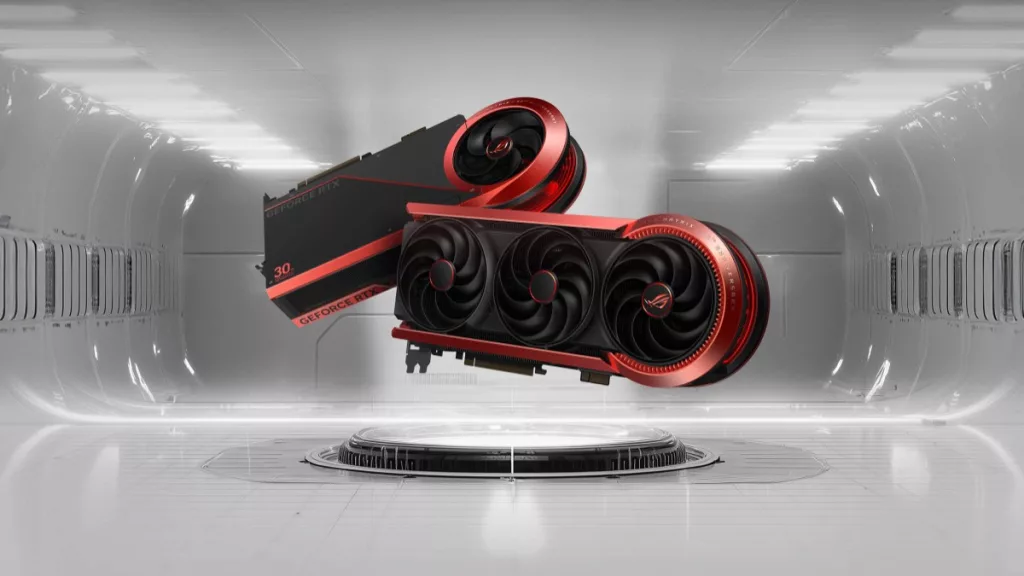
The $4,000 ASUS ROG Matrix GeForce RTX 5090 has been tested by a well-known overclocking specialist, where it showed a 10% performance uptick. The premium-priced graphics card has been produced to celebrate ASUS’s 30th anniversary and is designed to operate with a significantly higher power draw via its custom BIOS, combined with its BTF and 12V-2×6 connectors. ASUS has also gone all out in ensuring the GPU will remain cool by using (per ASUS), “a quad-fan design, a copper vapor chamber, liquid metal thermal compound, a 3-ounce copper PCB”.
“Celebrating three decades of ASUS innovation, the ROG Matrix GeForce RTX 5090 graphics card delivers unmatched gaming and thermal performance. When paired with an advanced BTF motherboard and a 12V-2×6 power supply connection, this ROG Matrix GeForce RTX 5090 can draw up to 800 watts and achieve 10% higher performance.”
– ASUS
Roman Hartung, also known as der8auer, subjected the ASUS ROG Matrix GeForce RTX 5090 to a series of tests to evaluate its performance, cooling, and power draw. A stock RTX 5090 FE has a power limit of 600W, and when overclocked will reach that limit. Our internal testing revealed a stable overclock of +270 MHz on the core, and a memory frequency of 1500 MHz could be achieved, producing clock rates in the 2900-3000 MHz range with memory operating at 31 Gbps. That being said, let’s take a look at what happens when a famed overclocker pushes a premium version of the same GPU die to its limits.
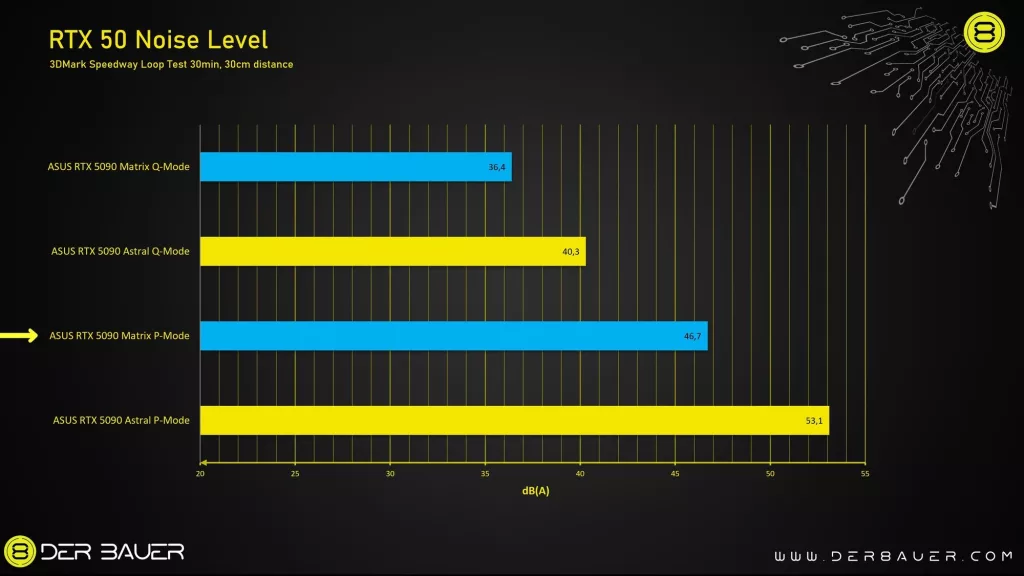

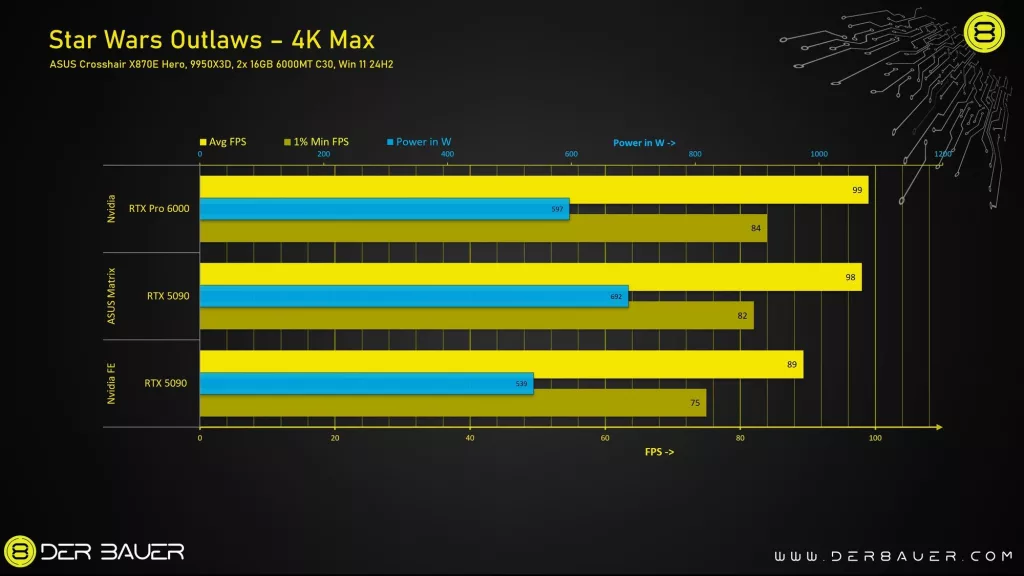
One thing which de8auer quickly noticed during his testing is how quiet and cool the graphics card was. It managed 46.7 dBs, roughly 7 dBs lower, in performance mode with fans running at 1,600 RPM, keeping the GPU under 70°C. This card already features higher clocks out of the box than the FE version, with 2730 MHz base / 2760 MHz OC mode, but der8auer applied +160 MHz on top of that, which had the GPU running at just over 3000 MHz and consuming 720W of power. He saw a roughly, and similar to our testing, 10% increase in FPS for 2 games tested. He also noted that this put the $4K card within 1 or 2 FPS of the $8K-$9K NVIDIA RTX Pro 6000 workstation graphics cards, but it drew more power than them.
After it’s all said and done, it becomes clear that, unlike many past GPUs when given more power, the GB202 die is already, more or less, at the sweet spot with a 600W BIOS power limit. Despite being allowed up to another 200W to consume, the GPU still only offered around 10% gains in gaming vs stock settings. The bigger takeaway here, though, is that the BTF connector allowed a badly needed alternative of power delivery, which alleviates the increased risks of pulling too much through the 12V-2×6 connector.
BIOS for the ROG Matrix leaked over the weekend, allowing users of non-Matrix cards to flash them, allowing up to the 800W limit. However, given the less-than-stellar reputation of 12VHPWR/12V-2×6 connectors, it is strongly not recommended to do so since these cards do not feature ASUS’s BTF connector, which means all added power must come from only the PCIe and aforementioned connector.
Discussion (7 replies)
Join Discussion →Yikes. $4000. Beautiful card, but no thanks.
I believe I was generous in how I reported on this as Roman did a tear down on the card where he discovered some questionable quality issues with the cooling solution. Clearly it works but some would wonder if given the price, if it could be better. I do recommend watching the vid in the post , for those interested.
All that aside, pretty card but I'd never pay that much for an air cooled card, and probably not for a liquid cooled one either since they too have finally started to drop in price.
P.S. Side note. Just a heads up that undervolting a RTX 5090 can have amazing results and you can basically achieve nearly full performance at a fraction of the power draw when also limiting FPS. I keep mine in the 70-80 FPS territory and combined with undervolting will see 200-ish Watts in games like HZD:Remasterd @ 4K with max settings and DLAA enabled, or 330W-430W in other more demanding games using max RT effects, DLAA, at 4K. Just saying since some folks are experimenting with this 800W BIOS to OC for a mere 10% FPS gain. I get a huge smile on my face everytime I fire up HZD:Remastered on the 9800X3D rig and see around 330W total system draw using this approach and regardless of rig the GPU temps are usually in the 50-60 range as well, occasionally going to 70c if the game has a ton of RT effects, and again not using DLSS. If using DLSS things only get better with lower power, temps, higher frames, but then there is a IQ compromise. I've also seen the Zotac card regularly hang in the 2700-2800 MHz range with this and the MSI only slightly lower than it (~50-100 MHz).
I forgot to mention that I do use MFGx3 but with everything tuned like it is, there's no noticeable bad side effects since I'm also limiting FPS and again in reference to HZD: Remastered, GPU TDP sometimes drops to under 200W.
Yeah, same.
I think this card is more of an evolution of the Astral for people to LN2 cool and use custom 1000+ watt BIOS on for benchmarks.
Yep, pretty much. Spend an isnane $$$ for benching when an OC'd FE will do about the same for gaming.
Asus is on a roll lately will over the top expensive 5090's, must be a market for them though it's not me.