
Gameplay Performance
Now we come to the interesting testing we are sure you all can’t wait for. We were also anxious to get to this part and see how it all ends up for gaming performance. We are testing only at 1080p to isolate CPU performance. We are using an NVIDIA GeForce RTX 5090 Founders Edition video card with driver version 591.74. All games are being run in their “Ultra” game settings, at native 1080p resolution, and with no ray tracing or upscaling.
Importantly, we are using ALL manual run-throughs for every game here except one. The one exception is Call of Duty: Black Ops 7. We are using the built-in multiplayer benchmark. However, for every other game, we are using long manual run-throughs in-game of actual gameplay.
Alan Wake 2
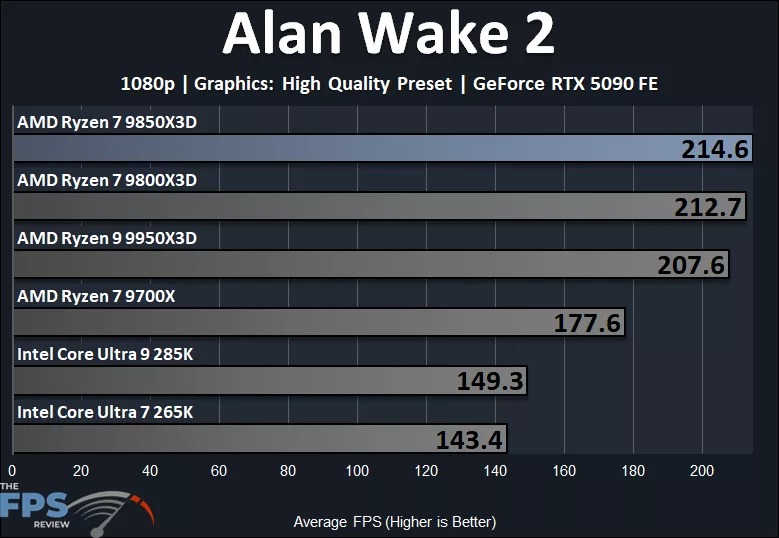
In Alan Wake 2, the new AMD Ryzen 7 9850X3D takes the top spot in performance at 214.6 FPS, beating every CPU in this game; however, the result compared to the Ryzen 7 9800X3D is minor, but still a technical win. The Ryzen 7 9850X3D is 1% faster than the Ryzen 7 9800X3D, and 3% faster than the Ryzen 9 9950X3D. The Ryzen 7 9850X3D is 21% faster than the Ryzen 7 9700X, showing the advantage of the 3D V-Cache capacity. The Intel Core Ultra CPUs get destroyed. The Ryzen 7 9850X3D is 44% faster than the Intel Core Ultra 9 285K and 50% faster than the Intel Core Ultra 7 265K.
Battlefield 6
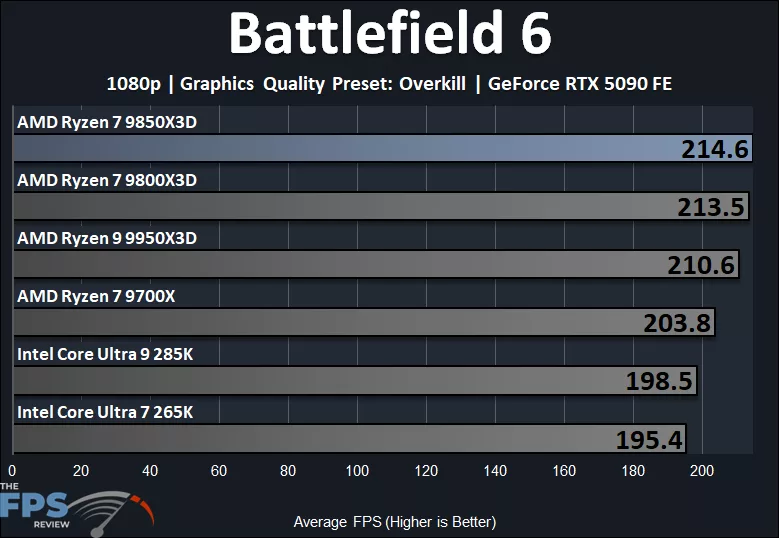
In Battlefield 6, the Ryzen 7 9850X3D has a technical win again, beating every CPU in performance at 214.6 FPS (no, this isn’t a mistake; we got the same result in this game as we did in Alan Wake 2; performance was consistent). The Ryzen 7 9850X3D was barely 1% (.51% technically) faster than the Ryzen 7 9800X3D in this game. Keep in mind, we are testing at the highest game settings. We are sure that if we dropped the game settings even lower at 1080p, there might be a bit more separation, as it would be even more CPU-dependent, but that would be rather extreme just to force a result.
The Ryzen 7 9850X3D was 2% faster than the Ryzen 9 9950X3D and 5% faster than the Ryzen 7 9700X. This seems to indicate to us that we aren’t entirely CPU-bound in this game, even at 1080p at these game settings, or with this GPU. The Intel CPUs claw back performance in this game, again it might not be as CPU-dependent. This is the first time we’ve used this game for CPU testing, and further fiddling may be warranted, such as trying lower game settings below “Overkill.” At this game setting at 1080p, the Ryzen 7 9850X3D is 8% faster than the Intel Core Ultra 9 285K and 10% faster than the Intel Core Ultra 7 265K.
Call of Duty: Black Ops 7
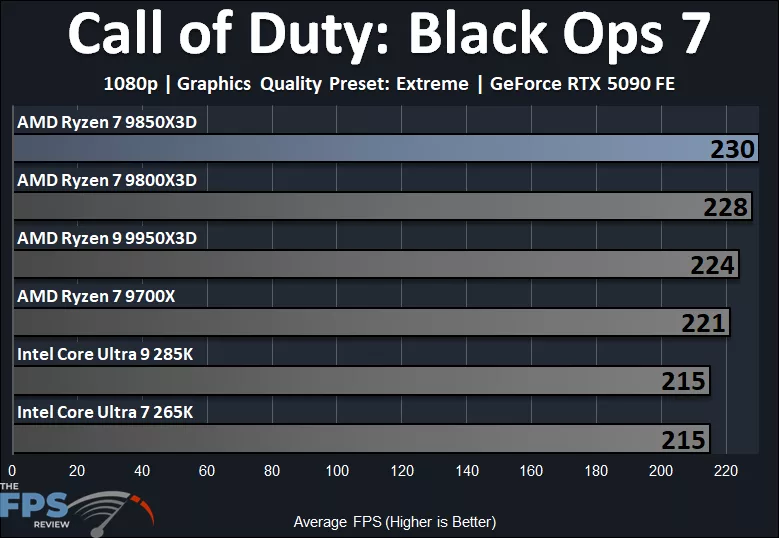
In Call of Duty: Black Ops 7, the Ryzen 7 9850X3D again tops the charts and is the fastest CPU for gaming. In this game, we are using the built-in multiplayer benchmark. We are testing at 1080p, but we do have the “Extreme” quality preset enabled, and Variable Rate Shading is turned: “Off.” The Ryzen 7 9850X3D is 1% faster than the Ryzen 7 9800X3D and 3% faster than the Ryzen 9 9950X3D. The Ryzen 7 9850X3D is 4% faster than the Ryzen 7 9700X.
The Ryzen 7 9850X3D is 7% faster than the Intel Core Ultra 7 285K and 265K. This game may be similar to Battlefield 6 in that we aren’t as CPU-dependent as we think we are, or it just doesn’t benefit from 3D V-Cache. This is our first time using this game as well for CPU testing, and it warrants further analysis, perhaps also trying lower game settings even at 1080p. That said, there are sometimes games that just don’t benefit from extra L3 cache as much.
Clair Obscur: Expedition 33
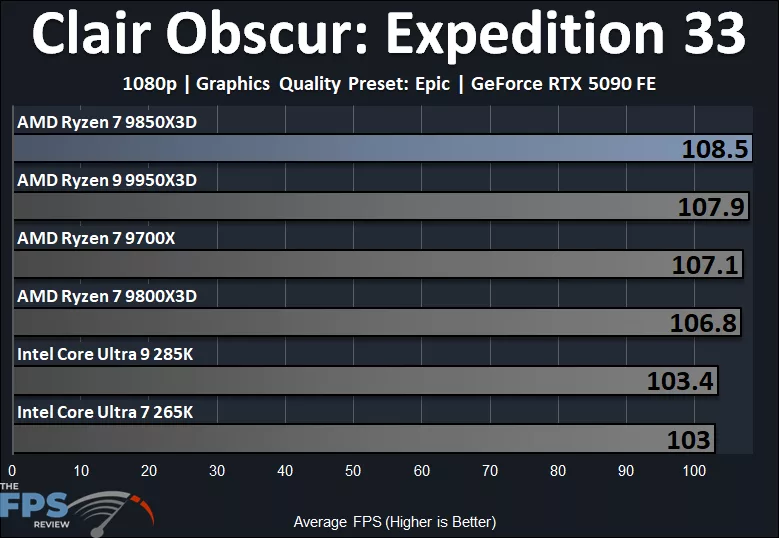
In Clair Obscur: Expedition 33, we are running at 1080p, but we do have the “Epic” quality preset enabled, which is the game’s highest image quality setting. This game runs with ‘always on’ Ray Tracing on the UE5 engine, and thus is very GPU-dependent, even at 1080p on “Epic.” This is quite possibly why we are exhibiting the result we are seeing here, where the CPUs are more tightly packed, and we don’t see any huge advantages with extra L3 cache. This, like the last two games, may be one we need to explore further using lower in-game settings.
That all said, the Ryzen 7 9850X3D is still the fastest CPU on this graph, providing the highest gaming performance. The Ryzen 7 9850X3D is 2% faster than the Ryzen 7 9800X3D, and 0.5% faster than the Ryzen 9 9950X3D and Ryzen 7 9700X. The Ryzen 7 9700X performs very high on the graph in this game, showing that 3D V-Cache isn’t really doing a whole lot for us right now in this game. The Ryzen 7 9850X3D is 5% faster than the Intel Core Ultra 9 285K and 265K.
Cyberpunk 2077
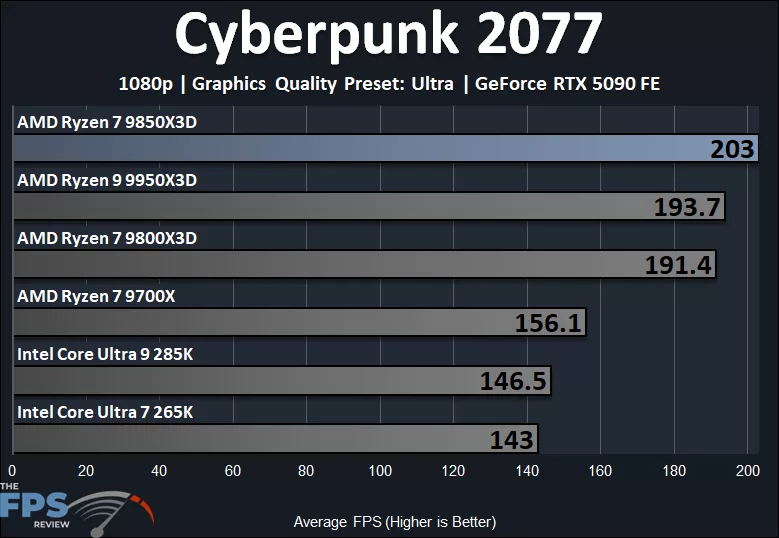
Cyberpunk 2077 clearly shows a huge advantage for 3D V-Cache and a clear distinction between CPU performance. At 1080p “Ultra” settings, the Ryzen 7 9850X3D dominates performance, and Intel gets destroyed. The Ryzen 7 9850X3D is 6% faster than the Ryzen 7 9800X3D, the highest advantage we have experienced yet. The Ryzen 7 9850X3D is 5% faster than the Ryzen 9 9950X3D. What is more impressive is the 30% advantage compared to the Ryzen 7 9700X, showing the advantage 3D V-Cache makes in this game. The Ryzen 7 9850X3D is 39% faster than the Intel Core Ultra 9 285K and 42% faster than the Intel Core Ultra 7 265K.
Discussion (19 replies)
Join Discussion →That is an impressive 8 core single CCD CPU. Very nice...
Would be neat to see what a single CCD 12 core 3dvcache CPU would be awesome. :)
Exactly what we expected.
This is the only review showing less power use vs the 9800x3d, all other tests show the 9850x3d consuming more power.
[embedded media]
Brent can probably speak to this better, but there's a ton of variables that go into power consumption - including the game, the game resolution and game settings that are selected for testing. We don't typically do far ranging power analysis - Toms, for example, seems to be running all their standard tests through benchlab which makes it easy to pull together a ton of power graphs that correlate to the benchmarks run. Our power testing tends to focus on games.
There can also be differences in where the power is measured - benchlab (which they used on the power testing page) is an external to the system pass through that doesn't directly measure CPU usage, whereas we're pulling our power measurements from HWiNFO64. Though, really, I can't tell what method they used to measure CPU power usage in their gaming benchmarks as it's not disclosed....
As stated in the review: "
As stated in the review: "On this page, we are going to test the power draw on the CPUs, testing multi-core performance in Cinbench 2026 running for 15 minutes."
The method I used (and always have used) is a simple Cinebench Multi-Core, full-load, power test. I run Cinebench on the multi-core benchmark for at least 15 minutes, looping. I have HWiNFO up on the screen, and monitor the "Package Power" reported. I then graph the maximum or peak power number represented.
I do not claim that this is a thorough or detailed power test. It is meant to verify or validate all-core power loads and report on the quoted or rated TDP from AMD and Intel. I am aware that TDP is the thermal design power recommendation for cooling.
I do claim this is a valid measurement, and a real-world use-case scenerio that an end user would realistically encounter in real-world usage. For example, if you are editing and encoding or transcoding video in a video editor, or running 3D renders, or anything that pushes all cores to the max, this is the power you would experience in a real-world use case.
This is different than testing power while gaming. This is not showing power while gaming. I have done that in the past, on certain CPUs, but this was not that. You will note that Tom's testing was in games, which has a very different load than what I was doing. I was using productivity-based testing.
In addition, I am aware there are more accurate ways to capture power usage, but our reviews don't focus on that aspect. This method shows the 'cap' that the motherboard BIOS sets for package power. We can see that power is above the "TDP" number they provide, and we can see where it caps out with this method. I encourage you to look at other reviews for more detailed power testing and analysis.
I hope that helps.
One thing I'll also add to my statement: Testing power while gaming will be very different from all-core full-load testing because, while gaming, the CPU cores will boost to higher frequencies and voltages, since less of them are being used, and the workloads are lighter. Therefore, the peak power registered on such things as the EPS rails will be higher and peak higher than pushing all-cores to full-load at the same time. When doing that, the clock frequency and voltages are lower, and thus it peaks lower overall.
That makes sense to me. You're not investing in power measurement devices like what others are doing as that is not your intended level of testing. This is more a user experience and repeatable test than say a specialized break down. Its clear tne texhnical chops are here and are in essence providing the tools and guidance to replicate local testing by us more... savvy I dare say... readers. Letting us more easily identify anomalous behaviors.that may or may not exist. (Looks cautiously at ASROCK motherboards.)
Nice CPU for sure but I'll be waiting for one (either the 9950X3D2) or something else down the road to replace the 5800X3D in my spare rig and the main one with a 9800X3D is plenty for now.
As always, thanks for the review!
why all the hoopla on a CPU that's not worth buying?
It's only a little bit faster than the 9800X3d, but is more expensive, draws more power and generates more heat.
I don't see any scenario where getting a 9850X3D over a 9800X3d makes sense.
The folks who have to have "the best"
Someone who just now is coming into tax money to build a new box and leave their 3000 series behind?
Should depend on pricing and availability more than anything. My guess is that we'll see the 9800X3D chips start drying up leaving the 9850X3D as the only choice and/or the price point will be so close that the extra $10-20 might as well be spent.
My original theory is the 9800X3D will go away and be replaced by a lower binned 9700X3D to provide some separation, but AMD has stated the 9800X3D production will continue (of course, that may mean just for one day....)
I've seen this suggested by others. I think they have contacts too. Starting to think this is a leak. :p
If the rumors of the 9700X3D are true, that's one more kick to Arrow Lake. The 265K will lose its appeal quickly since the 9800X3D's $449 price was making it turn up in the shopping cart of some people. Now people like that could opt for the 9700X3D if they can get it at something like $389.
Using canadian pricing as an example, I don't see an imaginary CPU causing any issues for intel.
265KF is $399
9700x is $460
7800X3D is $550
14900K is $620
9800X3D is $640
9850X3D is $720
285K is $780
Intel is the value leader right now. Given the price of ram. A full $240 difference between a 265k and 9800x3d. I won't even talk about the 9850x3d because the pricing makes zero sense. $80 more Cad$ is just terrible.