
Power and Temperature Testing
On this page, we are going to investigate the Intel Core Ultra 5 250K Plus power draw, temperature, and clock speeds. We are going to do this two ways. First, we are going to test while playing a game, under a gaming workload, and then we are going to test under a multi-threading Cinebench 2026 workload. In this way, we can get a feel for the gaming power and temp versus “all core” power and temp. CPU package power and temps are read with HWiNFO64.
Power Testing While Gaming
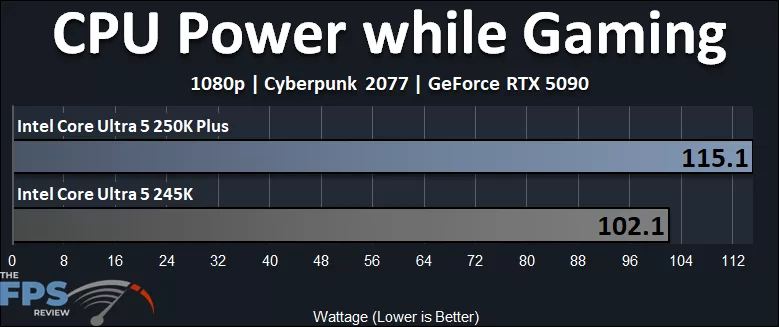
In the graph above, the Intel Core Ultra 5 250K Plus peaked at 115.1W while gaming, while the Intel Core Ultra 5 245K peaked at 102.1W. This means the Intel Core Ultra 5 250K Plus is pulling about 13W or 13% more power while gaming compared to the Intel Core Ultra 5 245K. In this particular game, the Intel Core Ultra 5 250K Plus was 6% faster than the Intel Core Ultra 5 245K, so it takes a little bit more power to achieve the percentage increase; it isn’t quite linear, a little less efficient, but close-ish. Even though it runs at 13% more power, we are still talking very low power utilization overall at just 115W.
Power Testing Multi-Threading
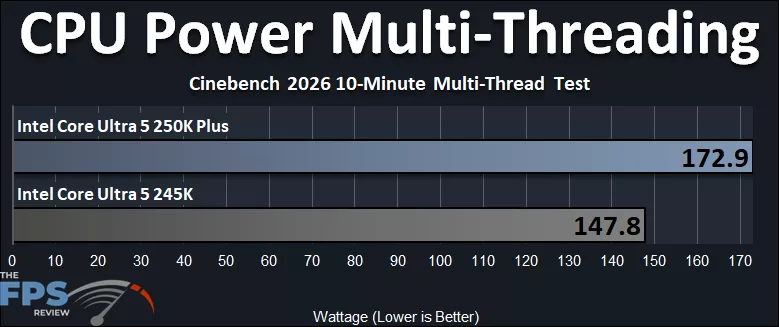
When pushing all-core Wattage, the Intel Core Ultra 5 250K Plus pulls 172.9W, while the Intel Core Ultra 5 245K pulls 147.8W. This reflects the increased core count with 4 extra E-Cores present on the Intel Core Ultra 5 250K Plus, as well as the higher clock speeds. The Intel Core Ultra 5 250K Plus, therefore, can use up to 25W or 17% more power in Multi-Threaded applications. Remember, the max Turbo Power is 159W, so the Intel Core Ultra 5 250K Plus is exceeding it on this motherboard, at Default settings.
Temperature Testing While Gaming
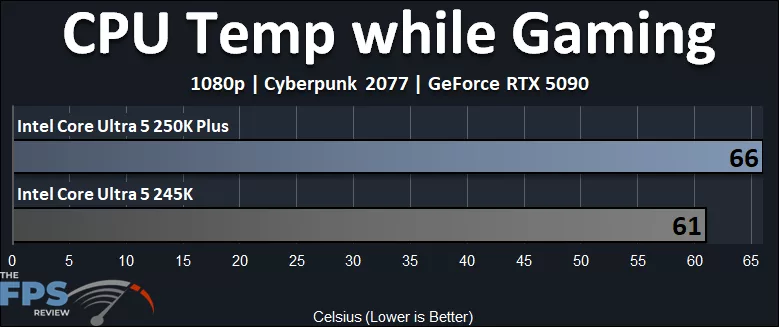
The Intel Core Ultra 5 250K Plus runs about 5 degrees warmer while gaming, compared to the Intel Core Ultra 5 245K. It was pulling about 13% more power, and we do see that this, plus the frequency increases, increases the temperature by 8% while gaming.
Temperature Testing Multi-Threading
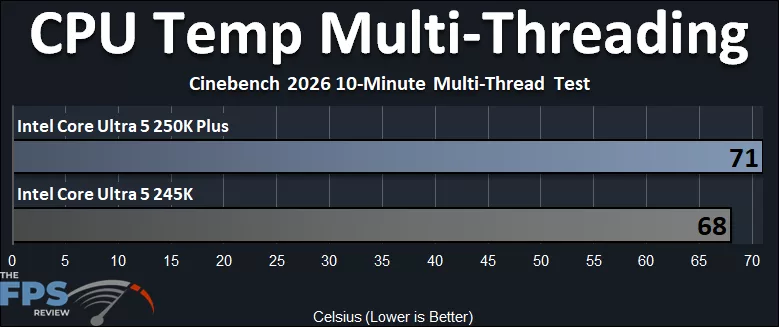
There is definitely an increase in temperature when all cores are active in Multi-Threading, but it isn’t a lot. We see that the Intel Core Ultra 5 250K Plus only increases temperature by 3 degrees up to 71c. That is only an increase of 4% temperature, considering the larger 17% power increase, this temperature increase is rather tame, and good to see. Of course, temps will vary based on your cooling; we are using a 360mm AIO.
Intel Core Ultra 5 250K Plus HWiNFO64 Sensor Data
We wanted to show the full HWiNFO64 Sensor Data for both the Intel Core Ultra 5 250K Plus and Intel Core Ultra 5 245K in our gaming workload, playing a game (left screenshot) and the Multi-Threaded Cinebench 2026 All Core workload (right screenshot), so you can compare the CPUs and clock speeds.
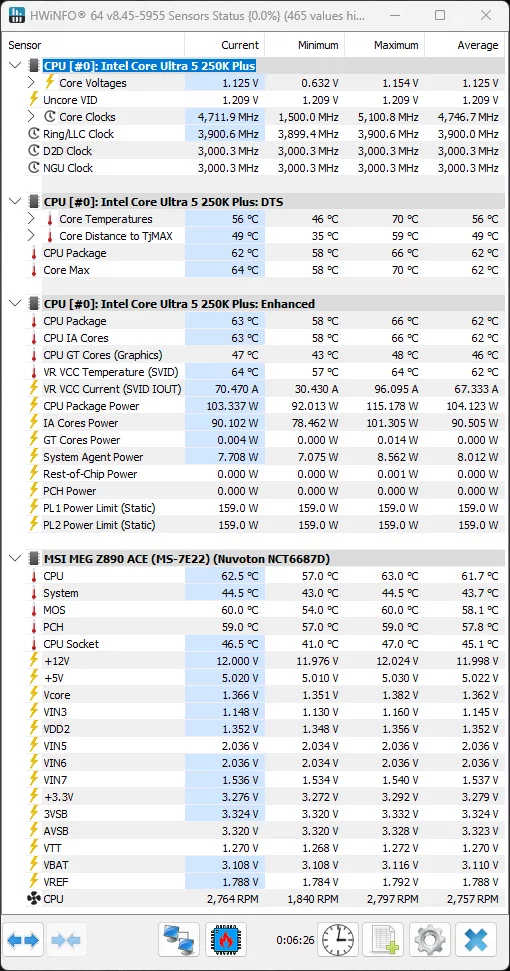
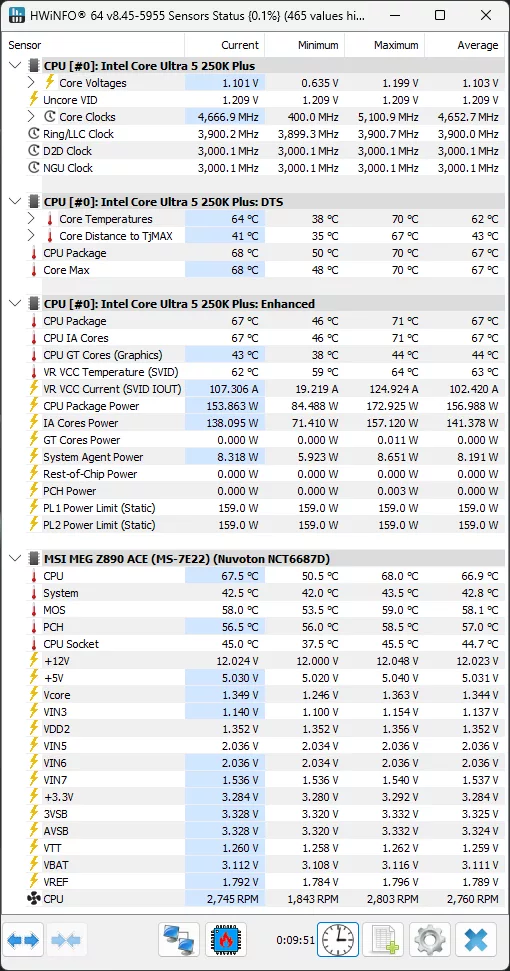
The Intel Core Ultra 5 250K Plus runs up to a maximum of 5.1GHz while gaming, but the average was 4.7GHz while gaming, with the current frequency while in-game at 4.711GHz. You can see how this compares to the 245K below. We can also see that in the Multi-Threading workload, the Intel Core Ultra 5 250K Plus can operate up to 5.1GHz, averaging 4.6GHz, and snapped while mid-workload current was 4.66GHz. You can also see that the Ring/LLC Clock is at 3.9GHz, the D2D Clock at 3GHz, and the NGU Clock at 3GHz.
Intel Core Ultra 5 245K HWiNFO64 Sensor Data
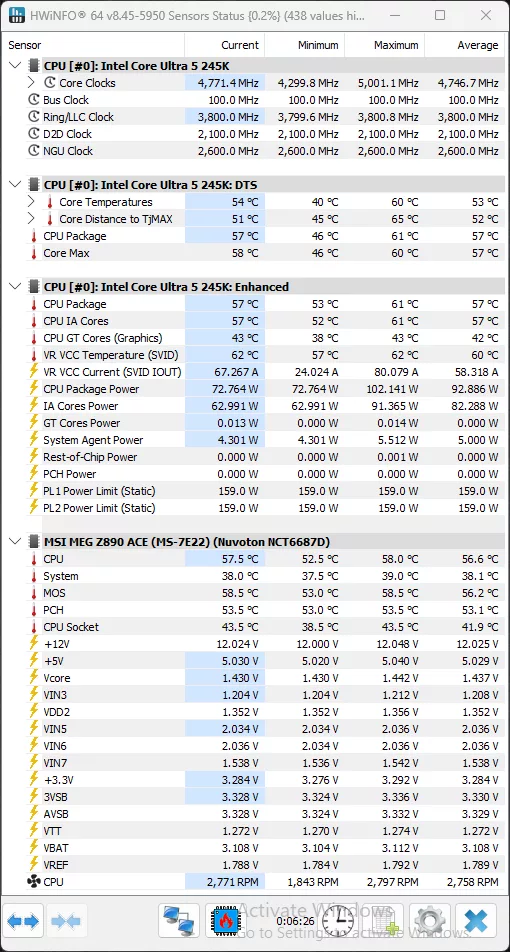
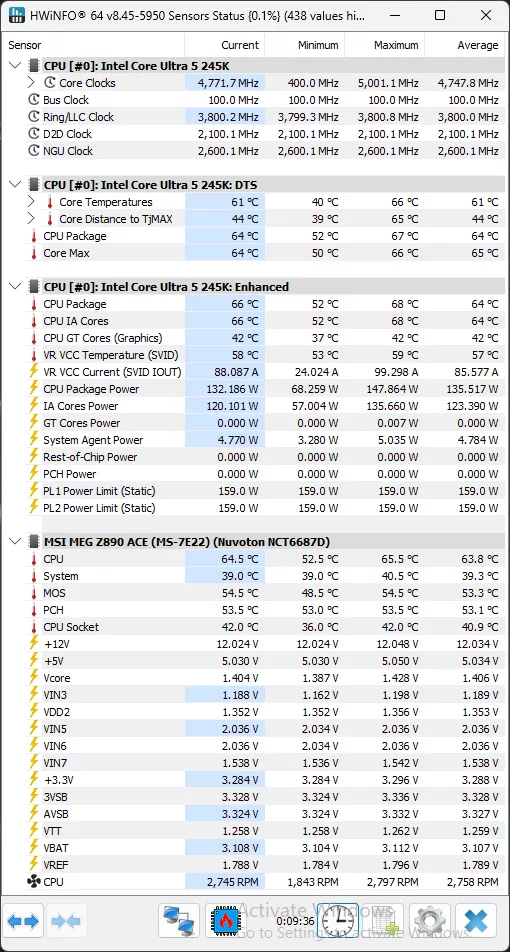
The Intel Core Ultra 5 245K runs up to a maximum of 5GHz while gaming, but the average was 4.7GHz while gaming, with the current frequency while in-game at 4.771GHz. You can see how this compares to the 250K Plus above, which runs 100MHz higher on the P-Cores. We can also see that in the Multi-Threading workload, the Intel Core Ultra 5 245K can operate up to 5GHz, averaging 4.7GHz, and snapped while mid-workload current was 4.771GHz. You can also see that the Ring/LLC Clock is at 3.8GHz, the D2D Clock at 2.1GHz, and the NGU Clock at 2.6GHz.
Discussion
Join Discussion →No replies yet. Be the first to reply on the forum.