
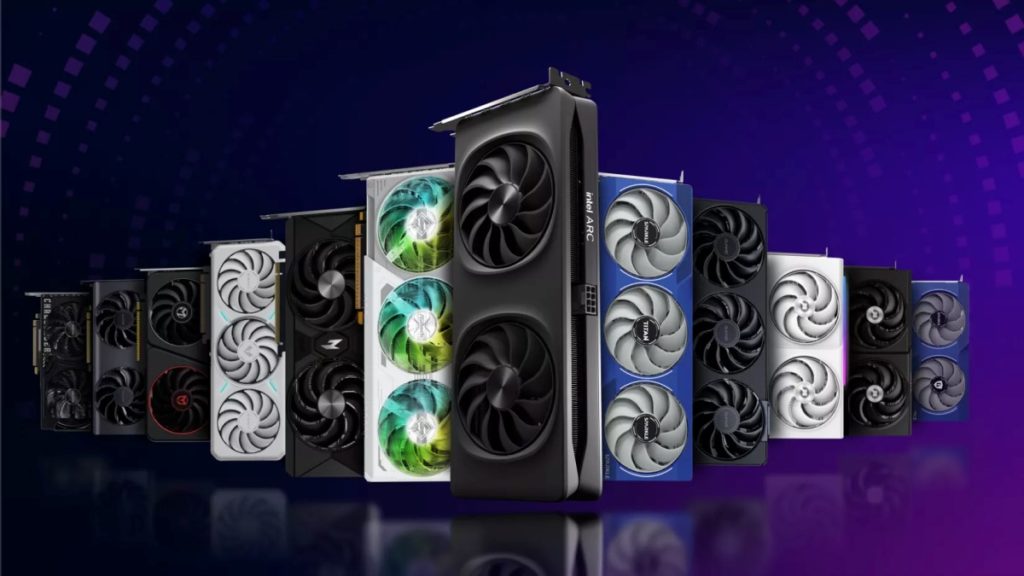
While Intel is celebrating its win in the stock market, it appears to have thrown in the towel regarding its consumer graphics card division. Intel’s struggles within both the CPU and dGPU sectors have been ongoing for the better part of a decade, but team blue has managed to make several successful turns in recent years with its discrete graphics cards. The Arc A770 16 GB launched at $349, giving PC enthusiasts an affordable model that was very capable of gaming at 1080p and 1440p resolutions, and thanks to ongoing driver updates, its performance continues to improve. Followed by the Arc B580 12 GB at $249, Intel once again showed prowess in producing a card that was affordable and able to be used for gaming at 1080p/1440p. However, at least for now, it looks like this is the end of the road for Intel’s consumer dGPU division.
Released in December 2024, the Arc B580 was the last consumer dGPU made by Intel. Featuring Xe2 Battlemage graphics, this low-priced offering (we have a review here) was a nice addition to the Arc family, but many in the PC community were looking forward to a more stalwart model with Xe3 graphics. It was rumored that the “Big Battlemage” Arc B770 would finally be the card to escalate Intel’s Arc line into the mid to high gaming product tier, but it would never come to be. Instead, in March 2026, the Arc B770 Pro would launch, but purposely designed for AI workloads and not intended for gaming. However, drivers for it do provide gaming support.
According to a report by VideoCardz, the Arc B770 Pro has gone on to become one of Newegg’s top-selling cards. At $949 with 32 GB of GDDR6 memory, the card featuring the BMG-G31 GPU is still very competitively priced for a dGPU with a large amount of VRAM. As mentioned, though, it is designed for computational tasks and not gaming, and so at that price point, it doesn’t necessarily compete well with cards made by NVIDIA or AMD when it comes to gaming.
No gaming GPUs.
— Jaykihn (@jaykihn0) April 24, 2026
Now, to further rub salt into the wounds of PC enthusiasts wanting a new Arc gaming graphics card, it’s rumored that Intel will skip offering an Xe3 consumer graphics card altogether. Some are already speculating that Intel has also reshuffled its roadmap for Xe4, giving further doubt to remained existence of Intel’s consumer discrete graphics division. Anything is possible, but between facts and rumors, it’s not looking good for gamers still hoping to see new Arc dGPUs.
Meanwhile, the only other option to see Xe3 graphics at work is with the impressive-looking Panther Lake processors, which made their debut at CES 2026. Intel’s new strategy appears to be AI-focused dGPUs, but then also integrating its latest graphics technologies into upcoming CPU packages.
Discussion (13 replies)
Join Discussion →🙄
That's too bad. But "gaming". Maybe they'll still keep trying in the low end SR-IOV market with Xe 3/4?
Their "APUs" should continue and provide some competition in that area. Handhelds maybe also.
Disappointing - no doubt the rampocalypse is playing its part.
Intel really entered at a bad time in the market, that just honestly got worse, and it is not surprising they can't get over the hump now. I completely understand it, but it is sad, they had real potential for providing competition.
I'd say it's everything... from the fallout of an unplanned additional half-decade of Skylake and 14nm, to having trouble with current processes in volume, to wading through the software hell that as GPU drivers, to having to fight (pay) for allocations at TSMC as well as yes, DRAM allocations.
What I expect to happen is for Intel to continue to develop and evolve the technology. No doubt that the other end of the rampocalyse is going to look different than today; maybe Nvidia abandons the low-end (more than they have)?
I expect APUs / SoCs to play a larger part too, as Brent says above. Mobile is a big thing (apparently, I have zero interest), and Intel has really the most experience in building lower-power designs that are limited by node next to Apple. Meaning that they're positioned to take advantage of whatever market pressures let up first.
I hate to tell you this but Intel has been in the market for decades. They are not some new kid figuring out how to compete in the IT market. ;)
Clearly. Explains why they have done so well since Broadwell, and Broadwell+, and Broadwell+++, Broadwell Refresh, and they are now outsourcing their production to TSMC...
Intel has had some brilliant moments, no mistake there. But they very nearly lost the company, and it still remains to be seen if the recent bump in stock price is a resurgence of the Brilliant Intel, or just a flash in the pan before the bubble pops on everybody.
I mean, even going to the Discrete GPU division that is now dead... Even taht really only existing in the first place because they wanted to take advantage of the mining boom... but they missed that by about a year. So they shipped what they had, maybe got part of that investment back, then realized that since they didn't keep R&D going it's too far behind to get up to speed in the AI boom... so they just cut bait.
They kept the driver folks alive, but killed hardware R&D, again. So it turned into Larrabee all over again. ~Everyone~ knew this was going to happen, but we all really really hoped it wouldn't and Intel was actually trying to support the gaming community. Surprise - they weren't.
I really hope it's a short lived hiatus from GPU development and they ramp development back up once they get their profitability in order.
I am Jack's total lack of surprise.
Didnt stick with optane, didnt stick with itanium, didnt stick with dgpus, have a tendency to attempt propietary crap, add that forced ranking, which they might still be doing idk.
Intel hasnt shifted mentality just yet, maybe never will.
I do think they will survive, mostly because they been determined to be strategic for the military and such .
But they havent figured out they arent the only player , and the mentality is that of high profit only, and the type of thinking this aint profitable ' enough' is absurd in the enviroment the reside, this aint the 80s.
That's the thing - they're still in the AI accelerator race.
Because those products have simpler software / driver requirements and far higher margins, and Intel can use their massive purchasing power leverage to get VRAM in quantity to supply that market sustainably with current prices.
But selling gamer silicon is definitely not going to pay the bills right now.
Intel's GPU division is in survival mode only due to the current market constraints; the product is great, they just can't afford to compete given that they were coming from behind.
As I said above, they're still positioned to take advantage of any changes to their current constraints. If fab space opens up or VRAM supply increases (dropping prices), they can throw together a solid mid-range gaming GPU at will. Higher-end if they really want to reach for the stars.
[URL unfurl="true"]https://www.tweaktown.com/news/111441/intels-arc-pro-b70-big-battlemage-gpu-falls-behind-rtx-5060-ti-in-gaming-performance/index.html[/URL]