
Conclusion
In our AMD Radeon RX 9070 GRE review today, we have taken a deep dive into thirteen games, looking at both the average framerate and 1% Low framerate at 1440p. We tested out the claim that the AMD Radeon RX 9070 GRE is geared for a 1440p gaming experience by running games at both Native Resolution, as well as enabling FSR Upscaling and Ray Tracing at High to Ultra game settings. We pushed the 12GB Radeon RX 9070 GRE hard in games and made a lot of comparisons. We compared it with the Radeon RX 9070 to see how close in performance it is, and we compared it with the Radeon RX 9060 XT to see how much faster it is. We also compared it with the GeForce RTX 5060 Ti and the GeForce RTX 5070 to give a complete picture of where the Radeon RX 9070 GRE sits in performance.
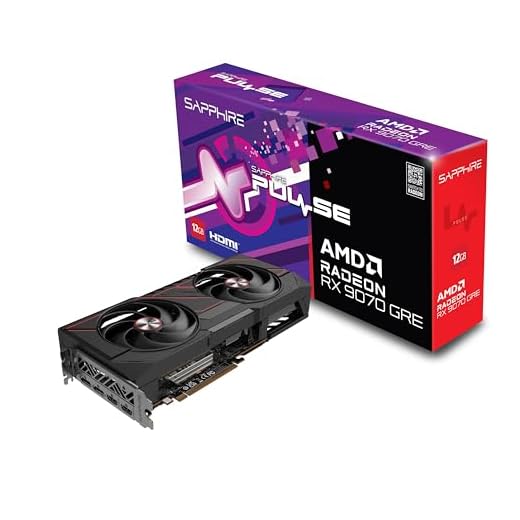
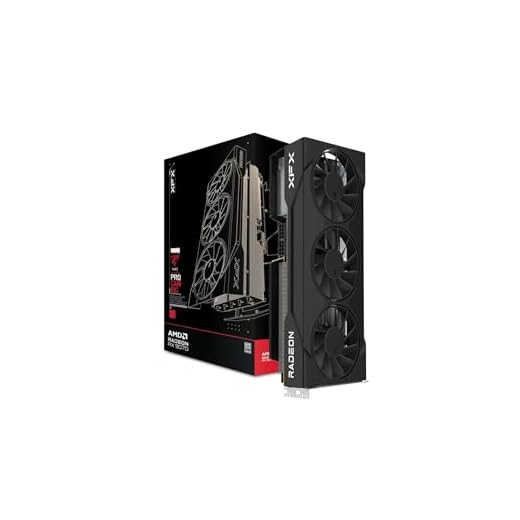
The AMD Radeon RX 9070 GRE was launched in the US and global markets on June 1st, 2026. It was announced at Computex 2026 that it would be released to retailers and online retailers at a $549 MSRP. This is a new release in the sense that it has not been available in these regions. Actually, though, the GPU and configuration were available in China as of March 2025, but it was exclusive until now. Now that it is available, we can see that it is actually maintaining its MSRP pricing of around $549 today, which makes it interesting to consider. Make sure to check out our XFX Swift Radeon RX 9070 GRE Triple Fan Gaming Edition video card and the SAPPHIRE PULSE Radeon RX 9070 GRE GAMING OC video card reviews.
The AMD Radeon RX 9070 GRE shares more in common with the Radeon RX 9070 than it does with the Radeon RX 9060 XT. In fact, it uses the same NAVI 48 GPU die as the Radeon RX 9070, just cut down in specification and with a lesser memory configuration. The Radeon RX 9070 GRE has 48 Compute Units, 3,072 Shading Units, 48 RT Accelerators, 96 HW AI Accelerators, 96 ROPS, and 192 TMUS. It has a Game Clock of 2220MHz and a Boost Clock of up to 2.79GHz. Where it differs is that it has 12GB of GDDR6 on a 192-bit memory bus, at 18Gbps, providing 432GB/s of memory bandwidth.
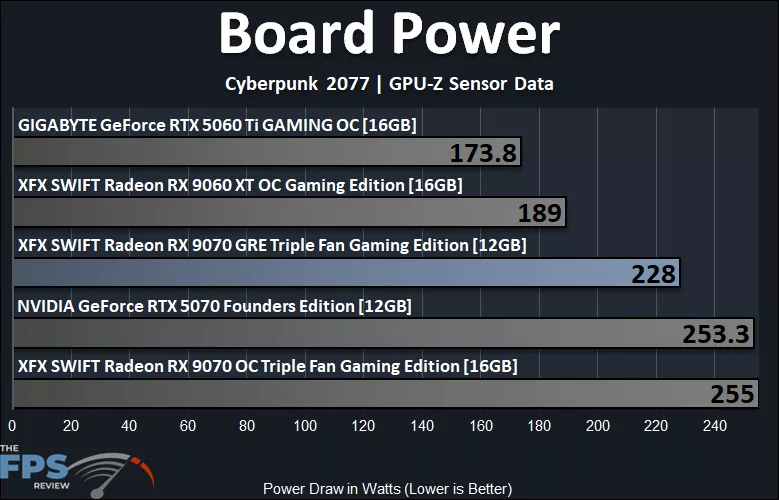
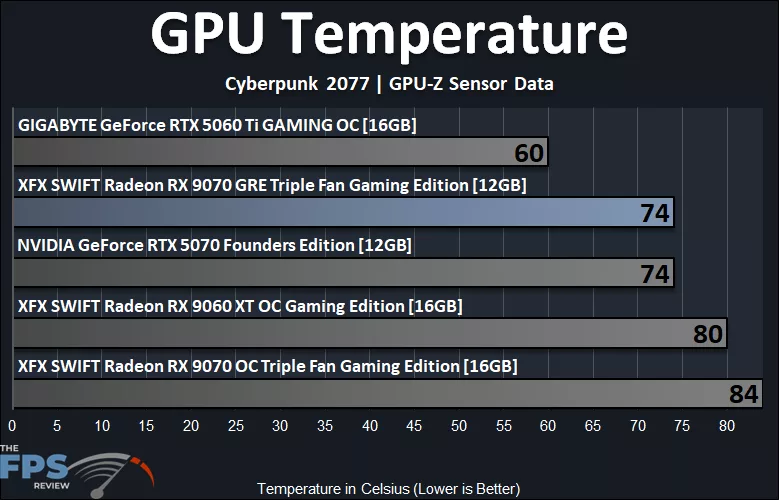
We are testing specifically an XFX Swift Radeon RX 9070 GRE Triple Fan Gaming Edition, and for board power, we hit a max of 228W. The TDP of the Radeon RX 9070 GRE is 220W, so we are hitting that TDP and not going too far over. This puts the Radeon RX 9070 GRE at a power savings over the GeForce RTX 5070 of 10%. It also has 11% less power than the Radeon RX 9070 OC. Temperature-wise, this is dependent on the video card being tested; this one performs very well and is the second coolest GPU at 74c.
Final Points
On the gameplay pages, you have read what the percentage differences were with AVG FPS and 1% Lows compared to the video cards. Addressing the claim that the Radeon RX 9070 GRE is geared for 1440p gaming, we can say with confidence that it does work well enough for 1440p gaming. This is a 12GB video card, so the natural concern is that of VRAM bottlenecking. In the thirteen games we tested, we did not encounter this issue at 1440p Native Resolution, even at High to Ultra game settings. However, there are probably games out there where it might.
What held the Radeon RX 9070 GRE back for our testing, rather than the VRAM capacity, was just the performance itself. In terms of that, most games were playable at 1440p Native Resolution, depending on the game quality setting. Some games at “Ultra” or “Epic” were not playable, but others were. Turning down the game quality settings to “High” solved this problem in most games.
However, there is also the option of simply enabling FSR Upscaling. With FSR 4.1 being supported, even just using “Quality,” FSR produces great image quality at 1440p. This is usually enough to bring unplayable games at 1440p “Ultra” up to a playable performance level. You can also increase the Upscaling to “Balance,” which gives even more performance, and again, with FSR 4.1, it doesn’t look terrible. We even found scenarios where optional Ray Tracing was playable, granted with FSR Upscaling enabled.
When it comes to comparison to the competition, the GeForce RTX 5070 is overall the faster video card. However, it is also a much more expensive video card in 2026. If you can afford the difference in pricing, then it would be overall better for the gameplay performance experience, considering they both have 12GB of VRAM. However, if you can splurge even the extra money for it, upgrading to the Radeon RX 9070 is going to be the preferred experience, as it outshines the GeForce RTX 5070 as well. We are talking about more money, though, and the whole point of the Radeon RX 9070 GRE is that you are getting it near MSRP today at $549, and neither of those video cards can match that price point.
Overall, the Radeon RX 9070 GRE is a choice worth considering if you are looking for a good value in 2026. It’s not the best value compared to previous years or generations at this price point, but we are in different times now, and in this current GPU pricing and performance economy, it has become a value at its current availability at the MSRP of $549. There is always faster, but that does cost you more, so you will have to decide what your wallet can handle. AT the end of the day, the Radeon RX 9070 GRE sits between the RTX 5060 Ti and RTX 5070, or between the RX 9060 XT and RX 9070 in performance. This is the gameplay experience you can expect: an acceptable 1440p gameplay experience in today’s games, maybe with a little help from Upscaling.


Discussion
Join Discussion →No replies yet. Be the first to reply on the forum.