

“Animate the cage, not the dense geometry,” says AMD as it demos its new tetrahedral cage representation, which can reduce a specific type of memory usage by up to 47x when using ray tracing. Ever wondered what BVHG is? Well, unless you work in video game design or some rendering-related field, you’re likely familiar with the term, but Per Wikipedia, a Bounding Volume Hierarchy (BVH) is “a tree structure on a set of geometric objects. All geometric objects, which form the leaf nodes of the tree, are wrapped in bounding volumes.”
So, per AMD’s GPUOpen presentation, BVH can use up to 80GB of GPU or System memory when using ray tracing due to having to process each unique vertex position. However, by utilizing a tetrahedral cage approach, BVH memory is reduced to 1.7 GB. Testing was done using a Radeon RX 9070XT at 1080p.
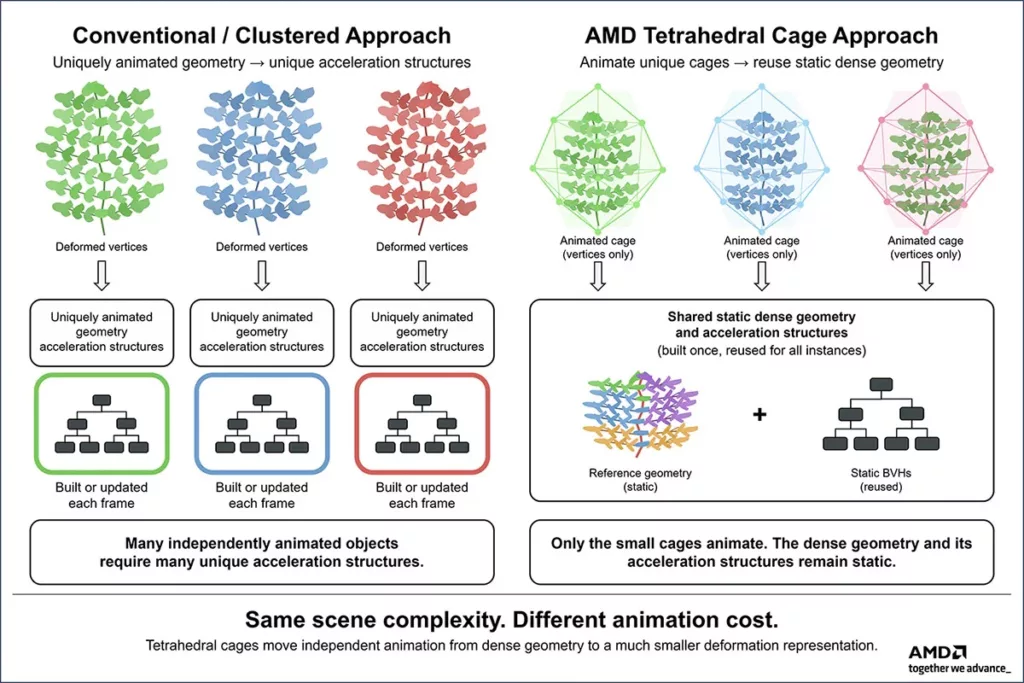
AMD explains that by using a Tet-cage, the dense mesh can be enclosed in a small deformable cage whereby its BVH structures remain static and reusable, but the cage itself can be deformed and have ray tracing effects applied. Perhaps a simpler way of thinking about it might be to imagine that, rather than trying to analyze every leaf and branch of a plant structure, you enclose it in a geometric shape with a specific set of vertices, and computations and effects are applied to the vertices only rather than to all of the plant structure. The tetrahedral cage approach has been reported on academically, so it’s good to see AMD implementing its own design using this solution. It will be interesting to see if it somehow is either adopted by game designers via engine support or perhaps as a feature in AMD’s FSR software stack. At this point, regardless of the type of memory usage, it’s a win for all to see any memory usage reduction given the ever-increasing costs of VRAM and the lack of new consumer GPU technology due to it.
Discussion
Join Discussion →No replies yet. Be the first to reply on the forum.