
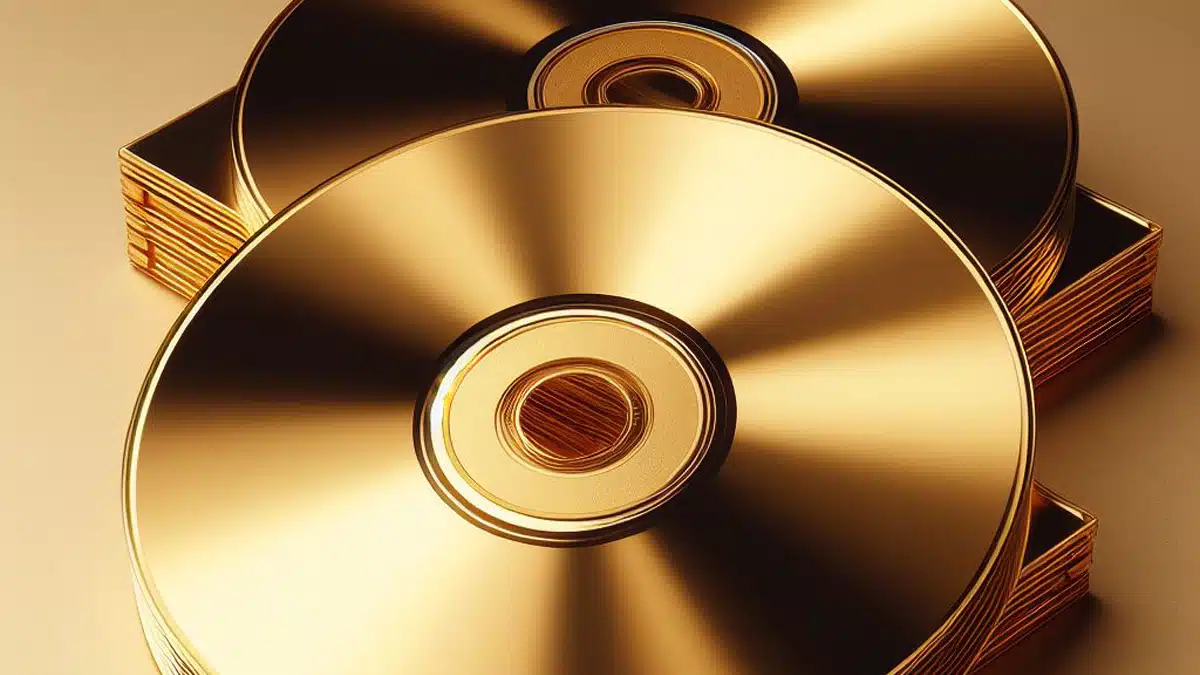
A research team in China has published their findings on “3D nanoscale optical disk memory,” a new type of storage technology that enables discs with up to a petabit of capacity—24 times the data of the most advanced hard disk drives that can be found today, according to coverage online, and 10,000 times more than the Blu-ray discs that are commonly used for today’s games and movies. The potential for “exabit-level storage” is teased in an abstract from the team, which mentions how the extended capacity is owed to a technique that enables “hundreds of layers.”
Units for reference:
- 1,024 gigabytes: 1 terabyte
- 1,024 terabytes: 1 petabit
- 1,024 petabytes: 1 exabit
Blu-ray capacities:
- 25 GB (single-layer)
- 50, 66 GB (dual-layer)
- 100, 128 GB (BDXL)
The researchers say:
- “The ODS [optical data storage] has a capacity of up to 1.6 [petabits] for a DVD-sized disk area through the recording of 100 layers on both sides of our ultrathin single disk.”
- “It will thus become possible to build an exabit-level data centre inside a room instead of a stadium-sized space by stacking 1,000 petabit-level nanoscale disks together…resulting in a large number of cost-effective exabit data centres.”
- “Energy will only be needed when data is written onto or read from the disk, but not when storing data, thanks to the inherent properties of ODS.”
- “The disks are also highly stable so there are no special storage requirements. The new disk is expected to last 50 to 100 years, unlike a hard disk drive which requires data to be moved to a new device every five to 10 years.”
As for the relevance of optical storage:
High-capacity storage technologies are needed to meet our ever-growing data demands. However, data centres based on major storage technologies such as semiconductor flash devices and hard disk drives have high energy burdens, high operation costs and short lifespans. Optical data storage (ODS) presents a promising solution for cost-effective long-term archival data storage.
Discussion (16 replies)
Join Discussion →Neat.
I can't think of many practical or new applications, but data density is always nice.
I wonder at read/write speeds.
Still it definitely would have its uses.
Um something seems fishy there is that a typo?
1024 gigabytes = 1 terabyte
But 1024 terabytes = 1 petabit?
Bits and bytes have a pretty solid definition
1024 terabytes should = 1 petabyte (bin) = ~8 petabits
Being 8 bits to a byte.
A researcher working in storage should never get this grossly wrong.
One wonders about the integrity of this disk in its ability to write data! Are they only writing the first bit of every byte? /s
Don't worry - all you have to do is tell the Disc a description of what you want to archive, and it's AI engine will fill in all the rest.
Cost is a big thing with this too and unless Philips/Sony or some such could get in on it and keep that to a bare minimum, say equal or less than DVD, let alone BDXL, it still won't save the physical media industry. The other downfall for that industry has been the rising costs of players and mass consumer purchasing will never again be what it once was unless they bring those costs down and include more options. These days ~$200 gets your foot in the door for Dolby Vision and even then that's just a basic player. I'm a huge fan of 4K DV since it really pops on our LG OLED TVs.
I could see this having some potential on an Enterprise level for backup if it's reliable and fast enough but otherwise on a consumer level will not matter unless the above changes. There was a time when I pined away for such a change but I no longer see it as a real possibility anymore.
This is where I see it having value. Even if the media is WORM that's perfectly fine. Then I can put it on my network and take backups of my critical information with the comfort of KNOWING something isn't going to come along and encrypt it. The issue will be storage and destruction. ;)
We won't see this... Ever. Discs have always been a disappointment, somehow, some way they will be. Cdr's can be sensitive divas (besides their now meager storage), forget cdrw or dvdrw.
Bdr can be better depending on the kind htl or lth whichever I forgot, but even then.
I don't know, the status of long term storage is... Unacceptable.
Reasonable cost 100+ year storage tech along with wordwide-agreed formats for video, sound, picture, and written language should be a thing in the year 2024.
Current status is unacceptable.
Yep and it should have been a thing in 2014, and in 2004, and in 1994.... and so on.
But the storage tech in 1994, and the tech in 2024 is SO VASTLY improved.
In 1994 I had a 80 megabyte harddrive. (maybe 200mb hard to remember.)
Today I have a 2 terabyte drive the physical dimensions of a 3 stamp single row stamp book. That can hold... Twenty Five Thousand 80 megabyte hard drives...
So if we were to agree to the storage tech today for the next 100 years... how woefully inefficient would it be by that time? It would be like chiseling our data onto stone tablets to people that far in the future.
Yes we need good long term storage, and a reliable way to access it going forward. We need that universal data repository where all things are known... But I don't think defining a standard for the next 100 years makes good sense.
I've thought about this a lot with the 2 TB Gen4 drives I've used in various machines in recent years. I can't even describe the awe I felt when I was able to get a 4 TB Gen4 drive for the new laptop, on sale during the holidays. I was able to install nearly every game I have between Steam, GOG, Epic, and EA. I haven't counted but somewhere in the hundreds. I only left off maybe a couple of dozen that I just don't care about and still had room to put some uncompressed UHD rips on it for testing and still had something like 200-400 GB left. It's one thing to see server RAIDs and so on but to see a single NVMe like that is a wow experience for sure.
Pressed CDs - last forever. Apart from scratches (or the microwave, in my teenage years), I've never had a pressed CD go bad
CDRs however... They love to delaminate and destroy themselves. I'm sure back when I was a teenager buying the cheapest ones I could in packs of 100 didn't help anything. But out of the hundreds of CDs I've burned over the years, today maybe only a handful are still good.
No idea about DVDs/BR - never got on that bandwagon. By then thumb drives were a thing and I had shifted my long term storage over to NASes.
Im thinking in the lines of nickel metal tape or some such oxides or some such.
A material durable in the 100+ years. The agreed upon file format should have happened long long ago. Sure all the stuff you mention is irrelevant, a save everything aspect is nonsense in terms of saving 100+ years storage. There only you save most relevant, valuable etc. Do it accessible enough, and I would save a compendium of my families most important memories, not everything, not terabytes or whatever. The capacity of such tape ( likely will have to be tape as things stand) its a lot less relevant when you think, hey, what should I save that can be seen in 100years. We don't have this and its unacceptable.
To store tape long term you need a properly controlled facility for temperature and humidity. Not to mention tape technologies.
For enterprise purposes a LT7 Tape drive can read down to LT5. LT 5 was new 5 years ago... you see my point.
Storing the important stuff is great. Accessing it is critical as well. So it would need to be something that is reliably made, easy to store, and easy to access generationally.
Right now USB has had a VERY long run. Things stored on USB disk have lasted better than most burned CD's. And even they are not truly "forever" storage.
Optical media on something truly stable... operating on a WORM fashion. (Write One Read Many) is the best way to go forward. BUT Your typical DVD or even blue ray just doesn't have enough capacity for proper storage. 30 gig is nothing these days. And from an enterprise perspective you start being useful at 1 TB. And even that is limited to a select subset of use cases.
We need some PB storage, or 100+ TB WORM storage. That is easily accessible. Has hardware that has a planned obsolescence closer to actual generational rotation of people. (25 years.) For enterprise 7 years would be good enough. And it needs to be backed by a company big enough to keep it going.
WORM has the added benefit of being a copy of record even in cases where systems and data are otherwise lost to encryption attacks. The storage industry calls it immutable backups.
We ain't thinking in the same terms though. ( this is fine of course)
Think black box tape stuff, think titanium oxide stuff. Think encased aluminum stuff inside a sealed strong plastic box or some such.
This not something meant to be accessed routinely, its meant to.be saved as a digital time capsule. But no such thing can even be considered, starting with the fact that no agreement has been done on file formats. Of course the ability to be read is necessary, which is why the development of such equipment woukd need to be accessible along with the instructions on how to build it and such. This way even if all reader devices are lost, as along as the knowledge remains in whatever form, then is can be re built, like a recipe, in the kitchen. Same goes for the interface and such.
Obviously, no I can't solve any of this, I ain't an engineer or whatever, nor do I make agreement's in the world or what have you. But all of it is possible.
Honestly the closest thing we have to what you're looking for today is the Library of Congress. I suspect they have a digital archive as well. I haven't looked it up.
And for a time some 20 odd years ago IBM was spearheading a program to keep an true copy of the internet. It was like 500 petabytes back then.
whatever happened to the holographic 3d infinite storage I was reading about back in the 2000's ?