
Intel’s first 18A node is expected to arrive sometime in 2026, and we could learn more details about it in a matter of days via an official update. Panther Lake was revealed at Intel’s Innovation 2023 event, and there have been numerous leaks and rumors regarding it over the last two years. One of the more recent leaks was that Intel’s engineers had been working on gaming optimizations in Linux and Windows. Meanwhile, Intel held an event in Arizona last week where it revealed that it would formally provide an update regarding Panther Lake on October 9.
As the first product to be based on Intel’s 18A node, Panther Lake is expected to feature improved Energy and Performance cores and will also be the first generation to feature Xe3 “Celestial” graphics. OEMs are already believed to be in possession of Panther Lake processors and have begun testing for integration into new desktop and laptop products.
Rumors regarding various specifications have become more frequent in recent months, so anticipation for an official reveal is growing. The latest rumors come from the Golden Pig Upgrade Pack (via VideoCardz 1, 2), which claims that Intel may lift review embargoes and provide official documentation for Panther Lake after CES 26. Additionally, they have provided some clarification regarding Panther Lake’s naming schema since Intel has had to make some changes to it due to hardware changes made following Lunar Lake.

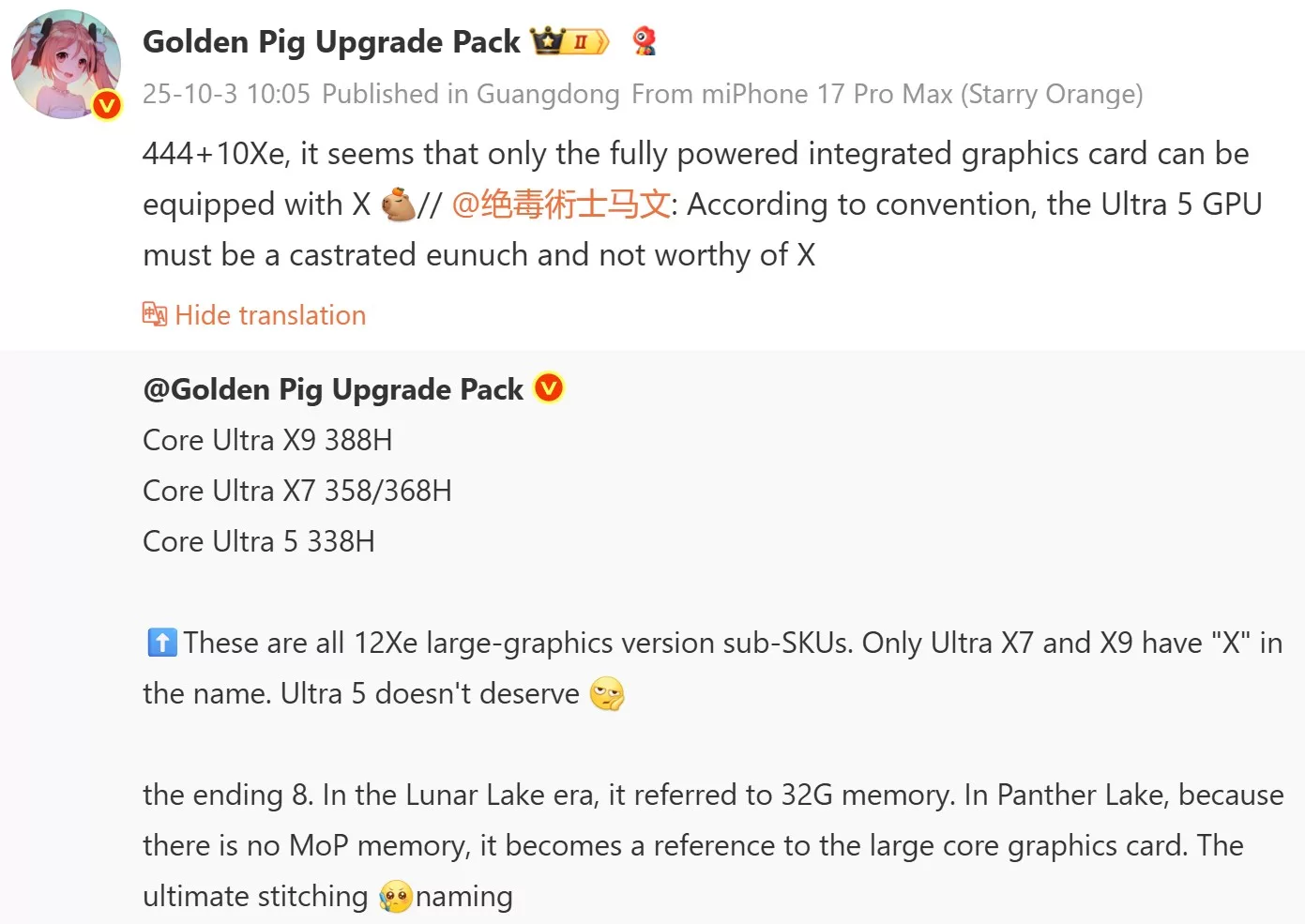
According to the above, the top SKUs are referred to as Core Ultra “X” and will feature a full Xe3 graphics solution with 12 Xe cores, while the lower Core Ultra 5 will have only 10 Xe3 graphics cores. One part of the naming schema change had to due to with the removal of Mobile-On-Package memory used in Lunar Lake. Combined with last week’s rumor regarding the CPU configurations, here’s an updated breakdown of the four reported Panther Lake-H SKUs. Data regarding clock rates or TDP has yet to leak; however, it was said last year that Panther Lake could have a Tjunction max temperature of 105°C.
| SKU | CPU Cores | Xe3 GPU Cores |
| Core Ultra X9 388H | 16 cores (4P+8E+4LP) | 12 Xe3 Cores |
| Core Ultra X7 368H | 16 cores (4P+8E+4LP) | 12 Xe3 Cores |
| Core Ultra X7 358H | 16 cores (4P+8E+4LP) | 12 Xe3 Cores |
| Core Ultra 5 338H | 12 cores (4P+4E+4LP) | 10 Xe3 Cores |
Discussion (7 replies)
Join Discussion →Fingers crossed I want it to be good and give AMD a run for their money.
I hope so do. I doubt it'll really compare with the higher end X3D/non X3D offerings but if they can launch good processors at competitive prices it won't necessarily matter for those willing to settle for a little less at the right price.
A little teaser.
[URL unfurl="true"]https://videocardz.com/newz/intel-says-panther-lakes-xe3-graphics-will-set-a-new-standard[/URL]
I'm cautiously optimistic - but what I really want is for Intel to push out more L3 cache, or whatever they have to do to push back ahead in gaming.
It's infuriating that we know Intel has had the technology to do so all along, they've just chosen not to...
Intel has cared more about using less power than being faster. The whole P-core and E-core thing is just odd. Fine for office PC's, not so much for gaming.
If they want to get the gaming crown back they're going to have to focus on power over economy. I don't see them doing that with their current leadership.
Meanwhile, AMD over there like:
With node shrinks they've gotten more efficient, and compared to AMDs setup they definitely have an edge in idle power usage.
But Intel and AMD both have no problem pushing power limits to the brink of what can be cooled off of their small consumer dies with ambient cooling.
Bigger problem is that Intel isn't focusing on reducing overall latency - like AMD has by adding X3D cache to consumer SKUs - so AMD can build a part that games at ~100W and stomps anything Intel has regardless of power draw or clockspeed.
Seems like if we learned anything from Prescott to Core it was — focus on efficiency, then scale that up for speed/power.