
The transition to clocked DDR5 modules has been underway for a while now, but having the chips to actually build those modules at the highest speeds is a different conversation. Rambus (Yes, that Rambus: the one that convinced Intel to bet the Pentium 4 platform on RDRAM, a memory standard so expensive and unloved that DDR wiped the floor with it anyway) is stepping into that gap today with the announcement of its complete DDR5 9600 Client Memory Module Chipset, a three-chip solution targeting CUDIMM, CQDIMM, and CSODIMM form factors for what the company is calling “future generation AI PCs.”
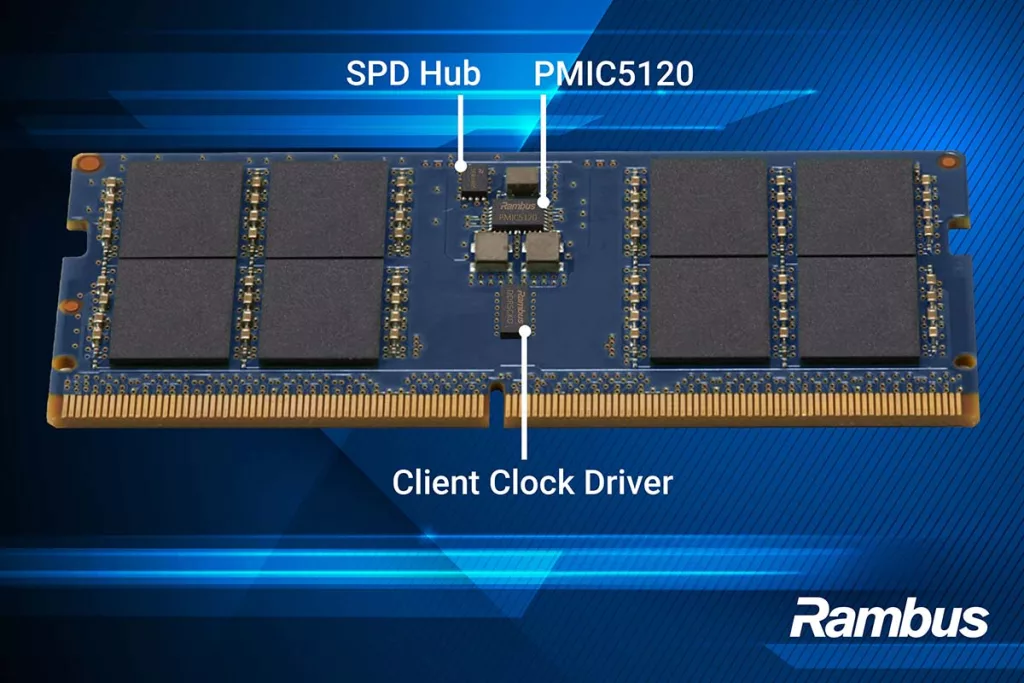
The core of the new offering is the Gen2 Client Clock Driver, or CKD02. For anyone who needs a refresher on why this chip matters: once you push DDR5 past 6400 MT/s, signal integrity becomes a problem. Clock jitter and timing instability start creeping in, and the traditional unbuffered approach runs out of headroom. The CKD’s job is to retime, condition, and redistribute the clock signal from the processor to the DRAM on the module, keeping everything locked and stable at speeds the raw trace alone couldn’t handle. Rambus says the CKD02 supports operation from 8000 to 9600 MT/s.
Completing the chipset are the PMIC5120, which steps the system voltage supply down to the levels the DRAM and other on-module chips actually need, and the SPD Hub with integrated temperature sensor, which handles module identification, configuration, and thermal telemetry over the I3C bus. Nothing exotic there, but having a validated, production-ready combination across all three chips is the actual deliverable here: module makers get a complete, tested stack rather than sourcing and qualifying components piecemeal.
The framing from Rambus is squarely on agentic AI workloads, and that’s not wrong, but it’s worth noting that high-bandwidth client memory is just as relevant to gaming and content creation (take a look at our dive into it from a couple weeks ago). Faster memory with better signal integrity means tighter timings and more sustained bandwidth regardless of whether your PC is running inference or just trying to feed an extremely texture-hungry game engine.
On the product page, Rambus also lists a 7200 MT/s chipset family (CKD01 / PMIC5100 / SPD Hub) for current-generation CUDIMM and CSODIMM designs, so there’s a clear generational ladder in place. The 9600 lineup is the top rung at the moment.
No word on specific module partner availability or retail timing in today’s announcement. Rambus sells these chips to memory module makers, not directly to consumers, so the clock on when 9600 MT/s CUDIMM kits hit shelves is largely in DRAM and module vendor hands.
Discussion
Join Discussion →No replies yet. Be the first to reply on the forum.