
This week’s review landscape is anchored by the ASUS ProArt GeForce RTX 5080 OC, a 2.5-slot Blackwell card with a wood-grain trim panel and USB-C display output that looks more like studio equipment than a gaming GPU, and Guru3D put it through 32 pages of testing to find out if the unconventional packaging holds up. We also published our review of the ASRock X870E Challenger WiFi, the X870E step-up from the Challenger White he covered last week, rounding out a full week of ASRock AM5 coverage. Elsewhere, Gen 5 storage gets attention from Kioxia’s own-NAND flagship, Igor’s Lab returns the Noctua NH-D15 G2 in black, and the SilverStone FLP03 makes its review debut as the smaller, mATX follow-up to last year’s well-received retro tower.
ASUS ProArt GeForce RTX 5080 OC
Written reviews:
Consensus summary: Guru3D’s 32-page evaluation confirms this 304mm, 2.5-slot card built on the GB203 die: 10,752 CUDA cores, 16GB GDDR7 at 30 Gbps, factory-overclocked to 2,730 MHz boost in OC mode. Under sustained gaming load the card holds approximately 2,775 MHz, and the triple Axial-tech fan vapor chamber cooler keeps temperatures well-controlled for the footprint, with a Quiet BIOS option for noise-sensitive environments. Their conclusion calls it a standout for “standing apart precisely because it doesn’t try too hard,” rating the thermal and acoustic engineering among the better implementations at the RTX 5080 tier.
FPS Review take: We reviewed the GIGABYTE RTX 5080 WINDFORCE SFF 16G earlier this year for a compact RTX 5080 comparison point; the ProArt OC goes further with USB-C display output and the wood-trim aesthetic, targeting builders who want a card that fits a smaller case or a cleaner workstation without sacrificing Blackwell performance (you can find it here on Amazon).
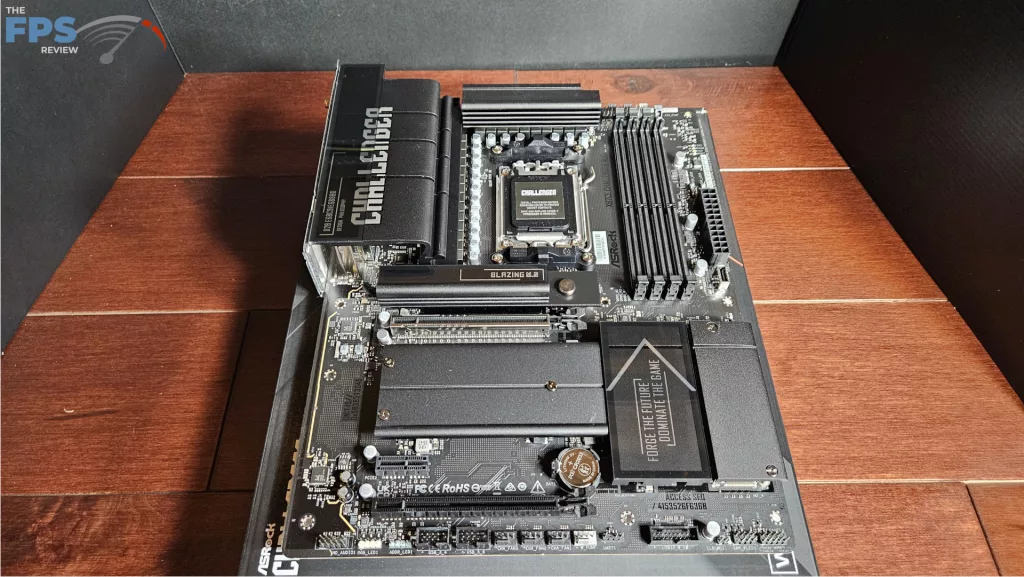
ASRock X870E Challenger WiFi
Written reviews:
- The FPS Review: https://www.thefpsreview.com/2026/07/20/asrock-x870e-challenger-wifi-motherboard-review/
Consensus summary: Rick Patterson scores this one an 8.8 out of 10 at $229 on Newegg, making it the current price floor for X870E with dual USB4. The 20+2+1 VRM at 110A DRMOS, ten USB-A ports across 2.0, 5 Gbps, and 10 Gbps tiers, dual 40 Gbps USB-C, 5G LAN, Wi-Fi 7, and one PCIe 5.0 primary M.2 alongside three Gen 4 slots give it a feature sheet that competes with mid-range X870E boards at a noticeably lower entry cost. Rick flags tight PCIe clasp tolerance with wider GPU coolers and proximity of M.2 slots 2 and 3 to GPU heat as the practical caveats to building around.
FPS Review take: This completes a week-long sweep of ASRock’s AM5 lineup: Rick covered the X870 Challenger WiFi White last week at entry tier, the X870E here adds the full chipset feature set for $229, and last week’s Weekender covered the X870E Taichi White at flagship. If you are mapping ASRock’s AM5 options before a build, those three reviews together cover the full stack in two weeks.
SilverStone FLP03
Written reviews:
- Hardware Asylum: https://www.hardwareasylum.com/reviews/cases/sst_flp03
Consensus summary: Dennis Garcia over at Hardware Asylum reviews the SilverStone FLP03, the MicroATX follow-up to the ATX-sized FLP02 retro tower that drew strong enthusiasm when it launched late last year. Like the FLP02, the FLP03 goes back to the beige computer tower aesthetic of the 1990s: simulated 5.25-inch bay covers, a retro control panel, no tempered glass, and no ARGB. The MicroATX format makes it smaller and more practical for compact builds while retaining the same retro-forward philosophy. Hardware Asylum finds the FLP03 takes the concept further rather than simply shrinking it.
FPS Review take: The retro PC case market turned out to be more durable than the industry expected, and the FLP03 signals SilverStone is building a product line rather than running a one-time experiment. The MicroATX footprint opens the nostalgia aesthetic to a broader range of builds that are able to keep their cool with today’s hardware.
Kioxia Exceria Pro G2
Written reviews:
Consensus summary: Samuel Willetts at Club386 rates the 2TB model 4.5 out of 5 at £299 (Ed: How much is that in greenbacks?), built on Kioxia’s own BiCS8 218-layer TLC NAND with a Silicon Motion SM2508 controller and 2GB of LPDDR4X DRAM cache. Sequential reads hit 14,906 MB/s in CrystalDiskMark with peak temperatures of 60°C using only the motherboard heatsink, and the drive earns 1,200 TBW endurance and a five-year warranty. Club386 notes the Crucial T710 was its only real value competition at this price point, and Micron’s announced exit from consumer storage removes that alternative from the market going forward.
FPS Review take: Kioxia manufactures its own NAND rather than sourcing from the same suppliers as most SSD brands, which gives the Exceria Pro G2 a supply-chain and bin-quality argument worth noting in a year when NAND allocation has been tight across the board. Club386’s independent hands-on is the right starting point for anyone comparing Gen 5 flagship options right now.
Noctua NH-D15 G2 chromax.black
Written reviews:
- Igor’s Lab: https://www.igorslab.de/en/noctua-nh-d15-g2-chromax-black-review-return-of-the-king-in-black/
Consensus summary: Enrico Steinert at Igor’s Lab reviews the black-finish version of the NH-D15 G2, finding a “consistently refined dual-tower air cooler” that reaches near-maximum thermal performance at moderate fan speeds with very little incremental gain from pushing the NF-A14 fans to maximum. Testing on a Ryzen 9 7900X platform confirms predictable, consistent behavior well within what the full NH-D15 G2 has established as the benchmark for flagship air cooling. The chromax.black finish holds up under Igor’s Lab’s rigorous methodology without any acoustic or thermal trade-off versus the standard finish.
FPS Review take: Noctua appears in two entries this week, here and in the Seasonic PSU below, which is a good summary of where the brand’s 2026 collaborations have landed. The chromax.black version addresses the longstanding ask from builders who wanted flagship air cooling performance without the signature brown.
G.SKILL Trident Z5 NeoX RGB DDR5-6000 CL30 32GB
Written reviews:
Consensus summary: TechPowerUp evaluates this 32GB (2x16GB) single-rank kit, G.SKILL’s first DDR5 implementation of AMD’s EXPO ULL (Ultra Low Latency) standard, which requires AGESA 1.3.0.1b Path A or later for activation. At DDR5-6000 CL30, the NeoX targets the tighter end of the latency spectrum for this frequency class, and testing on Ryzen 7000 and 9000 platforms confirms improved latency and a clean one-click compatibility path versus manually tuned kits. TechPowerUp’s verdict calls it an easy recommendation for AM5 Ryzen builders seeking a memory performance upgrade, with the caveat that the current DRAM market makes the price a significant premium over standard EXPO kits.
FPS Review take: EXPO ULL is AMD’s attempt to deliver Intel XMP-style tight-timing profiles for Ryzen owners without requiring manual tuning, and the NeoX is among the first retail kits to implement it properly. Whether the real-world gains justify the price premium over standard EXPO kits is a harder case to make today, but for a high-end Ryzen 9000 build where memory latency matters it at least provides a clear upgrade path.
MSI MAG B850 Gaming Plus MAX WiFi
Written reviews:
Consensus summary: Guru3D’s evaluation covers the full feature set of this white-finish B850 MAX refresh: PCIe 5.0 GPU and primary M.2 slots, 5G LAN, Wi-Fi 7 with tri-band 6 GHz support, Bluetooth 5.4, and the 64 MB BIOS chip that distinguishes the MAX revision from earlier MSI B850 releases. Guru3D positions it as the sensible mainstream AM5 platform for builders who want modern IO without the X870E premium, describing the board as designed to be built, tweaked, upgraded, and lived with across multiple GPU generations.
FPS Review take: Rick reviewed the MSI MAG B850 Gaming Plus MAX WiFi in February at launch, making Guru3D’s July evaluation a second opinion after the board has had several months in the wild.
Seasonic Prime TX-1600W Noctua Edition
Written reviews:
Consensus summary: TechPowerUp’s evaluation covers the full electrical and acoustic test suite on this 1600W Seasonic and Noctua collaboration, finding rock-solid voltage regulation, very low ripple at 110 percent load, and a Cybenetics LAMBDA A++ acoustic rating from the custom NF-A12x25 fan and purpose-designed grille that replaces the standard 135mm unit. ATX 3.1 and PCIe 5.1 certification alongside dual 12V-2×6 connectors covers current and upcoming GPU requirements, and TechPowerUp calls it “a benchmark in power supply engineering” at approximately $569.
FPS Review take: The Noctua Edition is the version of an already strong PSU for builders prioritizing near-silent operation under heavy load, and the pairing with the NH-D15 G2 chromax.black reviewed above is the obvious combination for a low-noise-floor build. Both products address the same goal from different angles.
Discussion
Join Discussion →No replies yet. Be the first to reply on the forum.