
The best-covered product of the week is a 39-inch ultrawide, which tells you something about where display tech is right now. Alienware’s AW3926QW put a glossy 5K2K RGB-stripe tandem panel at $1,099 and reviewers spent the week trying to find the catch. Elsewhere, DLSS 4.5 Ray Reconstruction finally shipped to every RTX card, S.T.A.L.K.E.R. 2 got the engine upgrade it has needed since launch, and a surprising number of outlets found themselves reviewing AM4 hardware in the back half of 2026.
Alienware AW3926QW
Written reviews:
- Club386: https://www.club386.com/alienware-aw3926qw-review/
- T3: https://www.t3.com/tech/monitors/alienware-aw3926qw-review
- Tom’s Hardware: https://www.tomshardware.com/monitors/gaming-monitors/alienware-aw3926qw-39-inch-wuhd-oled-gaming-monitor-review
Video reviews:
- TFTCentral: https://www.youtube.com/watch?v=fKbs-_nR2fI
- Monitors Unboxed: https://www.youtube.com/watch?v=ZO9wzHabIP4
Consensus summary: Reviewers agree the panel is the story: a 39-inch 5120×2160 tandem WOLED with a true RGB-stripe subpixel layout and no white subpixel, which fixes the text-clarity complaint that has dogged WOLED ultrawides. Tom’s Hardware handed it an Editor’s Choice and measured reference-grade color out of the box, and Club386 and TFTCentral both framed $1,099 as the genuine surprise given it undercuts the LG 45GX950A-B. The glossy coating is the one point of divergence, since it buys contrast in a dark room and costs you in a bright one, and T3 noted UK and EU buyers wait until early September.
FPS Review take: A 165Hz native panel that flips to 330Hz at 2560×1080 is an odd pitch on paper, but it is the right compromise at this size, and the dual-mode implementation is the part worth reading the reviews for. Worth checking your GPU can actually feed 5K2K before you get excited: our GIGABYTE GeForce RTX 5090 GAMING OC 32G review is a decent yardstick for what this resolution asks of a card.
be quiet! Light Mount TKL
Written reviews:
- Guru3D: https://www.guru3d.com/review/be-quiet-light-mount-tkl-keyboard-review/
- Club386: https://www.club386.com/be-quiet-light-mount-tkl-review/
- OC3D: https://overclock3d.net/reviews/input_devices/be-quiet-light-mount-tkl-review/
- PC Gamer: https://www.pcgamer.com/hardware/gaming-keyboards/be-quiet-light-mount-tkl-review/
- eTeknix: https://www.eteknix.com/be-quiet-light-mount-tkl-mechanical-keyboard-review/
- MADSHRIMPS: https://www.madshrimps.be/2026/08/be-quiet-light-mount-tkl-gaming-keyboard-review/
Video reviews:
Consensus summary: Six outlets landed on the same verdict from different angles: the acoustics are the product. Silent V2 switches, triple-layer dampening and a brushed aluminum top plate produce a board that Club386 measured as quieter than some membrane keyboards, and everyone credits the build quality at $139.90. The disagreement is about who it is for, since Guru3D and PC Gamer both point out that at this price you are giving up adjustable actuation, rapid trigger and 8K polling that magnetic-switch rivals include, and the 1,000 Hz polling and wired-only design make the competitive pitch thin.
FPS Review take: be quiet! built a keyboard for people who game at midnight in a house with other people in it, and that is a real and underserved buyer. Quick Tap covers the SOCD box for shooter players, so the only group genuinely poorly served here is the esports crowd who were never the target anyway.
AMD Radeon RX 9070 vs. RX 9070 XT
Written reviews:
Video reviews:
- Hardware Unboxed: https://www.youtube.com/watch?v=eSv8n3seMi0
Consensus summary: Across 52 games, the XT came out 12% faster on average at both 1440p and 4K, which sits inside the 9 to 14% range from the original launch reviews but on a far larger sample. The two cards are otherwise identical on paper: 16GB of 20Gbps GDDR6, a 256-bit bus, 640 GB/s of bandwidth and 64MB of Infinity Cache. The undervolting section is the practical takeaway, since every card tested handled a -80 mV offset, most were stable at -100 mV, and a few managed -120 mV.
FPS Review take: At launch the non-XT made no sense at 8% cheaper for 13% fewer cores, but street pricing has moved enough since that the answer now depends entirely on what your retailer is doing this week. If you are cross-shopping the rest of the RDNA 4 stack, our AMD Radeon RX 9070 GRE review covers the awkward middle child neither of these two has to worry about.
NVIDIA DLSS 4.5 Ray Reconstruction
Written reviews:
- TechPowerUp: https://www.techpowerup.com/review/nvidia-dlss-4-5-ray-reconstruction/
- Tom’s Guide: https://www.tomsguide.com/computing/gpus/i-tested-nvidias-new-dlss-4-5-ray-reconstruction-it-finally-fixes-path-tracings-biggest-flaw-but-heres-the-reality-check
Consensus summary: The new second-generation transformer model carries 20% more parameters and 35% more compute, and the striking result across every test is that it costs almost nothing. TechPowerUp measured performance on an RTX 5090 with path tracing as essentially unchanged, slightly faster at 1440p and 4K and a few percent slower only at Ultra Performance, with a VRAM cost of 63MB in Cyberpunk 2077, 51MB in Pragmata and nothing measurable in DOOM: The Dark Ages. Tom’s Guide saw no frame rate penalty at all on an RTX 5080 and negligible drops on an RTX 5060 Ti 16GB. Reviewers converge on path-traced titles showing the biggest gain, since Ray Reconstruction only touches ray-traced pixels and path tracing means the whole frame qualifies.
FPS Review take: The quiet headline is that Preset F applies to all 30 supported titles with no per-game training, so this is one algorithm that just works everywhere Ray Reconstruction already did. We covered the release in DLSS 4.5 Ray Reconstruction is out now, and it works on every RTX card you own, and TechPowerUp’s finding that DLSS Ultra Performance is now viable is the part RTX 20 and 30 series owners should read.
S.T.A.L.K.E.R. 2: Heart of Chornobyl Update 2.0
Written reviews:
- The FPS Review: https://www.thefpsreview.com/2026/08/22/s-t-a-l-k-e-r-2-heart-of-chornobyl-update-2-0-performance-unreal-engine-5-5-4/
- OC3D: https://overclock3d.net/reviews/software/stalker-2-patch-2-0-tested-huge-improvements/
Consensus summary: Update 2.0 moves the game from Unreal Engine 5.1 to 5.5.4, and the gains are real rather than a placebo patch. OC3D recorded 41.9% average and 65.9% first-percentile improvements in a CPU-limited area, which matters because CPU-bound settlements were the specific thing wrecking the experience on high-end rigs. Everyone flags the same caveat: GSC locked to 5.5.4 for the Cost of Hope DLC, so the game misses the further optimizations in 5.6 through 5.8, and gains in open areas are considerably smaller than in dense hubs.
FPS Review take: Our testing was GPU-focused and run against the 2.0.1 hotfix, which pairs usefully with OC3D’s CPU-limited numbers rather than duplicating them. If you shelved this one at launch over performance, this is the patch that earns a reinstall, and the A-Life work and 500 bug fixes are not nothing either.
MSI B550 GAMING WiFi6E (2026)
Written reviews:
- The FPS Review: https://www.thefpsreview.com/2026/08/24/msi-b550-gaming-wifi6e-2026-motherboard-review/
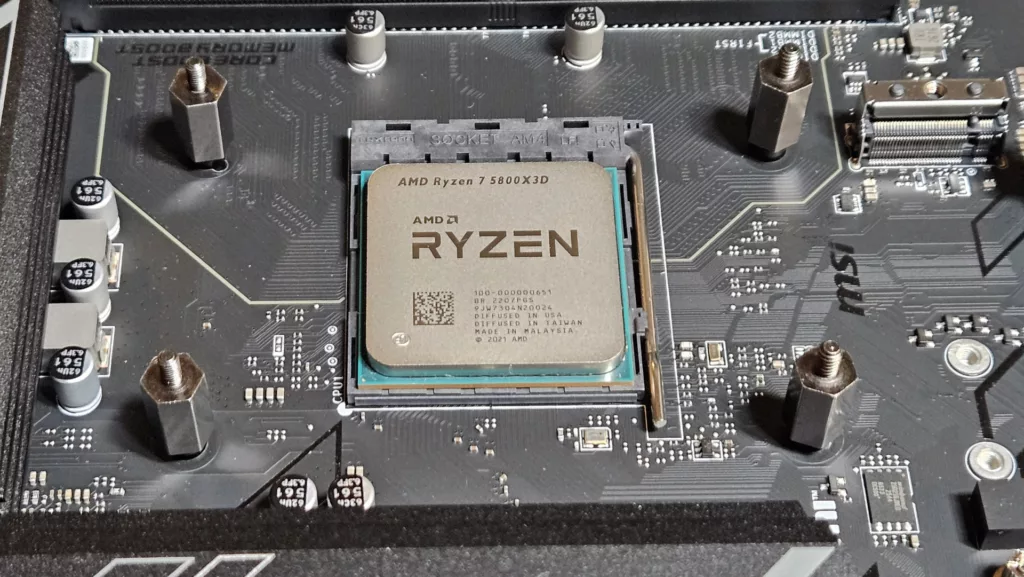
Consensus summary: This is what you would expect for a $109 AM4 release in the back half of 2026. The pitch is a refreshed B550 with updated WiFi and Bluetooth, a three-year warranty, and a price that looks increasingly rational as DDR5 and NVMe pricing stays inflated by AI demand.
FPS Review take: A new AM4 motherboard in 2026 sounds like a punchline until you price a DDR5 kit, and MSI has more AM4 boards coming. See our standalone piece on the AM4 revival for the fuller argument. If you are going the other way and building on AM5 instead, our ASRock X870E Challenger WiFi review covers the value end of that platform.
Colorful iGame X870E VULCAN W OC V14
Written reviews:
- Guru3D: https://www.guru3d.com/review/colorful-igame-x870e-vulcan-w-oc-v14-review/
- FunkyKit: https://www.funkykit.com/reviews/motherboards/colorful-igame-x870e-vulcan-v14-w-oc-motherboard-review/
Consensus summary: The white edition is more than a repaint, and both reviews focus on that. Colorful added immersion-gold treatment and PCB back-drilling, which removes unused conductive material from plated through-holes to cut signal reflections that interfere with high-frequency memory, plus upgraded solid EPS connectors. The platform underneath is unchanged and serious: an 18+2+2 phase design with 110A DrMOS stages, dual 8-pin EPS, a 10-layer PCB with two-ounce copper, and only two DDR5 slots, which sacrifices capacity flexibility for shorter traces and better memory overclocking.
FPS Review take: Colorful going after the ASUS Apex and ASRock OCF crowd on AM5 is the interesting part here, because that segment has been a four-manufacturer club for years. Two DIMM slots is a deliberate signal about who this is for, and if that is not you, our motherboard specifications database is the faster way to find a four-slot X870E.
ASUS ROG Strix OLED XG34WCDMS
Written reviews:
Consensus summary: TweakTown rates the panel highly and the price poorly. It is a 34-inch 3440×1440 fifth-generation Tandem RGB QD-OLED running at 280Hz with 0.03ms GTG response, and the tandem construction delivers the brightness and longevity improvements that generation promised, along with a BlackShield film ASUS rates at 2.5 times the scratch resistance of previous QD-OLED panels. The problem is $899 when MSI ships the same panel for roughly $150 less.
FPS Review take: “Same panel, different badge, $150 apart” is a recurring 2026 monitor story and it is worth internalizing before you shop by brand. Note the contrast with the Alienware above, where a larger and higher-resolution panel lands at $1,099 and looks like a bargain by comparison.
PCSpecialist Momentum Pro (Ryzen 7 5700X + RX 9060 XT 16GB)
Written reviews:
Consensus summary: KitGuru’s question is whether a current-generation 16GB GPU bolted to an older AM4 platform makes a genuinely good £1,099 machine, and the answer is a qualified yes for 1440p. Assembly quality gets praise; the motherboard limits CPU boosting, which is the compromise you accept for the price.
FPS Review take: This is the same AM4 economics story as the MSI board above, just assembled and shipped to your door, and it is a reasonable reading of a market where the RAM is more expensive than the CPU. The 16GB frame buffer is the right corner to not cut in 2026.
TRYX HOLO ARGB 360 AIO
Written reviews:
Consensus summary: FunkyKit calls it one of the craziest looking AIOs they have tested. The pump head swaps the now-standard flat LCD for a 640×480 beam-splitting lens assembly that makes the image appear suspended inside the optical chamber, mounted in an aluminum housing with 60 degrees of viewing-angle adjustment. Underneath the theatre it is a conventional 360mm Asetek unit rated for 280W with pump speeds from 800 to 2,800 RPM, and FunkyKit found cooling performance decent when tested against a Core Ultra 7 270K Plus.
FPS Review take: Pump-head displays hit their aesthetic ceiling a while ago, so credit to TRYX for finding a genuinely new trick rather than shipping a slightly bigger screen. The KANALI software’s GIPHY integration is either the best or the worst thing in this Weekender depending on your tolerance for a reaction GIF looping inside your loop.
Discussion (3 replies)
Join Discussion →The only thing not getting devoured by data centers?
Soon!
Just wait for the news article about how vendors are now adding un used display technology to grid compute engines and letting it run behind the scenes so AI can be faster...
I mean honestly... lets say that the next Console version releases and the ultra uber edition is 2 thousand dollars. BUT... get this little jimothy, if your parents agree to let Uncle AI run on your consoles you can HAVE the console for just 1/10th that price! Isn't that neat!
** All electricity and internet costs are born by the purchaser, Console must be left on no less than 12 hours a day on average per year without a game being played. For slightly more money (1000 dollars) you can have the console and only need it to be on and un-played for 4 hours a day!) The vendor is not responsible for any incidental fires or other events that may cause harm or loss to the host of said console.