
Test Setup
Please read our test setup information carefully below, we are using Windows 11 Pro, and each testbed is customized for each CPU platform being compared. There are common components.
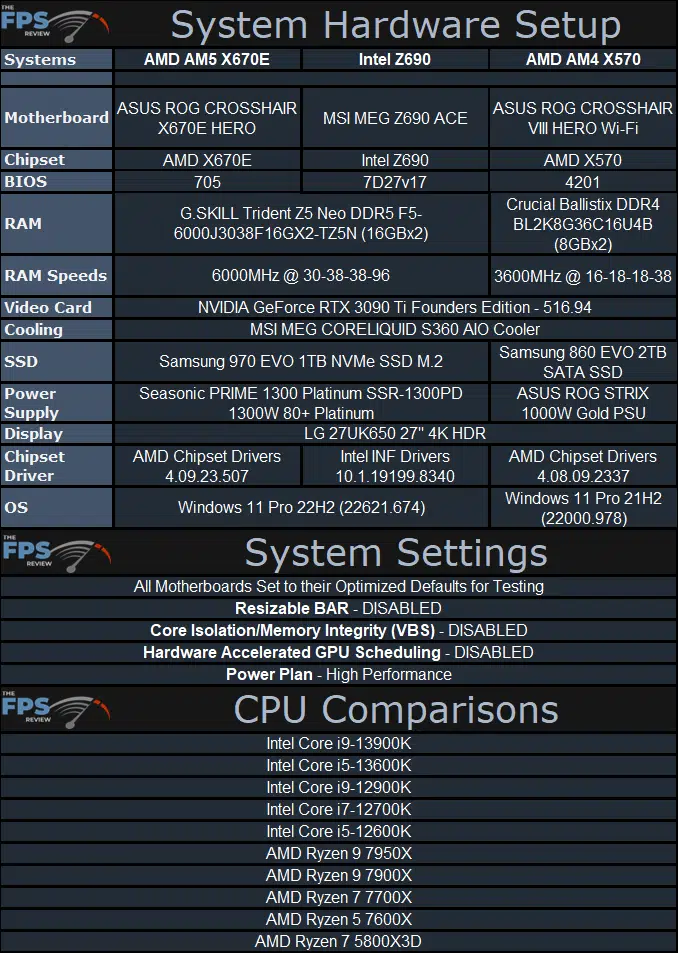
System Config
Take note that the same G.SKILL DDR5-6000 memory kit is being used on the Intel Alder Lake platform, Intel Raptor Lake platform, and AMD AM5 platform. We are using the same memory profile on all systems at the same frequency and timings. We have updated the BIOSs on every motherboard to the absolute latest BIOS versions. We are using the same CPU cooler MSI MEG CORELIQUID S360 AIO Cooler on all CPUs. We are also using the same GeForce RTX 3090 Ti Founders Edition video card on all systems. We have updated the chipset drivers to the latest versions.
Note that we installed a fresh copy of Windows 11 Pro and applications and games on each platform tested With each new platform, we set up, a new fresh copy of Windows and games was put on. We are using the latest Windows 11 Pro 22H2 on the Raptor Lake platform to benefit from Intel Thread Director 2 as recommended by Intel.
Also, take note of the motherboard settings we have disabled. Firstly, we did set each motherboard to its “Optimized Defaults” before testing each CPU. We utilize the default motherboard settings across all CPUs. We set the CPU Cooler option in the BIOS to AIO, which is what is being used. However, we did specifically disable PCI-Express Resizable BAR in the BIOS. The reason for this is so that we can isolate CPU performance only when it comes to gaming performance differences. We did not want Resizable BAR to add to, or interfere with the CPU performance in games. We wanted to isolate the CPU differences so you see what the real CPU performance is bringing to the table, not what PCIe Resizable BAR is adding to it.
The same reasoning is also why we disabled Hardware Accelerated GPU Scheduling on the GeForce RTX 3090 Ti FE in Windows. In addition, Virtual Based Security is also disabled so it doesn’t interfere with performance. We are using the “High Performance” power profile on all CPUs.
Again, we want to isolate CPU performance, and this was the goal of turning these features off. In our GPU reviews, we ALWAYS have Resizable BAR enabled, so if you want to see what performance in games is with that feature enabled, all of our GPU reviews have it enabled and will continue to in the future.
Discussion (16 replies)
Join Discussion →Brent, very well done with the review! This thing is a power monger (both in terms of performance and consumption!).
I'm torn though and not liking the current "Trend" from AMD and Intel with their strategy on becoming the performance king. Throwing more power a the device shouldn't be the way to achieve this.
I'm inclined to make my next CPU decision based on Performance per watt. I can deal with slower performance if it means I'm not going to be spending an arm and a leg with the Electric Company.
Nice review enjoyed reading it. Would have loved to have seen some 5900x and 5950x cpu comparisons since you had the previous gen intel ones. But chart space is a thing. :) Gotta make it so eyeballs can read it!
Looks like I'm keeping the 12700k a while longer, this thing runs hot enough as it is, don't need a bigger heater.
If the AMD GPU's don't make for a good upgrade I might just upgrade my AMD machine with a 5800X3D and leave it at that.
That's the most cost effective upgrade you can do strictly for gaming. Obviously not a slow CPU in any desktop task of course. But that's if you have a need for it; the 12700K ain't slow by any means!
Alas, my poor Haswell-E...
I think both AMD and intel dropped the towel on power efficiency (and nvidia too for that matter). To think that all of them at some point touted power efficiency for their next gen products. At least nvidia delivered with Maxwell and Pascal.
Think of it another way - compare a modern V8 that's more powerful (more torque and horsepower) across its RPM range than a similarly displacing V8 from thirty years ago, and then note that said modern V8 is not only more efficient when putting power down, but has cylinder deactivation and is more efficient at idle. Or, can be made significantly more powerful than the older V8 peak to peak tuned, but again peak to peak, the newer V8 uses more fuel. Because it can, not because it needs to.
We're seeing massive leaps in efficiency, and we're also seeing companies be able to push their parts closer to the limit stock.
Hey, I'm right there with you with my Ivy Bridge E. I was thinking of saving up for one of these this summer but now after seeing the gaming performance I'm rethinking it.
I do need to upgrade but I think I'll wait for the Ryzen 7000 3D versions. The only thing I know for sure is I'd like something that can last around 7-10 years as this has and since I've already got a rig with a 5800X3D it doesn't make sense to build another with the same, especially seeing it within a couple of frames of this processor at 4K gaming. Those 3930/4930/5930 K processors are still amazing after all this time but definitely getting long in the tooth.
I think this is closer to the truth.
The flip side of that coin is that stock power goes up when companies hit walls on other means to generate performance increases.
If you can't engineer it in more performance as part of the architecture, or throw more cores at it, then you hope like hell you can just push more power through it and boost the clocks.
It will continue to go up until people stop buying them. For the mass market - you aren't going to see 280W 13900K's in the average desktop computer in a cubicle for a call center, or in a POS cash register, or a laptop. All the chips in that market will continue to get more efficient -- because the cost of cooling is an overhead item they can cut out as the technology does get more efficient - the performance boosts just aren't as pronounced when the technology to run it has been fast enough for more than a decade now.
That part the V8 analogy still carries through - you don't see big Hellcat-driven minivans mass produced at the car lot, you see smaller displacement and more fuel efficiency and more gears in the transmission, while staying around a hp/torque level that seems "good enough" for the size of the car. The speed limit on the highways haven't changed in a long time, after all (but Americans have gotten fatter - hence turbochargers becoming more common ---- that's a bad joke, but only because part of that is at least true).
Those big, power hungry chips really only have two markets: big workstations that do serious work (pro content creation, engineering CAD, simulations, etc) - and gamers/enthusiasts. And in those markets - they won't really care about power until they start tripping breakers. And even then, good odds on them just saying "Oh well, I'll call the electrician" and still not caring.
Great review. This just drives home the point, if you use your rig for gaming primarily, and that's done in 4K, jumping up to the 13th Gen isn't really worth it since you are more GPU bound.
IMO the current price/performance cpu for 4k would be a 5800X3D. Might go as low as a 5600X if in a budget.
If you're on Intel... 7th-gen maybe, or have an AMD board that cannot take a 5800X3D, then it's a good upgrade if you also have a higher-end GPU. Especially keeping in mind that GPUs drive higher average framerates, while CPUs drive minimum framerates.
Well I went against my thoughts and got a 13900K as my buddy wanted my 12900K and offered me a fair deal. I thought about just going with a 13700K or 13600K, but I wanted to stick with an i9. Honestly when gaming this chip only gets about 5 degrees Celsius hotter than the 12900K using a NH-U12A cooler which isn't bad at all to me. Goes to show you what a good air cooler and a high airflow case can do to even a hot running chip.
This... is entirely relative to the load. Granted, that only matters if you do something that would benefit from more cooling - gaming and general desktop usage aren't going to really tax these CPUs.
Agreed, but I was just comparing it to my 12900K and what temps I had with that chip doing the same games/work loads. I'll probably never push this chip to its limits, but I never really did that with the 12900K either, just on occasion. I'm just impressed with the NH-U12A on how it has been effectively cooling this chip so far. I had some doubts, but it shows that air cooling isn't dead.