
Sound Level Testing
While we were testing cooling capabilities, as outlined in our introduction article, we were also tracking the sound level of each of the coolers using a Risepro SPL meter attached to a boom arm pointed directly at the fans of the radiator at a distance of 12 inches. We recorded the dB(A) level for each fan and pump speed tested. The ambient room sound level measured 33 decibels. Displayed below are the results of our Stock Clock Testing.
Max Fans – 100% Pump Speed
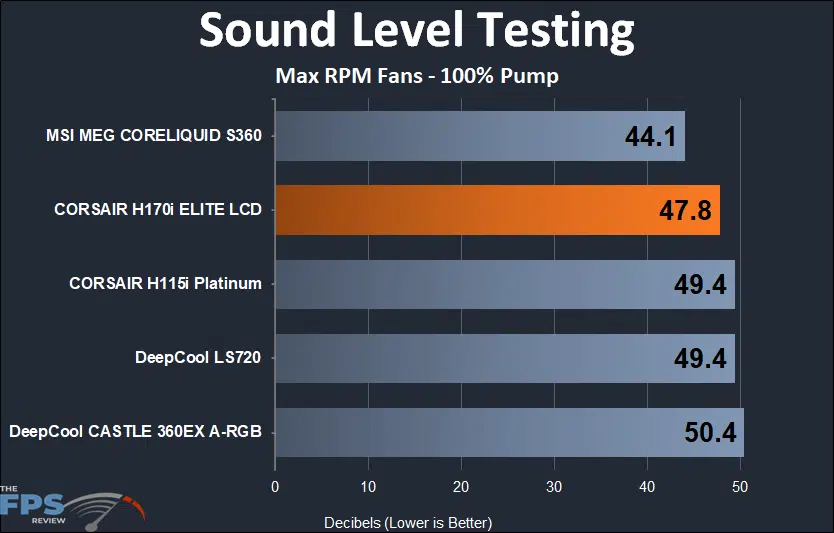
One thing to note with the CORSAIR H170i ELITE LCD is that our test sample’s ML140 fans maxed out at 1500RPM, which is in the ballpark of the rated 1600RPM +/- 10%. With that, we will still compare it at its maximum performance against the competition and again with its competition set at 1500RPM. Overall, 140mm fans tend to have a slower maximum speed than 120mm fans.
With fans blasting as fast as they will go, the CORSAIR H170i ELITE LCD landed in second place, belting out 47.8 dB(A) which was 3.7 dB(A) higher than the MSI MEG CORELIQUID S360. On a subjective level, it was obvious that air was being moved, however, it did not sound obnoxious.
1500 RPM Fans – 100% Pump Speed
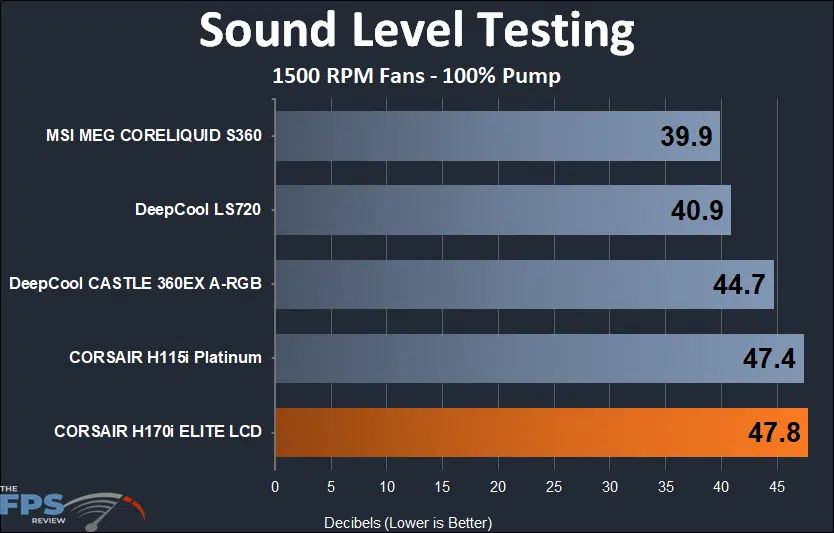
Moving all the contestants down to 1500RPM, which is also the CORSAIR H170i ELITE LCD’s top speed finds it in last place, with the rest of the pack leaving it for the mid to low 40s. This is expected as the 120mm fans it was up against were well north of 2000RPM in the first test.
1000 RPM Fans – 100% Pump Speed
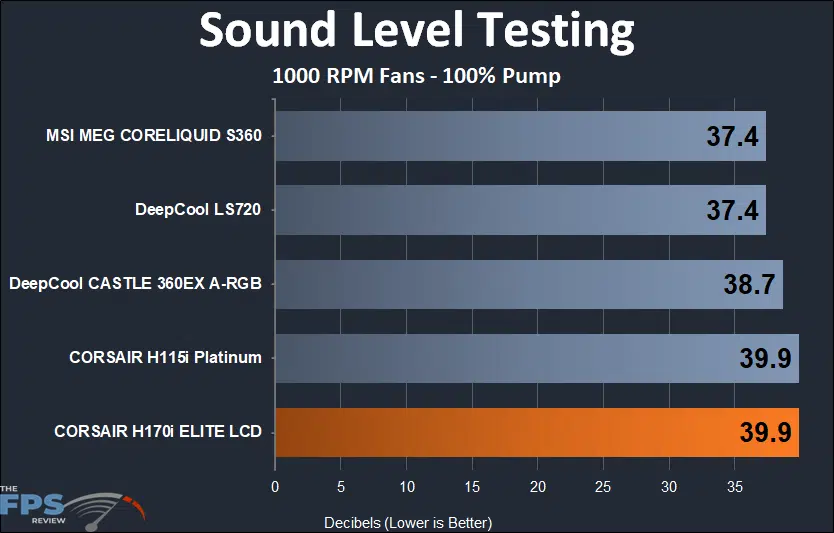
Heading down to 1000RPM, we again find the CORSAIR H170i ELITE LCD tied for last place with the CORSAIR H115i Platinum (the other 140mm fan-based AIO), however, subjectively at this point, we’re not able to distinguish the difference between any of the competitors.
600 RPM Fans – 100% Pump Speed
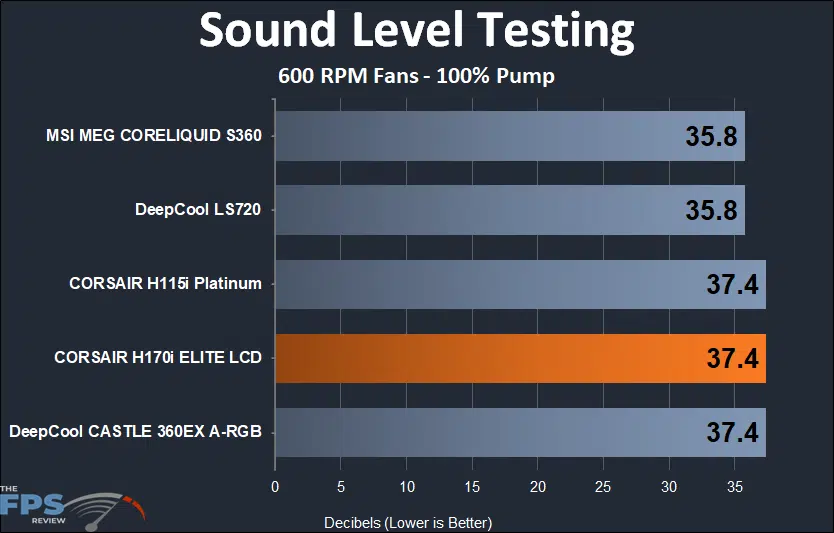
For our lowest test at 600RPM, we find the CORSAIR H170i ELITE LCD at the 37.4 dB(A) mark which ties it for second place, although the difference to first place is rather immaterial. When you pair the performance at this fan speed and sound level, it simply crushes the competition (silently).
Discussion (19 replies)
Join Discussion →What case would house a 420mm cooler??
You know I question even if my monster of a case can handle a 420mm rad. Reaching out to thermaltake on my View 51 TG ARGB case. Product page only lists 360mm rads.
Exactly.. I've been looking for cases to handle 360, and now there's a 420? To be honest this is the first 420mm cooler I have ever heard of.
I mean, it's a beast with the performance it has but that price just says NOPE.. That and finding a case for this thing.
I've found mixed reviews saying my case can handle it. What I need really is a template I can place to confirm and make me feel good. Corsair needs to offer a template to potential purchasers. Something cut to size or printed to size so we can place it to make sure.
https://www.thefpsreview.com/2022/09/15/cooler-master-haf-700-black-case-review/ should work :-)
A 420mm setup is basically 3x 140mm fans plus room to connect the hoses. Same length as a 360mm AIO, just a bit wider. Cases that support it will have essentially two rails to accommodate 360/420 in the same place.
Capellix version should be the same cooling setup, just sans LCD, which should shave about 100 quid off the cost.
BTW spell correction gotcha, I don't think the fans are supposed to support " low notice" Probably low noise.
The list is growing and it's something I'm passively tracking, but both the Carbide and H7 Flow I have can, and with a little work you can use one with a 360 mm GPU AIO as well. Presently, I won't buy a case that doesn't support both as I try to plan for future CPUs and their power-hungry appetites.
Thanks, @David_Schroth for the review. This has been on my radar but I held off on it due to price and took a chance on an Amazon/Newegg China brand called Vetroo (a horrible name I know but it had a lot of good reviews). It's done well other than that at low-mid speeds the fans have a bit of a whine to them but at $115.99 (360 mm) I'm still happy.
So I just read the article... nice job. Seems to me that a better set of fans would both increase performance AND reduce noise appreciably. Yet with the high cost I would be loathe to spend another 60 bucks or so on some high performance high pressure fans.
I think this may be true for quite a few AIOs out there these days. At one point I was thinking of doing that but decided that I can live with it.
Well... sort of kind of maybe but maybe not.
The difficult part here with the comparison with the raw numbers here is that, for the most part, it was up against 360mm AIOs (and a 280mm AIO). 140mm fans tend to have a much lower top speed (and in this case, 1500RPM), so the performance and noise levels observed aren't exactly an apples to apples sort of comparison. The 120mm fan sweet spot for fan speed tends to be in the 1000-1500RPM range with a max in the low 2000's,l but the 140mm fans max around 1500rpm and do quite well around 1000 or a little lower.
In everyday use, this unit will be just as quiet as any other 360mm unit that I've tested. At full blast, it's still quieter than most of them...
My Thermaltake Core WP100.
My 7000X case. It's still in that case so I may go back to it at some point, though I really didn't see a big benefit over a 360mm AIO. It's an Artic 420mm.
More than you'd think; I'd have to go back through our review list, but I can add at least the Phanteks case we reviewed as well. The bigger challenge with 420mm AIOs is usually figuring out how to route everything.
Vendors almost never put their best fans on their AIOs. I guess it makes sense given the bundling effect and that their 'lesser' fans do still work. The other part is that the very best fan designs are simply not available in 140mm. Given that the performance difference between 280mm, 360mm, and 420mm systems isn't that great overall versus say a stock cooler, there's a reason 360mm has become more or less the standard, even in custom loops.