
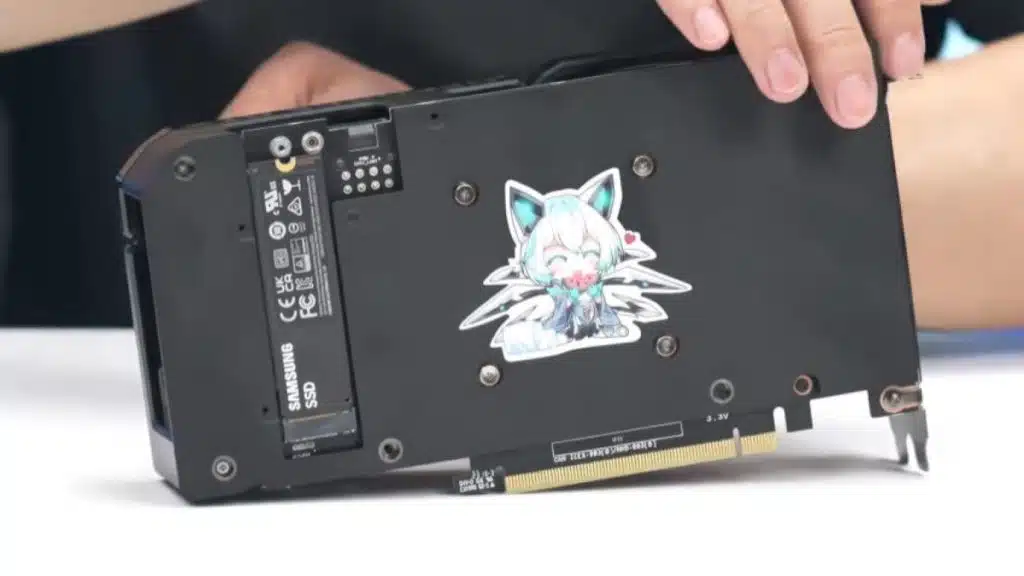
Although not the first to the punch it’s never too late for innovation as ASUS shows off its prototype GPU featuring extra storage options. ASUS General Manager Tony Yu debuted the Dual GeForce RTX 4060 Ti concept card in a new video that can be seen here. In it, we see that the backside of the card has a custom PCB which includes two M.2 2280 slots. One is on the front of the PCB while the other is on the backside. The backplate has been modified for easy access and airflow to the rear drive.
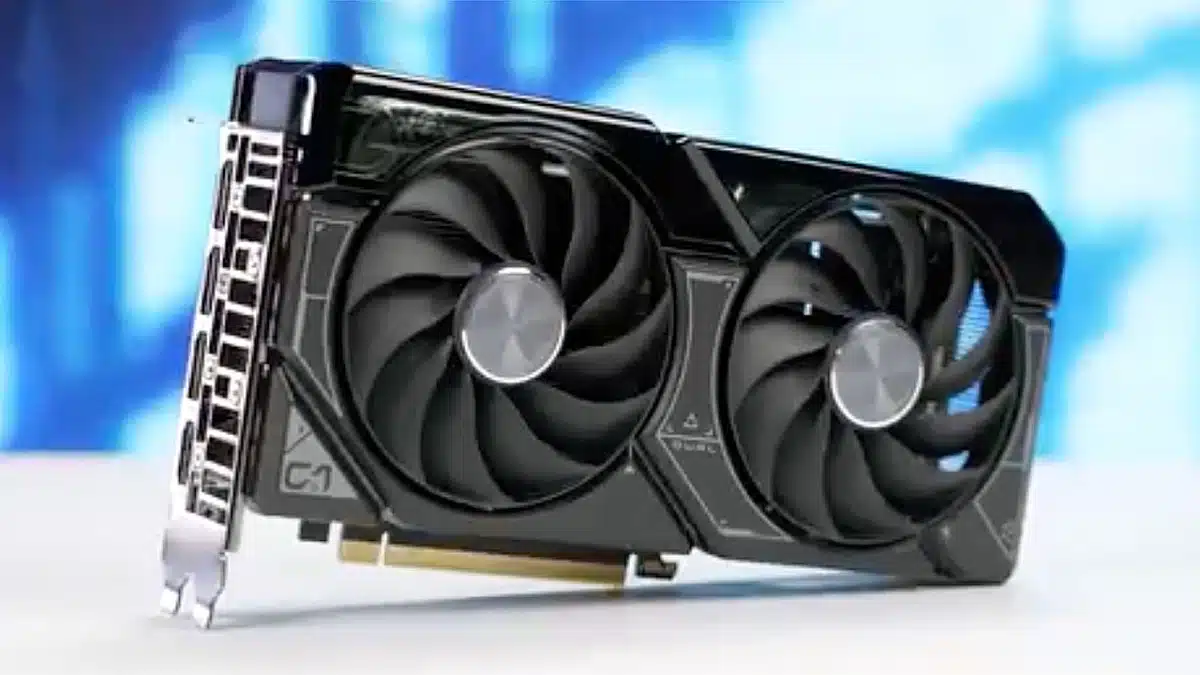
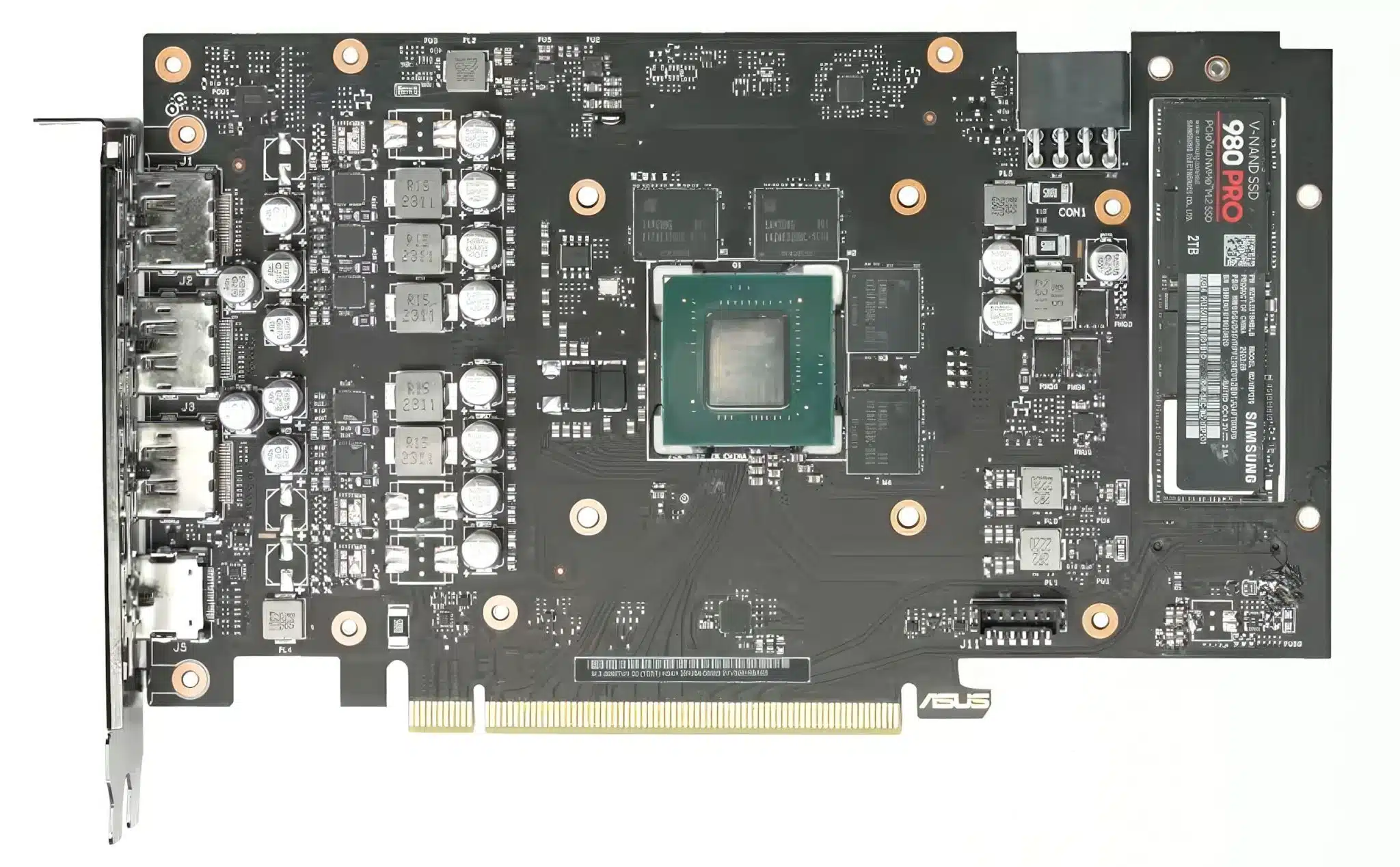
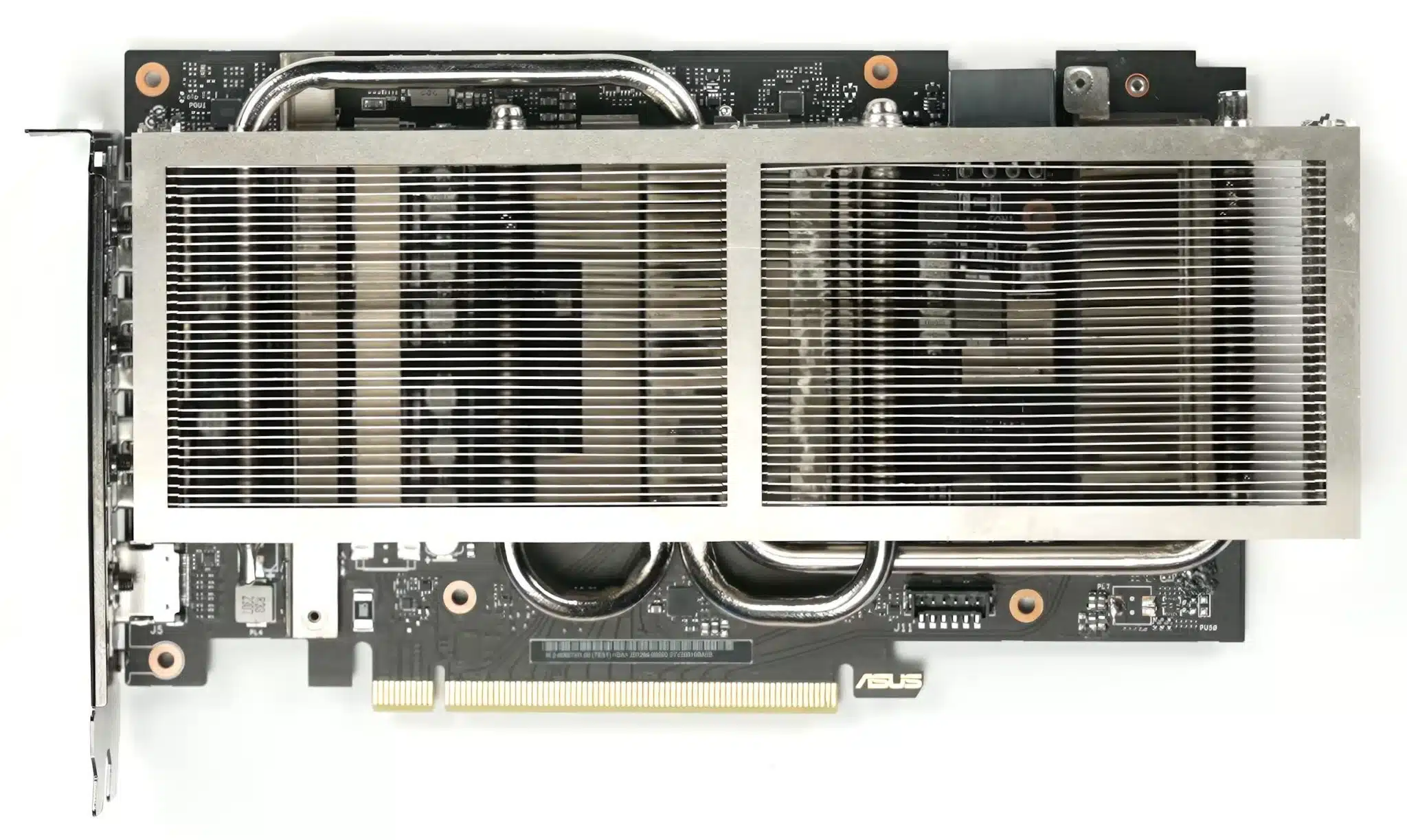
The reasoning behind adding storage to a graphics card like the RTX 4060 Ti is not to increase its memory but to take advantage of the unused PCIe lanes the card doesn’t utilize. Each M.2 slot supports PCIe 4.0 x4 whereas the GPU is using a PCIe x8 interface thus leaving 8 lanes unused.
Another advantage is that a mid-tier card such as this has low enough power requirements that it can still support the ~10W needed for these SSDs and still only have a single 8-pin connector. Now the elephant in the room becomes the issue of cooling. More than a few builders would be right to be concerned about the possibility of slapping M.2 drives onto an iGPU, something commonly thought of as heat-intensive as a risky venture. However, ASUS has purposely designed the heatsink and airflow for the card to accommodate the cooling needs of the drives and GPU. The heatsink actually makes direct contact with the drive on the top of the PCB via heat pads.
Speeds and temps
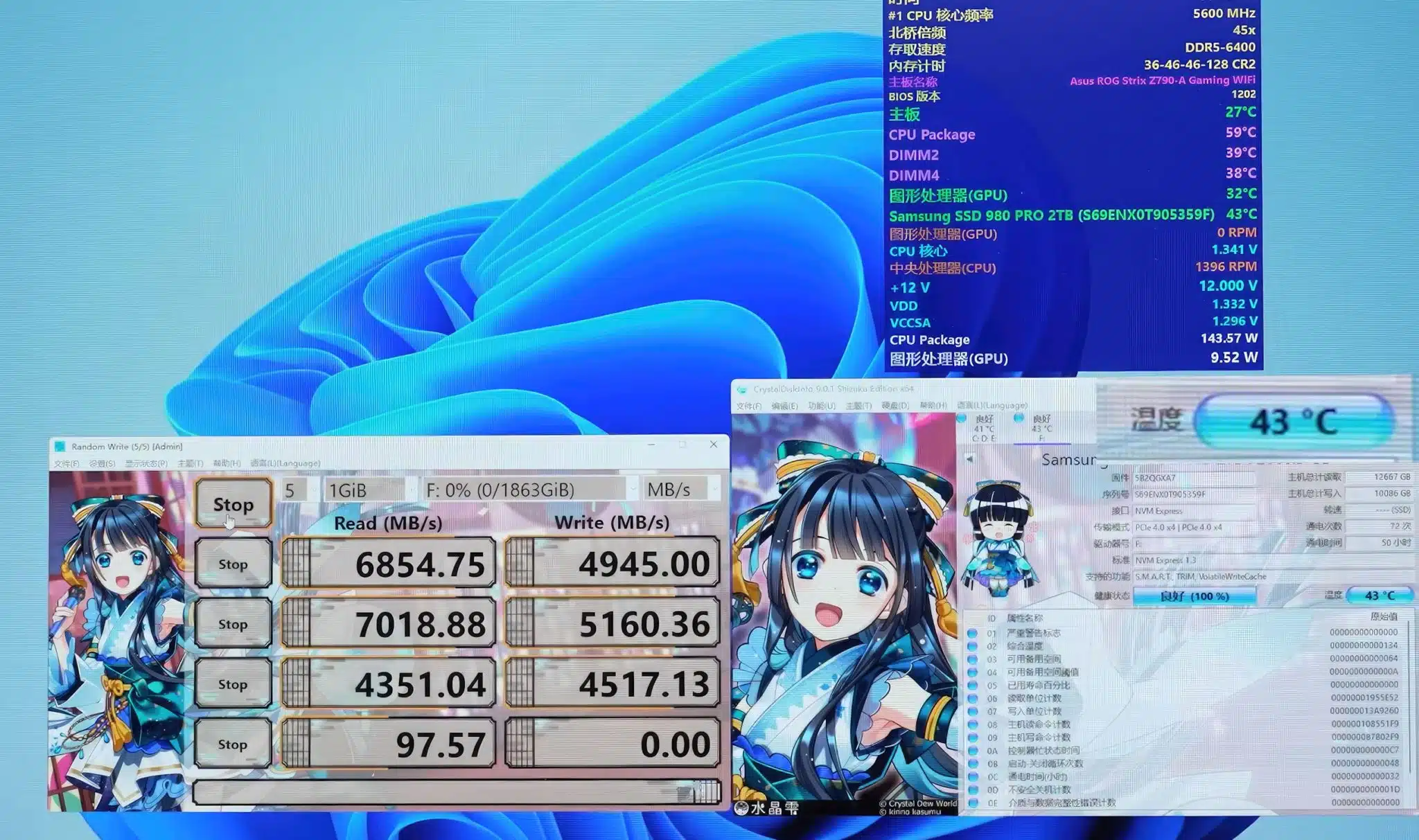
ASUS tested the concept card using a Samsung 980 Pro 2 TB SSD. It managed to reach 6.8 GB/s of its 6.9 GB/s speed and temps were at a comfortable 43 C during testing, ~10 C lower than when it had been installed on the motherboard which brings up another point. Currently, most users install their M.2 drives via the motherboard slots which are then obstructed by GPUs or CPU coolers. As ASUS shows off its prototype it can be seen that by having them on the card the user could potentially have easier access for upgrading them without removing as many components.
Side Note:
VideoCardz does mention that ASUS is not the first to try adding drive storage options to a graphics card. AMD had previously done so with its Radeon Pro SSG Vega graphics card.
Discussion (19 replies)
Join Discussion →What in tha fuuuuuck...
Storage is storage I suppose.
Correct me if I'm worongnbut wasn't there a nvme hosted drive on a 30 series as well. Guess it's faster for direct storage?
Never seen a 30-series card with one, but the AMD Radeon Pro SSG had 4 slots.
The storage isn't used by the card. It's used by the system. Most GPUs don't use all 16x lanes, so the extra lanes can be used by the NVME slot and borrow the cooling from the GPU to cool it.
There was an article about a rumor from nVidia called BaM - but it wasn't the same thing. It just lets your GPU directly acess SSD without going through the computer - basically DX12 DirectStorage but I get the feeling it was more geared toward compute applications...
[URL unfurl="true"]https://www.pcgamer.com/nvidias-big-accelerator-memory-an-ssd-for-your-gpu/[/URL]
It probably just uses PCIe bifurcation in the motherboards bios. Set the 16x slot to 8x,4x,4x mode, and off you go.
Pretty neat solution to not let the PCIe lanes go to waste in a system with an 8x GPU if you ask me.
Too bad this means you can only get the extra storage if you have a mid to low end GPU :p
After looking over the card. I only see one m.2 slot.
I doubt it uses bifurcation. Not all motherboards support this. For the average gamer (which a mid-low end GPU targets) I don't think they'd fully understand bifurcation settings. This has to be a plug-n-play setup with no BIOS modifications needed.
Trying to find motherboards that support bifurcation is rather difficult.
Asus have implemented bifurcation in the BIOS in many of their motherboards, presumably because they want to sell those Hyper-X m.2 expander boards.
So it's already there, and already documented in their manuals.
For everyone else, if they can't get bifurcation to work, the GPU being the first in the order will still work, the m.2 slots just won't.
Yeah I am aware some motherboards have it. I've got a handful that have it where I use them with C-payne bifurcation cards for GPUs.
What I said still stands. For a GPU targeted towards the average gamer who may not have a motherboard with bifurcation settings using a pcie bridge chip makes the most sense except for the added cost.
We wont know what path ASUS has taken until more details are presented or reviewers get their hands on one assuming ASUS turns it into an actual product beyond the prototype they're demonstrating.
Lets be real honest here. The average gamer isn't building their own PC's any more. Largely they are console or prebought from the one their favorite streamer is using.
There is one in the front and one on the back, pretty clear on the pics
No it's not. The PCB has a square cut out so the heatsink on the front of the GPU can cool the NVME drive. Pretty clear to see in the pic.
I see this product as a proof-of-concept. It may work with their motherboards, but ASUS is not a large enough company with a large enough market share to create and enforce their own ecosystem of products.
Since they purposefully chose to develop this on a low tier product means they are not serious about taking it to market. If they were, they'd have developed this on the high-end flagship tier where they could squeeze more profit and recoup their R&D easier.
Bifurcation is available on other motherboards as well. I got some AsRock boards that have it as well as some server Supermicro boards that have it as well.
Something like this could be useful for those super small ITX builds where an m.2 slot might not be available on the motherboard and the board only having 1 8x slot.
Although most all of those builds I've seen people do generally have the most powerful GPU they can possibly get in the size that fits inside the case.
Ninja edits. Apologies. I finished my thoughts from after I posted. The question is ... is bifurcation going to catch on as a viable feature? And if so, what are the practical applications?
I see this prototype as a "let's see if we can mash these two technologies together and gauge the market reaction" rather than a serious product. They're fishing because they don't have a sense of where to the market demands will go and they're not large enough to lead the market with their stable of derivative products (i.e., motherboards and GPUs - where the primary technologies are developed by someone else and they just need to make them work together with other primary tech). Might just as well try to mash up an optical drive with an M.2 SSD.