
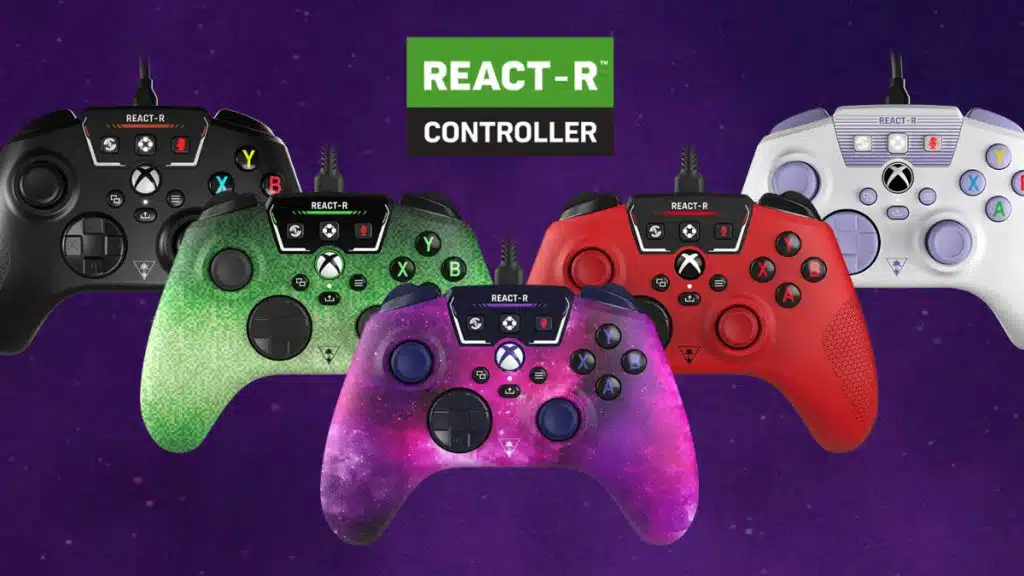
Turtle Beach has announced that its Red, Nebula, and Pixel Green REACT-R Xbox Controller colorways are available today from www.turtlebeach.com and participating retailers across Asia, and are available for pre-order in the U.S., UK, and Europe ahead of their September 22, 2023, release in the UK and Europe and on October 1, 2023, in the U.S. for $39.99/€34.99/£29.99 MSRP. Previously available only in black and white/purple colors, these wired alternatives to Microsoft’s first-party controllers feature two mappable quick-action buttons on the back, giving them some of the functionality that can be found in the Elite Wireless Controllers, as well as quick-access controls. Users will also find “Superhuman Hearing,” a sound setting that is supposed to make it easier to hear footsteps and other details.
“The REACT-R Controller is extremely popular with gamers because of the wealth of features it offers for a very competitive price,” said Cris Keirn, Interim CEO & SVP of Global Sales, Turtle Beach Corporation. “Not only are we expanding our controller range with new colors, but we’re offering even more value as we’ve upgraded the rear triggers, resulting in a controller that looks great and delivers unbeatable performance.”
Turtle Beach REACT-R Controller Features
- Turtle Beach Game-Enhancing Audio Controls
- Superhuman Hearing Sound Setting
- Ergonomic Textured Handle Surface
- Two Mappable Quick-Action Buttons
- Immersive, Vibration Feedback
- Responsive, Accurate Controls
- Officially Licensed for Xbox
Red, Nebula, and Pixel Green join the original Black and White/Lavender colors to further expand Turtle Beach’s growing game controller lineup. The new Red, Nebula, and Pixel Green REACT-R Controller colorways also improve upon the original by adding two additional rumble motors for added vibration effects. The new Red, Nebula, and Pixel Green REACT-R Controller colorways also improve upon the original by adding two additional rumble motors for added vibration effects.
Gamers on Xbox Series X|S, Xbox One, and Windows PCs can plug in any wired 3.5mm headset into the REACT-R Controller for an instant audio upgrade that includes Turtle Beach’s patented and exclusive Superhuman Hearing sound setting. Superhuman Hearing has been shown to provide a competitive advantage by letting players hear key audio cues like approaching enemy footsteps, nearby enemy weapon reloads, and enemy vehicles in the distance. Controls for game and chat volume balance and mic mute are also perfectly integrated into the controller for easy access while gaming. Play longer and stay in control thanks to the REACT-R Controller’s ergonomic shape and textured grips, handles, and triggers. Two mappable quick-action buttons on the backside of the controller let players customize their controls for quicker reactions. Feel the rumble of explosions, or the recoil of a gunshot with vibration feedback thanks to dual rumble motors in the REACT-R’s handles and near the triggers. The REACT-R Controller is the perfect companion for any wired gaming headset, such as Turtle Beach’s best-selling Recon 70 or Recon 50 series headsets.
Discussion (11 replies)
Join Discussion →Every time I see the word "Turtle Beach" my brain automatically adds "Tropez" to the end of it.
Their mid 90's Sound Blaster compatble DOS wavetable sounds cards are the only real product of theirs I've ever known :p
I wanted one at the time, but then eventually got a Sound Blaster AWE32 instead.
Yeah, as I said here: https://forums.thefpsreview.com/threads/turtle-beach-announces-atom-mobile-game-controller-for-ios-launching-next-month.13551/post-74847
About 20 seconds worth of research can probably confirm or deny this, but it is more time than I am willing to spend on it, but I bet it's just a shell of its old self, and some unrelated company just bought the brand name and now sells controllers.
Yea the Turtle Beach name is just being plastered to everything until it stops being a 'differentiator".
I liken it to Kodak, a once great company that is now relegated to licensing its brand name to the manufacturers of cheap chinese TV's and other junk.
I'm learning some interesting things about their historical catalog on their wikipedia page.
[URL unfurl="true"]https://en.wikipedia.org/wiki/List_of_Turtle_Beach_Corporation_products[/URL]
Apparently at one point they sold a product called the Turtle Beach Rio, which was a daughter board, designed for the Sound Blaster daughter board connector, which added wavetable midi synthesis to regular sound blaster cards. It even had a ram slot for expanding sample size.
Man, if I had known about this back in the day before my AWE32, I would probably have jumped on it.
Oh yea they partnered with Roland as well if I am remembering that correctly. for a long time it was TB, Roland or Creative Labs for a sound card. Most went creative labs and the others became so niche they died.
If I recall, they had a close relationship with Ray Kurzweil, which is pretty cool.
They even had a specific Kurzweil designed sound card for a while, if I am not mistaken.
Honestly I think the first real disruption to the sound card industry was what Nvidia showed you could do a good sound solution on a motherboard.
Oh... did you forget that Nvidia made AMD motherboards with some nice features for a while?
Nforce? Was that what they were called? I don't think never owned one but I do recall that era.
I had an Abit KR7A-RAID back then. It was based on a VIA KT266A.
An enthusiast motherboard witjh an MSRP of $139 that actually sold below MSRP in retail... Different times. Now we live in price gouged $1000 MSRPenthusiast motherboards, that are scalped and sold above MSRP.
I used an nForce 2 for my Athlon XP "Barton" 3200+, and an nForce 4 something-or-other (I think "Ultra" is the word I am looking for) for my Opteron 165 (which was my first dual-core CPU and my first 64-bit CPU, and I overclocked the f*ck outta that thing with the insaaaaaane stock cooler). That was my first PCI-Express system if I recall correctly. I loved the ActiveArmor hardware firewall on that nForce 4. I think I built that in 2006. In 2003 or 2004 one of my friends paid waaaaaay too much money for an Alienware system. nForce 3 with AMD's first-gen 64-bit processors which introduced x86-64/AMD64. I think he had an Athlon FX-51. SATA-1 HDDs in RAID 0. I can not for the life of me recall the graphics card. But I experienced a lot of games for the first time on that machine, like Doom 3, HL2, F.E.A.R., and a few others. I recall nForce 3 not being the best, but otherwise AMD+nForce used to be such an awesome team. Too bad Intel + nForce wasn't really anything special. I did build an nForce 6 system using an Intel CPU (maybe an E6750?) for a friend's dad, and maybe one or two others for other friends. I remember something about Intel and nVidia having fights back then too. Don't recall the details. As the decades pile on, details on computer industry cat fights start to get real murky.
I think you are referring to nVidia SoundStorm? I never knew much about it, but was always curious. Wasn't that only for nForce 1?
I was a big fan of the Aureal Vortex 2 sound card, and that was the only card to get me away from Creative Labs for a while. I used the Vortex 2 in my P3 500MHz machine and my Athlon Tbird machine.
One of these days I'm gonna go back through Turtle Beach's history, as you have done now. I remember my dad had a few of their cards, but which ones and why not even he can recall. Not even sure if we still have any 'em buried away somewhere. That was so long ago...
Ah yes, my brother, my father and I used quite a few generations of VIA chipsets. Certainly during my Athlon Tbird and Athlon XP days, probably well before. Don't remember the chipset in my P3 system or my dad's P3 system. My vague memory recalls SiS stuff thrown in the mix.
You don't know how badly I miss when $140 was still the general price point of high-end motherboards.