
Gaming Performance
We are testing only at 1080p, to isolate CPU performance. We are using an NVIDIA GeForce RTX 4090 Founders Edition video card with driver version 565.90. All games are being run in their “Ultra” game settings, at native 1080p resolution, and with no ray tracing or upscaling. In some games, we have set the desktop also to 1080p for Windowed/Borderless Window games. Importantly, we are using ALL manual run-throughs for every game here, not a single built-in benchmark was used, these are all manual run-throughs actually in the game, playing the game.
All CPUs are tested in Windows 11 power profile of “Balanced.” Where noted, Intel Arrow Lake CPUs are shown in both Balanced (B) and Best Performance (BP) power profile modes. As you look at the graphs, pay special attention to the AMD Ryzen 7 9800X3D (blue bar) versus AMD Ryzen 7 7800X3D (light gray bar), to see the generational uplift.
Alan Wake 2
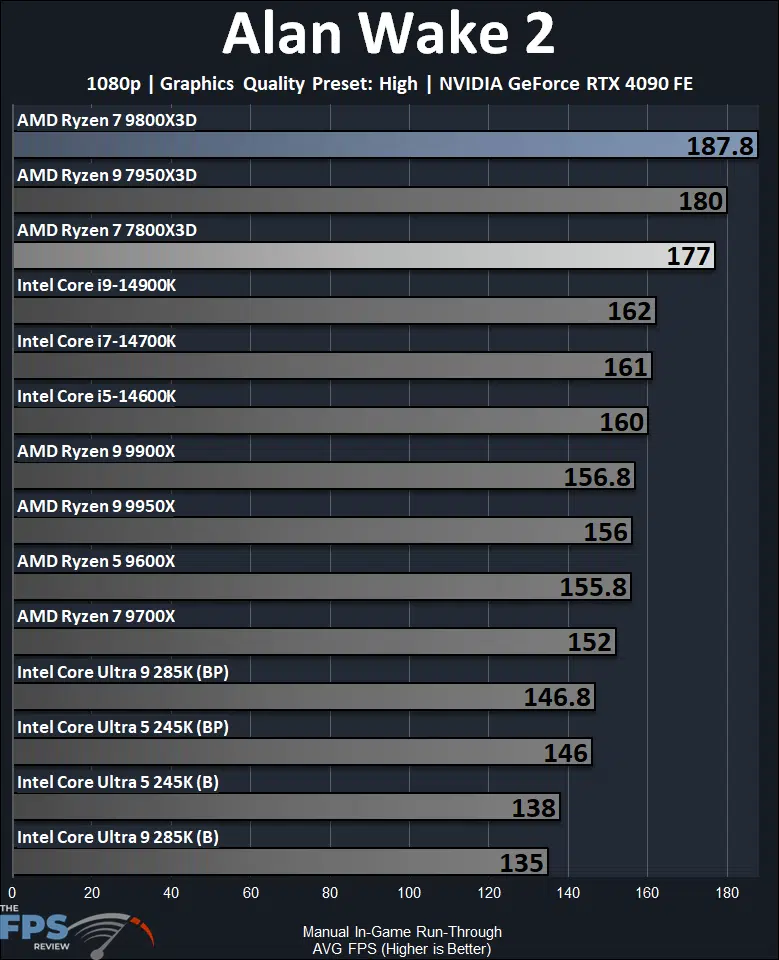
In Alan Wake 2 the new AMD Ryzen 7 9800X3D is 6% faster than the Ryzen 7 7800X3D and 4% faster than the Ryzen 9 7950X3D. The AMD Ryzen 7 9800X3D is also a pretty large 24% faster than the Ryzen 7 9700X, which shares the same core/thread count. Therefore, from generation to generation this particular game at Ultra is seeing a 6% improvement in performance with the new AMD Ryzen 7 9800X3D. At this performance level, it is faster than every other CPU, including Intel’s latest generation. The AMD Ryzen 7 9800X3D is 28% faster than the Intel Core Ultra 9 285K at its best performance. The AMD Ryzen 7 9800X3D is also 16% faster than the Intel Core Ultra i9-14900K.
Black Myth Wukong
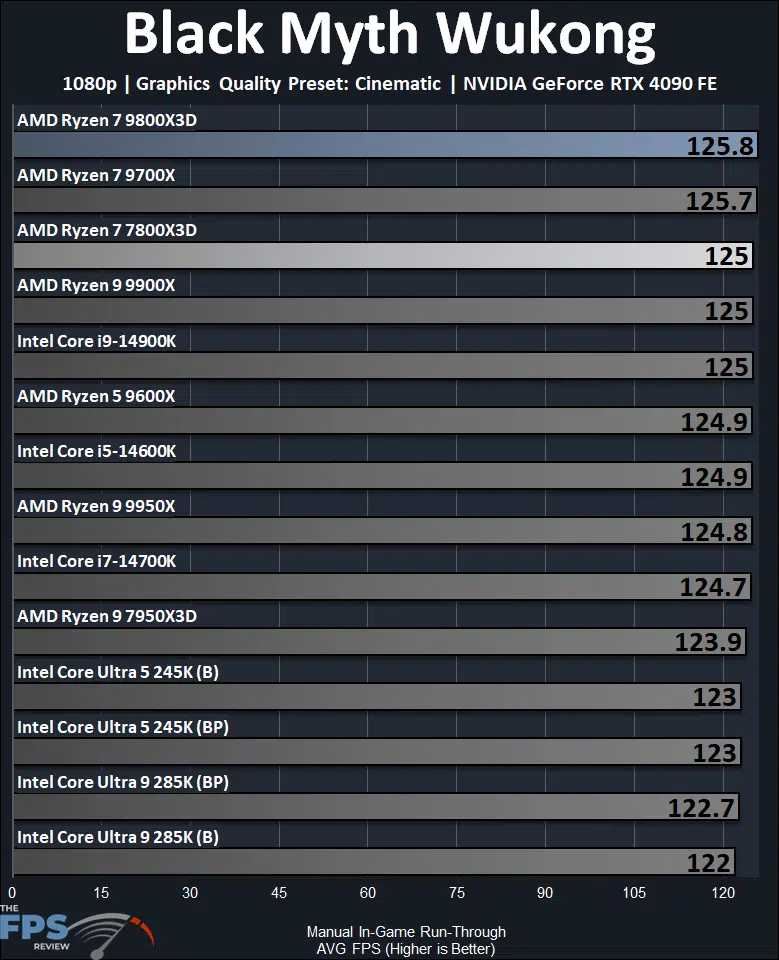
Before gasping at the results in this game, be aware that Black Myth Wukong is not the best game for CPU performance testing, it is very GPU-dependent on the Cinematic preset, even at 1080p, and is an outlier. However, we did perform a manual run-through in this game, this is in-game performance, not the benchmark. We thought this game would be relevant due to the popularity, and modern game engine and graphics. In the future, we will most likely drop the quality setting below Cinematic to better show CPU differences.
All of that said, the AMD Ryzen 7 9800X3D is 1% faster than the Ryzen 7 7800X3D in this game and does eek out overall as the fastest CPU. The Intel Arrow Lake CPUs do quite poorly, by contrast. The AMD Ryzen 7 9800X3D is 3% faster than the Intel Core Ultra 9 285K, which for this game at these settings is the largest difference. In the future, dropping the quality settings may help us to detect more differences in CPU performance. Look at this game as an outlier in our data.
Horizon Forbidden West
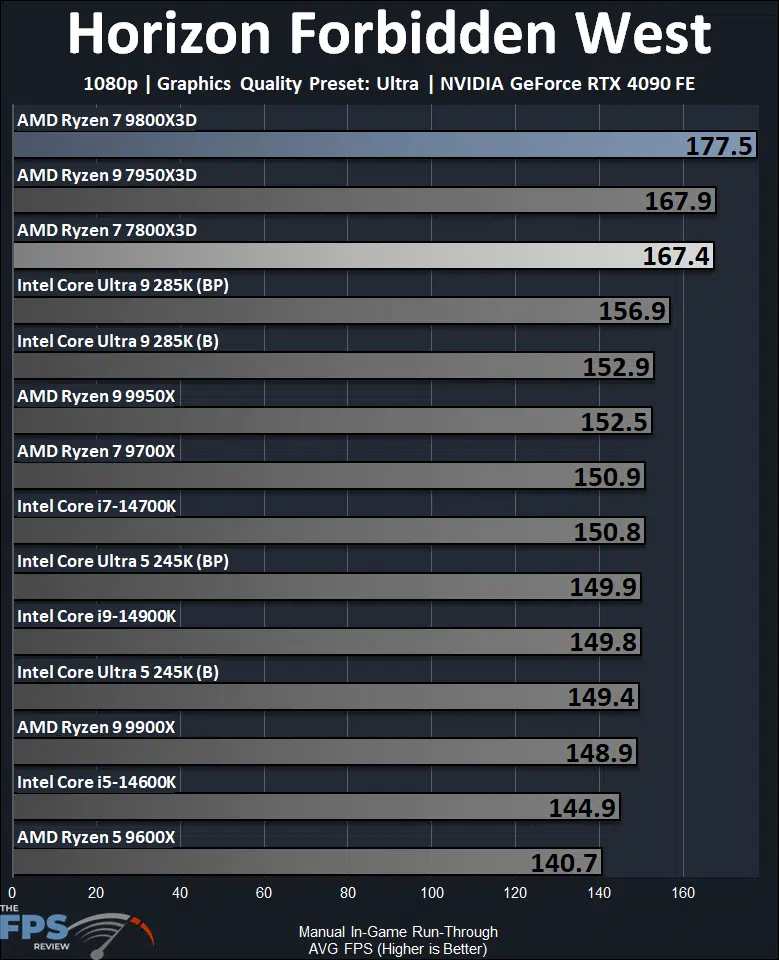
In Horizon Forbidden West the AMD Ryzen 7 9800X3D is 6% faster than the previous generation Ryzen 7 7800X3D and Ryzen 9 7950X3D. The AMD Ryzen 7 9800X3D is also a pretty big 18% faster than the Ryzen 7 9700X. At this performance level, it is also 14% faster than the Intel Core Ultra 9 285K and 18% faster than the Intel Core Ultra i9-14900K.
The Last of Us Part I

In The Last of Us Part 1 the new AMD Ryzen 7 9800X3D is 9% faster than the previous generation Ryzen 7 7800X3D and 7% faster than the Ryzen 9 7950X3D. It’s also a very large 23% faster than the Ryzen 7 9700X. Compared to the competition, it is 14% faster than the Intel Core Ultra 9 285K and 12% faster than the Intel Core Ultra i9-14900K.
Discussion (19 replies)
Join Discussion →Great review and the 9800X3D looks like a beast.
Yep, keeping my eye on this one and can't wait for the 9900X3D/9950X3D reviews to make my final decision for my 1st AM5 build.
After this review I am more excited about this gen than I have been before. The extra die space from these X3d's is having some add on benefit for performance that is hard to quantify (more space for heat?) but I don't care. This is kind of awaesome.
Just curious, what are you referencing here?
For pure gaming I'd still go with the 7800X3d, but the 9800X3D is better than the 9700X in every way. I don't really think we'll ever see a 9800X.
Hopefully we'll eventually see a 9700X3d or even a 7700X3d that's I would get myself.
I wonder what OC will bring to the table.
If going by recent rumors, anything from 200-400 MHz but so far as to how that will translate, added power draw, heat, etc., haven't heard anything credible yet.
I think he means this from Brent's review.
"In the 2nd Generation 3D V-Cache, AMD has re-designed the cache so that it is the same size as the CCD itself, eliminating the need for structural silicon."
@Brent_Justice
"In subsequent follow-ups, we will deep dive into gaming performance a lot more, with a very gaming-focused review with a lot more games, so stay tuned." - I bet you'll have a lot of fun doing this, very jealous!
Sorry if I missed mention of it, is there a separate review for that Trident mem kit coming up? I was doing some research on it this weekend as I prepare for the new build.
AMD is still using the same IOD - so 6000 C30 is basically it without tempting fate, same as at Zen 4 launch.
Some folks in the OC communities have been working on faster memory speeds but I haven't seen any real evidence of gains in effective performance.
Don't have one planned, but I've been using a similar kit since Zen 4 launched, it's my standard RAM kit for the AM5 platform, and I've been using it for every GPU review. Solid kit, no complaints, works perfectly great, it's the right configuration for the best Ryzen performance.
To be honest, I am quite looking forward to a 20 game performance roundup!
Done it before: https://www.thefpsreview.com/2023/11/20/intel-core-i9-14900k-vs-amd-ryzen-7-7800x3d-gaming-performance-in-20-games/
Basically in the review it was noted that the 3dvcache space is the same as the die space. Meaning that there is heat dissipation that can come downward into the 3dvcache layer. Allowing the actual processors to be pushed further.
nice work guys!
It would appear that placing the 3D cache on the bottom is allowing it to boost closer to it's full potential. This is good news. Now I can only hope even more than the 9950X has dual 3D cache on both of it's CCDs.
That makes a little bit of sense; still, it isn't likely to have near as much of an effect as having just gotten the 3D V-cache out of the way of the heatspreader IMO.
Disappointed in the lack of 2560x1440 and 3840x2160 numbers. I've done a lot of this type of testing over the years and 1080P just doesn't tell the whole story. Conventional wisdom says that when your GPU bound the CPU doesn't really matter, but I found that wasn't always the case. Often you'd get averages that seemed pretty close but the lows were lower and the highs higher on some CPU's.
On games like Cyberpunk 2077 where a few frames can make the difference between a playable frame rates and not, (even on a 4090) the CPU might make a difference. It sure did with earlier Ryzen family CPU's I tested.