
Temperature Testing
On this page, we are going to investigate the AMD Ryzen 7 9800X3D temperature. We are going to look at this two ways, first running an all-core, full-load stress-test scenario, and then we are going to look at CPU temps while gaming. All readings are taken with HWiNFO64. We are using the exact same AIO for all temperature testing, an MSI MEG CORELIQUID S360 AIO Cooler using the default mounting hardware.
Temperature – Cinebench R23
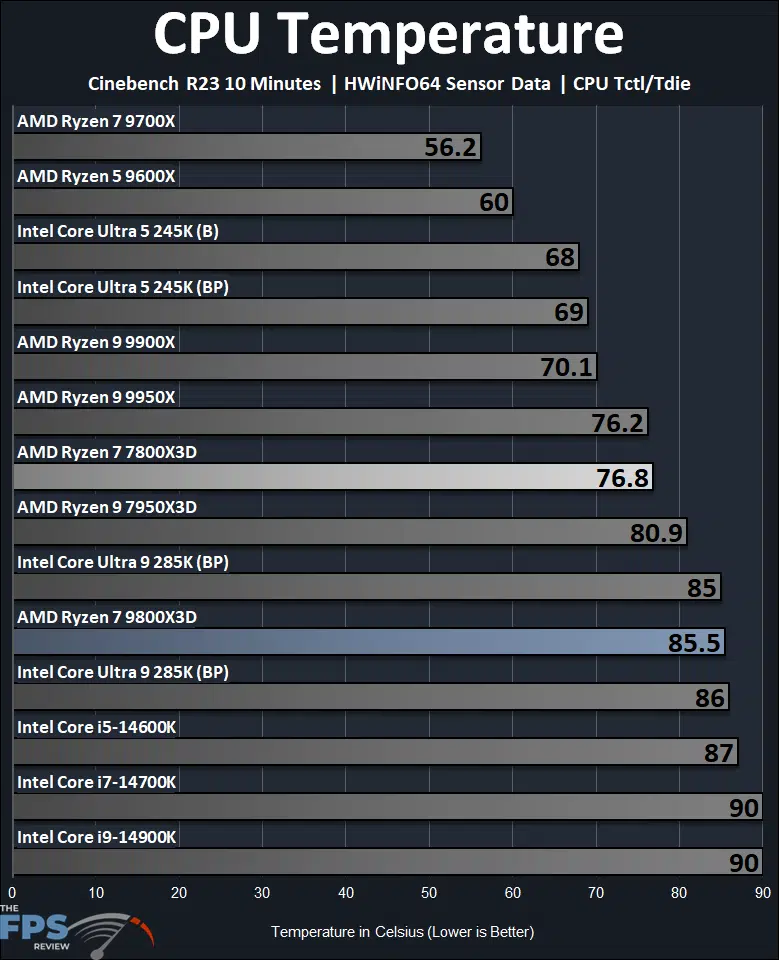
In this test, we are running Cinebench R23 for 10 minutes for all-core full-load testing. The new Ryzen 7 9800X3D does run a little warmer overall, but please keep this in mind the temperature sensors on Zen 5 have changed location. This placement shows an 8-degree increase with the 9800X3D. Compared to the competition, it’s on par with the 285K’s temps, and definitely warmer than the Ryzen 7 9700X which should have the same temp locations. Therefore, the 9800X3D does run 29 degrees hotter than the Ryzen 7 9700X, as a more comparative metric, but also two very different TDP CPUs mind you, 65W vs 120W.
Temperature – Gaming
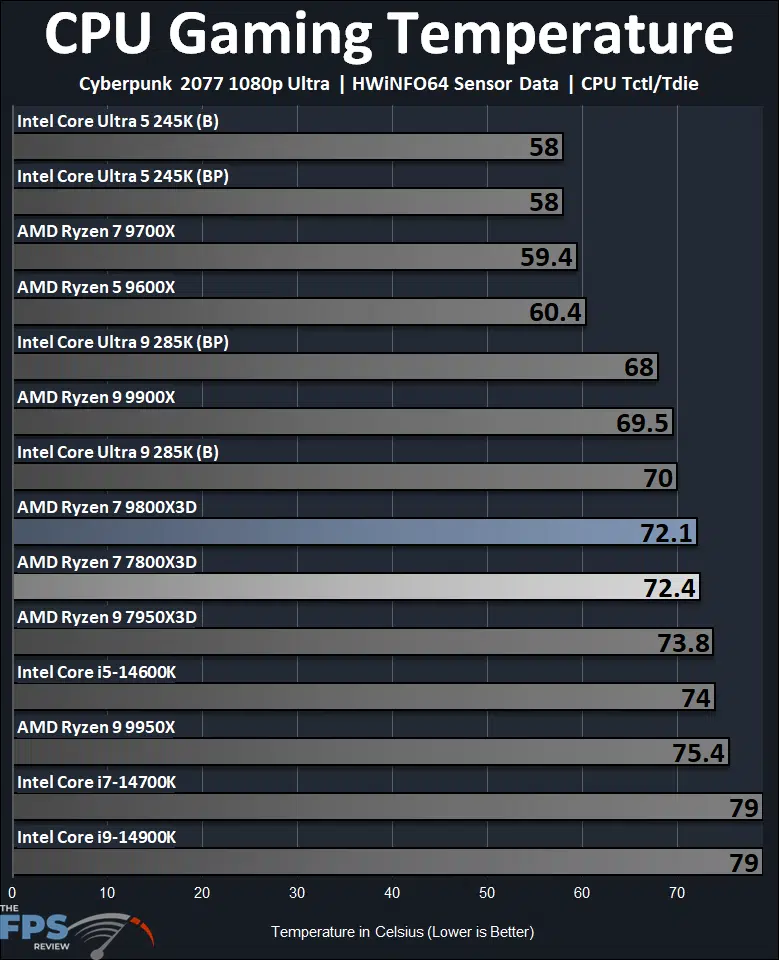
As the AMD Ryzen 7 9800X3D is geared as a gaming CPU, this test matters the most for users. From this, we can see that while gaming the 9800X3D is practically the same temps as the 7800X3D and 7950X3D. If we compare it to the lower TDP 9700X, then it is 12-13 degrees warmer. These temps are good temps though, they don’t run nearly as hot as the previous generation Intel CPUs, but do run a bit warmer than the average while gaming, absolutely nothing to be concerned about or that will require extreme cooling.
Discussion (19 replies)
Join Discussion →Great review and the 9800X3D looks like a beast.
Yep, keeping my eye on this one and can't wait for the 9900X3D/9950X3D reviews to make my final decision for my 1st AM5 build.
After this review I am more excited about this gen than I have been before. The extra die space from these X3d's is having some add on benefit for performance that is hard to quantify (more space for heat?) but I don't care. This is kind of awaesome.
Just curious, what are you referencing here?
For pure gaming I'd still go with the 7800X3d, but the 9800X3D is better than the 9700X in every way. I don't really think we'll ever see a 9800X.
Hopefully we'll eventually see a 9700X3d or even a 7700X3d that's I would get myself.
I wonder what OC will bring to the table.
If going by recent rumors, anything from 200-400 MHz but so far as to how that will translate, added power draw, heat, etc., haven't heard anything credible yet.
I think he means this from Brent's review.
"In the 2nd Generation 3D V-Cache, AMD has re-designed the cache so that it is the same size as the CCD itself, eliminating the need for structural silicon."
@Brent_Justice
"In subsequent follow-ups, we will deep dive into gaming performance a lot more, with a very gaming-focused review with a lot more games, so stay tuned." - I bet you'll have a lot of fun doing this, very jealous!
Sorry if I missed mention of it, is there a separate review for that Trident mem kit coming up? I was doing some research on it this weekend as I prepare for the new build.
AMD is still using the same IOD - so 6000 C30 is basically it without tempting fate, same as at Zen 4 launch.
Some folks in the OC communities have been working on faster memory speeds but I haven't seen any real evidence of gains in effective performance.
Don't have one planned, but I've been using a similar kit since Zen 4 launched, it's my standard RAM kit for the AM5 platform, and I've been using it for every GPU review. Solid kit, no complaints, works perfectly great, it's the right configuration for the best Ryzen performance.
To be honest, I am quite looking forward to a 20 game performance roundup!
Done it before: https://www.thefpsreview.com/2023/11/20/intel-core-i9-14900k-vs-amd-ryzen-7-7800x3d-gaming-performance-in-20-games/
Basically in the review it was noted that the 3dvcache space is the same as the die space. Meaning that there is heat dissipation that can come downward into the 3dvcache layer. Allowing the actual processors to be pushed further.
nice work guys!
It would appear that placing the 3D cache on the bottom is allowing it to boost closer to it's full potential. This is good news. Now I can only hope even more than the 9950X has dual 3D cache on both of it's CCDs.
That makes a little bit of sense; still, it isn't likely to have near as much of an effect as having just gotten the 3D V-cache out of the way of the heatspreader IMO.
Disappointed in the lack of 2560x1440 and 3840x2160 numbers. I've done a lot of this type of testing over the years and 1080P just doesn't tell the whole story. Conventional wisdom says that when your GPU bound the CPU doesn't really matter, but I found that wasn't always the case. Often you'd get averages that seemed pretty close but the lows were lower and the highs higher on some CPU's.
On games like Cyberpunk 2077 where a few frames can make the difference between a playable frame rates and not, (even on a 4090) the CPU might make a difference. It sure did with earlier Ryzen family CPU's I tested.