

Fall is here, and as usual, the rumor mill is in full swing, as are the industry leaks, with news regarding NVIDIA’s RTX 50 SUPER series. There’s never been any doubt that NVIDIA’s GPU refresh would be inbound; the question is not if but when it will be officially announced and when the launch will occur. There’ve been multiple rumors about these two events, but one of the more plausible is that NVIDIA will announce the RTX 50 SUPER series at CES 26. After all, NVIDIA has an established track record in revealing its newest GPUs at CES.
However, when it comes to a release schedule for its GPU refresh stack, details are a bit less consistent, but according to Benchlife, we could see them arrive sometime between March and May. This, too, seems somewhat plausible given that NVIDIA often staggers its GPU releases throughout the spring months. It’s also stated that to date, no board partners have been given any notifications regarding this SUPER series.
The next tidbit comes not as a rumor but as an actual product listing. Seasonic has updated its online wattage calculator to include two of three rumored RTX 50 SUPER series GPUs, namely the GeForce RTX 5070 SUPER and the GeForce RTX 5070 Ti SUPER. Oddly enough, the GeForce RTX 5080 SUPER is absent.
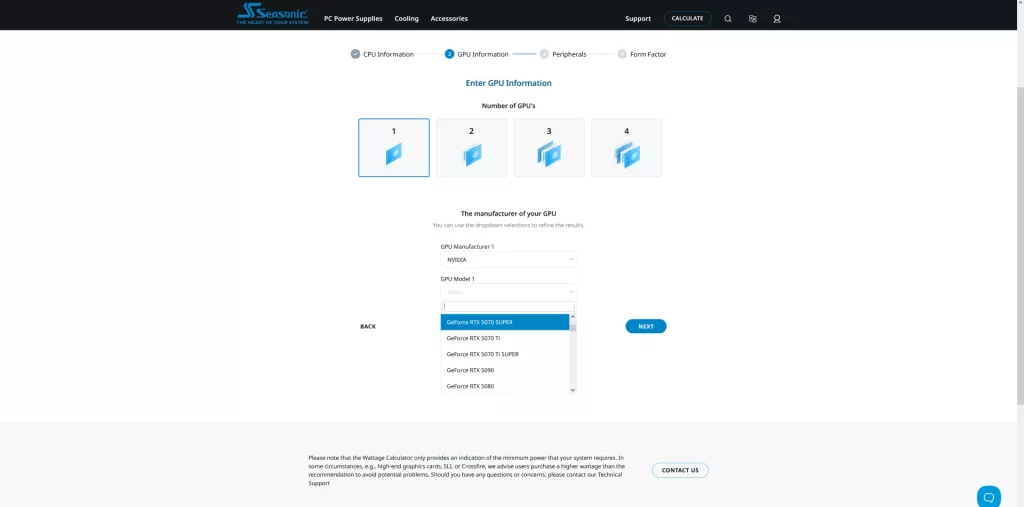
Expectations for the RTX 50 SUPER series should be tempered as rumors have remained consistent regarding their configurations. Once again, the mid-tier GeForce RTX x70 appears to be the model getting the most upgrades. The RTX 5070 SUPER could, as seen with the RTX 4070 SUPER, see its core count, memory, and TGP increased compared to the non-SUPER version, giving it potentially a more substantial performance increase over its predecessor, something that also happened with the RTX 4070 SUPER vs the RTX 4070.
Meanwhile, the most notable changes expected for the RTX 5070 Ti SUPER and RTX 5080 SUPER are their memory upgrades. Many have commented on how their 16 GB VRAM is a bit underwhelming and possibly limiting performance, and so the ongoing rumor has been that each will be upgraded to 24 GB GDDR7. It’s also been claimed that this is due to 3 GB GDDR7 modules now being available. This rumor is further substantiated by the fact that the mobile RTX 5090, which uses a cut-down RTX 5080 GB203 die, features 24 GB VRAM.
As of now, the only other spec rumored to increase is their TGP, which seems logical given the speculated memory increase. It’s said that the RTX 5080 already has the fully-enabled GB203 die, so increasing the core count would not be possible, but perhaps its boost clock might see an increase. The 5070 Ti SUPER also uses a cut-down GB203 die and could have its core count increased, but that move would be unlikely since it would further encroach upon the RTX 5080, thus risking lost sales numbers for that card. However, it too might have a boost clock increase.
| Model | GPU SKU | CUDA Cores | GPU Boost Clock | VRAM Size-Type | VRAM Bus | Bandwidth | TGP |
| GeForce RTX 5080 SUPER | GB203-450 | 10,752 | TBD | 24 GB GDDR7 | 256-bit | 1,024 GB/s | 415 Watts |
| GeForce RTX 5080 | GB203-400 | 10,752 | 2,617 MHz | 16 GB GDDR7 | 256-bit | 960 GB/s | 360 Watts |
| GeForce RTX 5070 Ti SUPER | GB203-350 | 8,960 | TBD | 24 GB GDDR7 | 256-bit | 896 GB/s | 350 Watts |
| GeForce RTX 5070 Ti | GB203-200 | 8,960 | 2,452 MHz | 16 GB GDDR7 | 256-bit | 896 GB/s | 300 Watts |
| GeForce RTX 5070 SUPER | GB205-400 | 6,400 | TBD | 18 GB GDDR7 | 192-bit | 672 GB/s | 275 Watts |
| GeForce RTX 5070 | GB205-300 | 6,144 | 2,512 MHz | 12 GB GDDR7 | 192-bit | 672 GB/s | 250 Watts |
Table: The FPS Review
One thing is given for all this, though, as we get closer to the holiday season, there will likely be more leaks and rumors surfacing since that is a long-established pattern regarding new GPU releases. The only other questions really left unanswered are pricing and availability, because after all, as also seen with most GPU launches, just because a manufacturer gives a price or date, it doesn’t mean consumers can actually get new cards at the launch date or for MSRP. It is hoped that the RTX 50 SUPER series will launch at the same or lower price, versus its non-SUPER counterparts, but that remains to be seen and could be more difficult given current global economic conditions.
Discussion (19 replies)
Join Discussion →So many people were convinced it was happening this fall/Xmas season. The advice "just wait for the fal for the supers" wasn't the best advice. After all with Blackwell being released this year it would be pretty odd to have a refresh so soon
No news of the $350? 5060 super 12gb yet ???
5080 Super with 32GB for half the price of a 5090 and I'm in. Otherwise non-buynary.
16 GB is not an issue at 1440. I can max out settings for every game in my library.
TBH, I tried a few of my games, side by side, on two 32" monitors. One 1440, other 4k. I honestly can't tell much, if any, difference in quality. Maybe, slightly, in some instances is the 4k better.
YMMV
I have a 4K wide monitor, plus I also want 32GB for AI use.
Was it native or with DLSS? Because DLSS ruins everything, even on quality preset, if you try native it looks far better. nVidia and devs just gaslit people into believing DLSS is just as good as native.
The advice "just wait for XYZ" never changes - something better is always just around the corner.
Just a matter of if it ends up being worth it. For most people, the answer is yes, it's almost always better to wait unless you are several generations behind and/or are having issues with most current software today (not just a few outliers). For us bleeding edge people, it isn't always about a value proposition though.
In some games, DLSS is better than native 4k if only because TAA sucks, which is weird since DLSS uses a form of TAA for antialiasing, I'm assuming it uses AI also for the AA part hence DLAA.
That's because those games have no AA implementation beyond DLSS, but you can try DLAA even though that also has temporal smearing the image will be 10x clearer than with upscaling enabled. If there was proper AA it would look even better.
I think it's never worth waiting precisely because there is always something new around the corner. And the leaps between the new and the old are not that big anymore as they used to be anyway. If you are an early adopter you overpay anyway and deal with potential issues too. The best is to buy right bang in the middle of the life cycle. Meaning if someone wants a 5xxx now is the time. I'd certainly buy now and wouldn't wait if I didn't already have a 4080.
Take a look back over the past 5 years...
RTX 3000 - Late 2020
RTX 3090 Ti/3080 12gb - CES-ish 2022
RTX 4000 - CES-ish 2023
RTX 4000 Super - CES-ish 2024
RTX 5000 - CES-ish 2025
When I say CES-ish, the cycle has been initial announcing starting as early as Nov/Dec before CES (usually first week to 10 days of January) running through CES, with on-shelf dates staggered every week or two from mid Jan until they're done with the batch of cards being launched. Usually samples arrive after getting back from CES for the first one up....
From a stock perspective, the last few generations have been tough to find until about now, especially on the upper end - end of Q4/start of Q4, but then they quickly evaporate by November or so to make way for the new stock.
If history is any indicator, we'll see some supers lighting up in the run up to CES. This is also how NVIDIA reprices their cards to better align with the market (AMD) - they never dropped the 4080 price (as it was overpriced compared to where it should have been), they simply priced the 4080 Super $200 less....
Local hosted AI models would be my reason - fits the 27B-ish parameter versions with room to spare, where they won't fit on a 16GB card.
I do not disagree with you, I think we are talking about the same thing - but I think that statement right there is exactly what I'm trying to describe. Why upgrade unless it serves a purpose?
Of course it goes without saying that you should wait until there is a wortwhile upgrade available. I'm just against waiting for the next thing when something is already readily available.
I skipped the RTX50 series, but I'll keep an eye on the RTX5070Ti Super
Well, yeah, right tool for the job applies. All I use my GPU for is gaming. And for my needs at 1440P 16 GB is more than enough.
I'm focused on gaming, and I really don't see 16GB being a problem for at least the next couple of years, i.e., I don't think there is any advantage between a 16GB, 18GB, or 24GB GPU for gaming. As long as it's 16GB, I think it's fine for a couple of years. Now, once games that are designed for the PS6 come out, yeah maybe 24GB will be welcomed at the high-end. But I do think 12GB should be the bare minimum entry-level at this point. 8GB should be reserved for cards under $200, anything above that, 12GB, and then 16GB should start in the $350 range and up.