
Conclusion
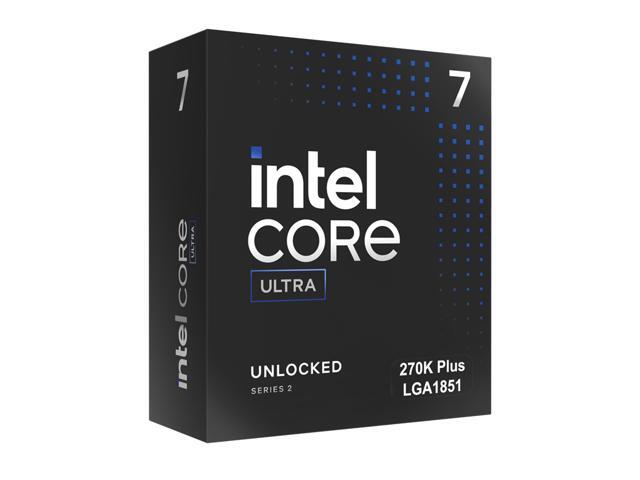
In our Intel Core Ultra 7 270K Plus versus Intel Core Ultra 7 265K CPU Performance Review, we benchmarked both CPUs to find out how much faster the new Intel Core Ultra 7 270K Plus “Arrow Lake Refresh” CPU really is.
The new Intel Core Ultra 200S Plus desktop CPU series was launched in March, 2026 and represents a refresh of the current Arrow Lake architecture, based on the same Socket LGA1851 platform and motherboards. For $299 MSRP, the Intel Core Ultra 7 270K Plus has been launched at a very competitive price point, considering the Intel Core Ultra 7 265K launched at $394 MSRP in October of 2024. The Intel Core Ultra 7 270K Plus brings some refreshes to the existing architecture, including upgrades in terms of Die-to-Die frequency, 4 extra E-Cores, more Cache, and the new Intel Binary Optimization Tool.
We therefore wanted to find out just how much faster the Intel Core Ultra 7 270K Plus is compared to the Intel Core Ultra 7 265K. How much more does it have to offer really? What do those Die-to-Die frequency changes, or 4 Extra E-Cores, really bring to the table for both multi-threading application performance and gaming? In today’s CPU performance comparison review, we pit the Intel Core Ultra 7 270K Plus versus the Intel Core Ultra 7 265K in several application-focused, synthetic benchmarks, as well as 14 modern games, with some new releases including Crimson Desert and Resident Evil Requiem.
Synthetic Performance
Let’s start with the multi-threading, IPC, and synthetic benchmark testing first. One of the key new features of this refresh is the addition of 4 more E-Cores, and of course, the clock speed differences internally. Since the architecture remains the same, IPC should be similar, save for clock speed differences; most benefit should be from the E-Cores or clock speed differences.
In the 3DMark CPU Profile test, we were able to customize the number of threads tested, and thus were able to see those advantages. Under the Max Threads test, the Intel Core Ultra 7 270K Plus was 12% faster than the Intel Core Ultra 7 265K, showing the benefit of 24 threads versus 20 threads. However, once we lowered the thread count to equalize between the CPUs, that advantage fell off. Under that, when it was using the same thread count between the CPUs, the advantage was merely about 3%-4%. I mean, technically, yes, the Intel Core Ultra 7 270K Plus is faster, but not to a meaningful degree outside of the extra cores here. Even single-thread performance was just 1% difference.
Geekbench 6.7 revealed the same kind of information, though it tests in a more generalized way. With it, the difference in Multi-Threaded testing was about 7% over the 265K. 3DMark shows a more direct single-workload full-potential kind of workload, while Geekbench has several types of real-world workloads. The single-threaded workload was 3% difference. The PassMark PerformanceTEST CPU Mark synthetic test was the most advantageous system benchmark, with a 15% advantage to the Intel Core Ultra 7 270K Plus.
Where the Intel Core Ultra 7 270K Plus did shine, though, was in the very workload-specific content creation area. For example, in Cinebench 2026, the Intel Core Ultra 7 270K Plus was 24% faster than the Intel Core Ultra 7 265K, having a huge win with those extra 4 E-Cores. The single-thread test was also pretty good here, 7% advantage with the Intel Core Ultra 7 270K Plus, showing the clock speed advantages. V-Ray 6 also backed this up with impressive 23% faster results. We also saw a respectable 13% time reduction in HandBrake video transcoding with the Intel Core Ultra 7 270K Plus, so this is very positive if you are doing a lot of video editing.
Gaming Performance
We really wanted to put the Intel Core Ultra 7 270K Plus through its paces in games, and make sure to test out as many as we could squeeze in, and try to get some newly released games in there as well. We tested 14 games at 1080p to test in a CPU-dependent scenario since we are testing CPU performance, not GPU performance. We used a GeForce RTX 5090 to give the Intel Core Ultra 7 270K Plus as much headroom as we could to achieve all the framerates it can achieve, and see how much faster in framerate it allows over the Intel Core Ultra 7 265K. One thing people forget with the Intel Core Ultra 7 270K Plus, it has more Cache! 36MB compared to 30MB on the 265K, and this matters.
We aren’t going to list out every game here; make sure to check out the two game pages to see all the percentage results in each game with AVG FPS and 1% Lows shown and compared. Overall, like anything, things are game-dependent. However, there was a clear trend that we recognized. The Intel Core Ultra 7 270K Plus was generally faster than the Intel Core Ultra 7 265K in games, to varying degrees based on the game.
There were wild swings, depending on the games. We experienced anywhere from a minimum of 1% performance difference between the CPUs, all the way up to a massive 29% in one game, but that game was an outlier. For the most part, the Intel Core Ultra 7 270K Plus was below 10% faster than the Intel Core Ultra 7 265K in the majority of games, edging more in the middle of the 5-7% range on average. This isn’t terrible, though, considering nothing about the architecture has changed, only Die-to-Die frequency changes, and that extra bit of cache; it is actually kind of impressive there’s a difference at all. It was certainly welcomed.
Keep in mind as well that only two games in our testing suite benefited from the Intel Binary Optimization Tool software here, Hogwarts and Cyberpunk. Otherwise, every other game wasn’t using the Intel Binary Optimization Tool or even the APO optimizations. That is actually great news to see, then, when a new game like Crimson Desert that has just come out, and has no APO or Binary Optimizations, yet still gets a 6% performance bump on the Intel Core Ultra 7 270K Plus over the Intel Core Ultra 265K.
Final Points
Looking back at the content creation and gaming overall, the results make a lot of sense. In the applications, synthetic benchmarks, or multi-threaded workloads that demand it, the extra 4 E-Cores make a difference. If you are a content creator, or a gamer that also needs content creation workloads, or a content creator who also wants to game, either way, the Intel Core Ultra 7 270K Plus is faster and better than the Intel Core Ultra 7 265K.
The Intel Core Ultra 7 270K Plus was more impressive in the gaming performance advantages compared to the Intel Core Ultra 7 265K than we would have expected. Though the changes seem somewhat minor, there are real, tangible improvements in gaming performance, and importantly, 1% Lows with high-end GPUs.
The Intel APO optimizations and Intel Binary Optimization Tool optimizations are limited, being very game-specific; the list of games supported is quite small at the moment. If your game is on the list, then it will perform great with the software. However, don’t hedge your bets on that being a “game changer” for you for gaming; it’s a nice bonus when a game shows up there, but that’s it. It’s still nice to know, though, that even in games that don’t have these optimizations, the Intel Core Ultra 7 270K Plus is still faster than the Intel Core Ultra 7 265K in games, even recently released ones that haven’t had time to undergo optimization testing.
The Intel Core Ultra 7 270K Plus does consume a bit more power while gaming, and of course, in all-core workloads, and it does run a bit warmer. You aren’t getting this upgrade in performance for free, but it is still worth it when you look at the price comparison. The Intel Core Ultra 7 270K Plus is launching at $299, and that puts the Intel Core Ultra 7 270K Plus in a very solid place for midrange computer users who don’t want to sacrifice content creation, business application performance for gaming performance.
We have more comparisons like this planned, with the Intel Core Ultra 5 250K Plus coming up next, as well as a full review with comparisons to AMD equivalents, and some fun RAM testing as well, so stay tuned.



Discussion (7 replies)
Join Discussion →What's disgusting is that prices are already over 50% markup on these.
Yeah, I was noticing that. I'm hoping it comes down. But I'm also not surprised.
Any memory latency tests done?? Are they lower than the initial released procs? Best I can get my 265KF to is 70.1ms per aida64.
I haven't tested it, but I will be doing some DDR5 memory performance comparisons with different speed DDR5 for an upcoming memory comparison review, and I'll make sure to check out the latency in that testing.
I just did a quick test with the 270K Plus with 7600 MT/s DDR5 I'm using, CL38-46-46-105 CR2 - AIDA64 reports 81ns
I'll be doing more testing, and have a different kit I'll be comparing with, just wanted to share with you what I got on this system at the moment.
Should be able to tweek that down even more with NPU and Core to Core overclocking. Thank you as well!
That's a good stock result given the hardware configuration (separate memory controller and CPU dies).