
Gaming Performance (A-D)
For all of our game testing, we are testing at 1440p resolution. We will test with a combination of Native Resolution and Upscaling. When using Upscaling, we are either using DLSS for NVIDIA or FSR for AMD. We have FSR 4/4.1 enabled where supported in games. The video cards being compared are all AIB video cards with a factory OC, including the SAPPHIRE PULSE Radeon RX 9070 GRE GAMING OC. The video card models and VRAM capacity are listed in the graphs. We have sorted the graphs from fastest to slowest. All games are using manual run-throughs for benchmarking. Keep in mind that some games have Ray Tracing built into the game/engine, and always on, while others do not. We will have a dedicated page for games that have optional Ray Tracing settings to enable.
When looking at the results, keep the pricing of each card in mind, especially the GeForce RTX 5060 Ti 16GB, and how it compares with the SAPPHIRE PULSE Radeon RX 9070 GRE GAMING OC in performance. One of our goals is to see where the SAPPHIRE PULSE Radeon RX 9070 GRE GAMING OC sits on the scale between the Radeon RX 9060 XT and Radeon RX 9070.
Alan Wake 2
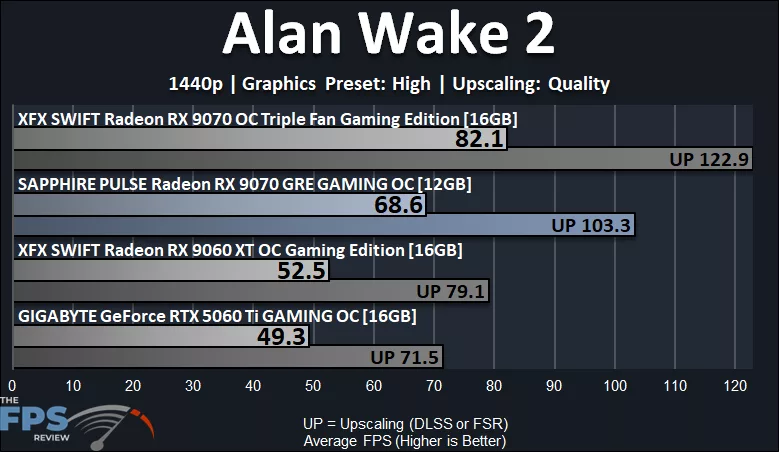
In Alan Wake 2, the SAPPHIRE PULSE Radeon RX 9070 GRE GAMING OC is swinging a little closer to Radeon RX 9070 performance here. It is 31% faster than the Radeon RX 9060 XT and 16% slower than the Radeon RX 9070. It is 39% faster than the GeForce RTX 5060 Ti, which is pretty significant.
Battlefield 6
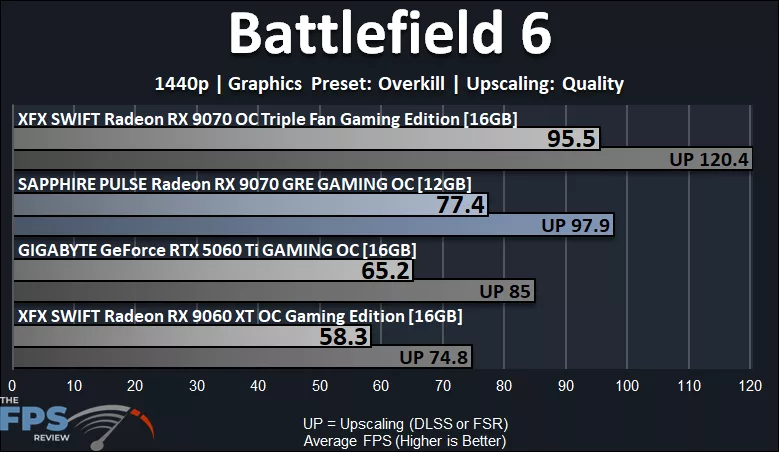
In Battlefield 6 the SAPPHIRE PULSE Radeon RX 9070 GRE GAMING OC is a pretty large 33% faster than the Radeon RX 9060 XT. In this game, the SAPPHIRE PULSE Radeon RX 9070 GRE GAMING OC is much closer to the Radeon RX 9070 performance, and really pushes far beyond the Radeon RX 9060 XT. The SAPPHIRE PULSE Radeon RX 9070 GRE GAMING OC is 19% slower than the Radeon RX 9070. The SAPPHIRE PULSE Radeon RX 9070 GRE GAMING OC is 19% faster than the GeForce RTX 5060 Ti.
Black Myth Wukong
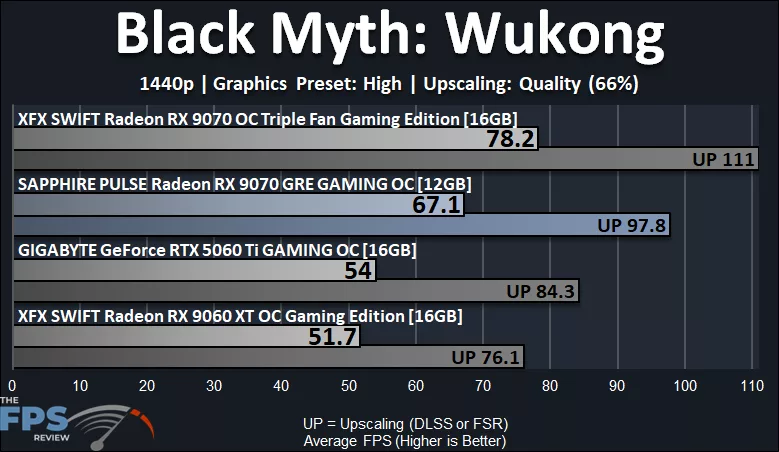
In Black Myth Wukong, the SAPPHIRE PULSE Radeon RX 9070 GRE GAMING OC is much faster than the Radeon RX 9060 XT as well. Here, it is 30% faster than the Radeon RX 9060 XT and 14% slower than the Radeon RX 9070. It is 24% faster than the GeForce RTX 5060 Ti.
Clair Obscur: Expedition 33
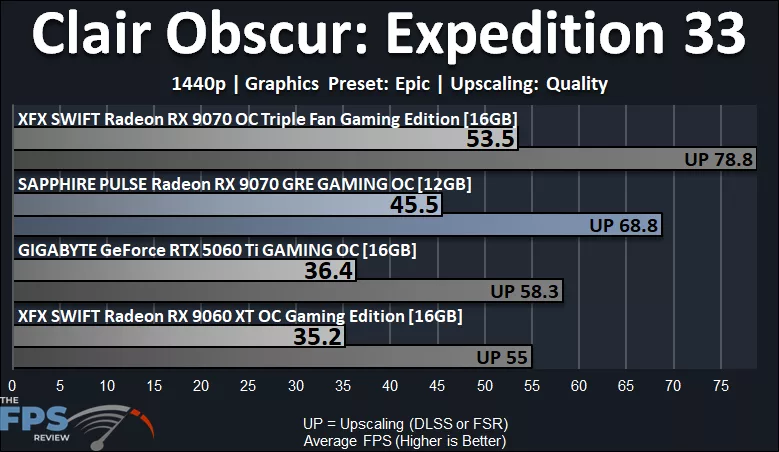
Clair Obscur: Expedition 33 uses Unreal Engine 5’s Software Lumen for global illumination and reflections. In Clair Obscur: Expedition 33, the SAPPHIRE PULSE Radeon RX 9070 GRE GAMING OC is again much faster than the Radeon RX 9060 XT, by 29%. It is 15% slower than the Radeon RX 9070 and 25% faster than the GeForce RTX 5060 Ti.
Crimson Desert
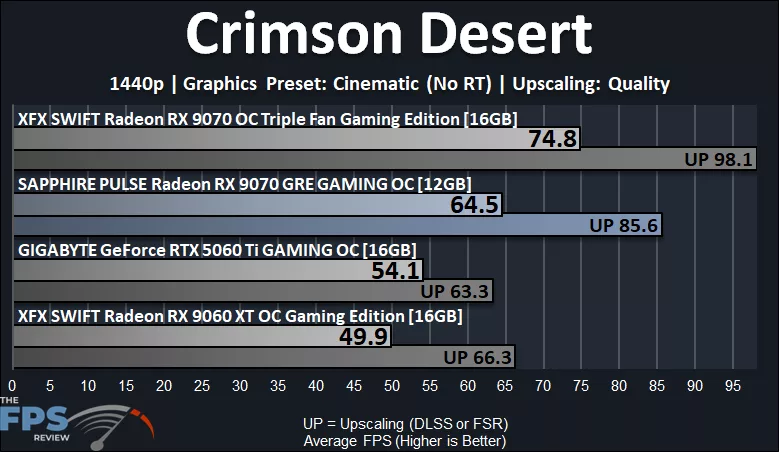
In Crimson Desert, we are testing with the latest 1.09.00 patch. The SAPPHIRE PULSE Radeon RX 9070 GRE GAMING OC performs great in this game, closer to the Radeon RX 9070. It is 29% faster than the Radeon RX 9060 XT and 13% slower than the Radeon RX 9070. It is 19% faster than the GeForce RTX 5060 Ti.
Cyberpunk 2077
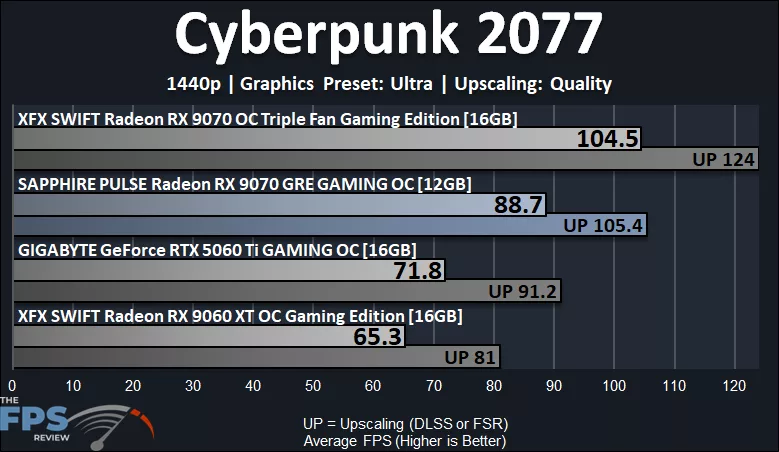
In Cyberpunk 2077, the SAPPHIRE PULSE Radeon RX 9070 GRE GAMING OC is a whopping 36% faster than the Radeon RX 9060 XT and 15% slower than the Radeon RX 9070. It is 24% faster than the GeForce RTX 5060 Ti.
Doom: The Dark Ages
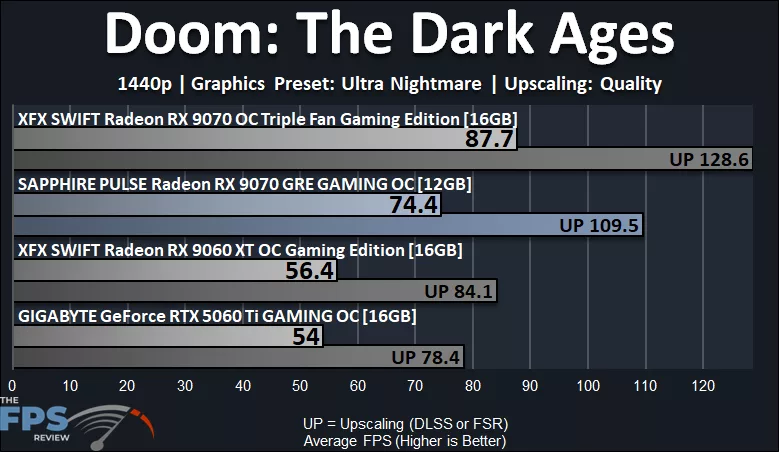
Doom: The Dark Ages is one of those games that requires hardware-accelerated ray tracing using ray tracing for global illumination, accurate reflections, and to process precise hit detection, distinguishing between complex materials. In this game, the SAPPHIRE PULSE Radeon RX 9070 GRE GAMING OC is 32% faster than the Radeon RX 9060 XT and 15% slower than the Radeon RX 9070. It is 38% faster than the GeForce RTX 5060 Ti.
Discussion
Join Discussion →No replies yet. Be the first to reply on the forum.