
Gaming Performance Continued (D-S)
For all of our game testing, we are testing at 1440p resolution. We will test with a combination of Native Resolution and Upscaling. When using Upscaling, we are either using DLSS for NVIDIA or FSR for AMD. We have FSR 4/4.1 enabled where supported in games. The video cards being compared are all AIB video cards with a factory OC, including the SAPPHIRE PULSE Radeon RX 9070 GRE GAMING OC. The video card models and VRAM capacity are listed in the graphs. We have sorted the graphs from fastest to slowest. All games are using manual run-throughs for benchmarking. Keep in mind that some games have Ray Tracing built into the game/engine, and always on, while others do not. We will have a dedicated page for games that have optional Ray Tracing settings to enable.
When looking at the results, keep the pricing of each card in mind, especially the GeForce RTX 5060 Ti 16GB, and how it compares with the SAPPHIRE PULSE Radeon RX 9070 GRE GAMING OC in performance. One of our goals is to see where the SAPPHIRE PULSE Radeon RX 9070 GRE GAMING OC sits on the scale between the Radeon RX 9060 XT and Radeon RX 9070.
Dying Light: The Beast
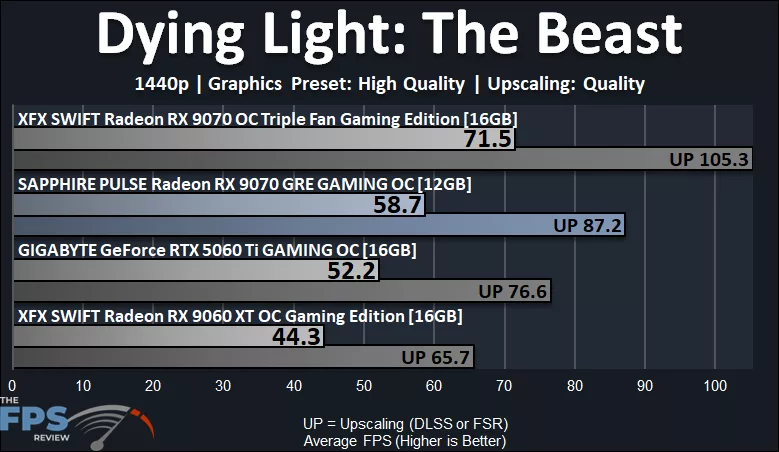
In Dying Light: The Beast, we can’t quite reach 60FPS at Native Resolution 1440p on the SAPPHIRE PULSE Radeon RX 9070 GRE GAMING OC at High settings. However, with FSR 4 Upscaling, it can hit up to 87FPS AVG and is much more enjoyable. The SAPPHIRE PULSE Radeon RX 9070 GRE GAMING OC is 33% faster than the Radeon RX 9060 XT and 18% slower than the Radeon RX 9070. It is 12% faster than the GeForce RTX 5060 Ti in this game.
Horizon Forbidden West
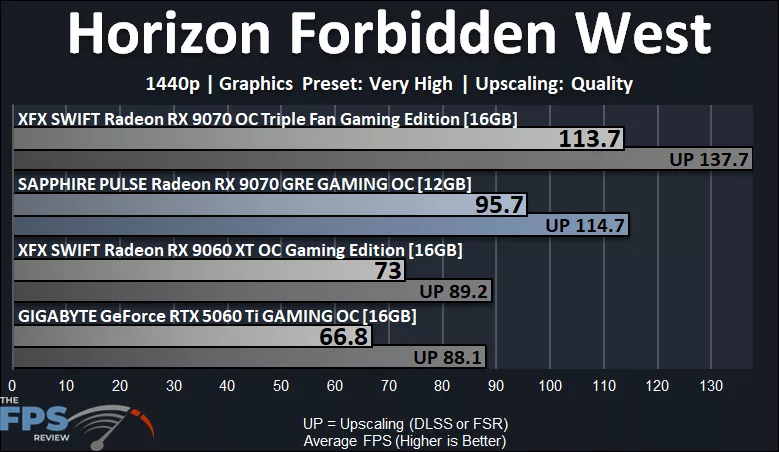
In Horizon Forbidden West, the SAPPHIRE PULSE Radeon RX 9070 GRE GAMING OC is once again hanging closer to the Radeon RX 9070. The SAPPHIRE PULSE Radeon RX 9070 GRE GAMING OC is 31% faster than the Radeon RX 9060 XT and 16% slower than the Radeon RX 9070. It is 43% faster than the GeForce RTX 5060 Ti.
Kingdom Come: Deliverance II
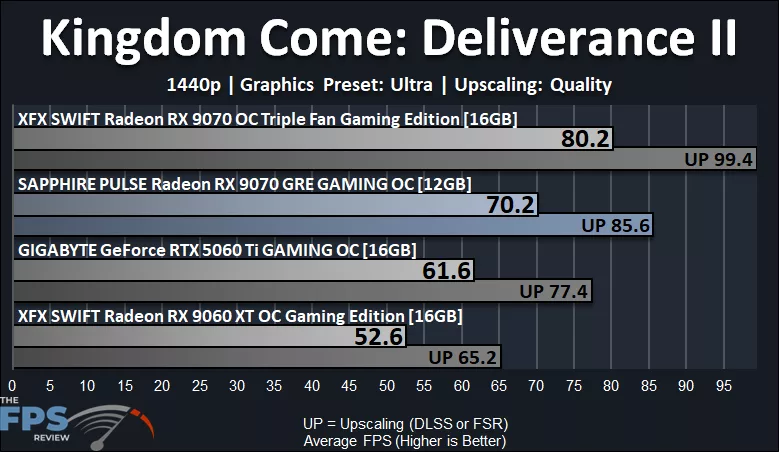
Kingdom Come: Deliverance II uses a custom Ray Tracing method for CryEngine, utilizing Voxel Cone Tracing and SVOGI (Sparse Voxel Octree Global Illumination) for global illumination and reflections. In Kingdom Come Deliverance II, surprisingly, the SAPPHIRE PULSE Radeon RX 9070 GRE GAMING OC is much faster than the Radeon RX 9060 XT and closer to the RX 9070, due to the better Ray Tracing performance. The SAPPHIRE PULSE Radeon RX 9070 GRE GAMING OC is 33% faster than the Radeon RX 9060 XT and only 12% slower than the Radeon RX 9070. It is 14% faster than the GeForce RTX 5060 Ti.
Mafia: The Old Country
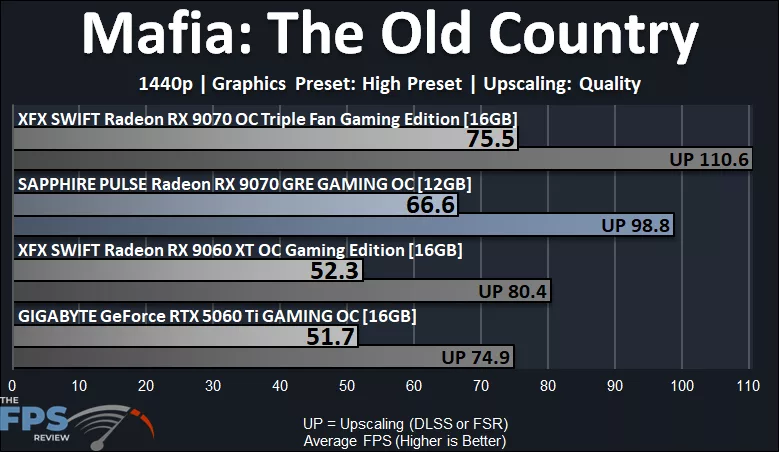
Mafia: The Old Country uses Unreal Engine 5’s Lumen for global illumination and reflections, which acts as a form of hardware/software ray tracing. In Mafia: The Old Country we had to lower the game to the “High” preset, instead of “Ultra”, the game was too demanding otherwise at 1440p on most of these video cards, even so, some require Upscaling at any rate to be playable. The SAPPHIRE PULSE Radeon RX 9070 GRE GAMING OC is 27% faster than the Radeon RX 9060 XT and only 12% slower than the Radeon RX 9070. It is 29% faster than the GeForce RTX 5060 Ti.
Resident Evil Requiem
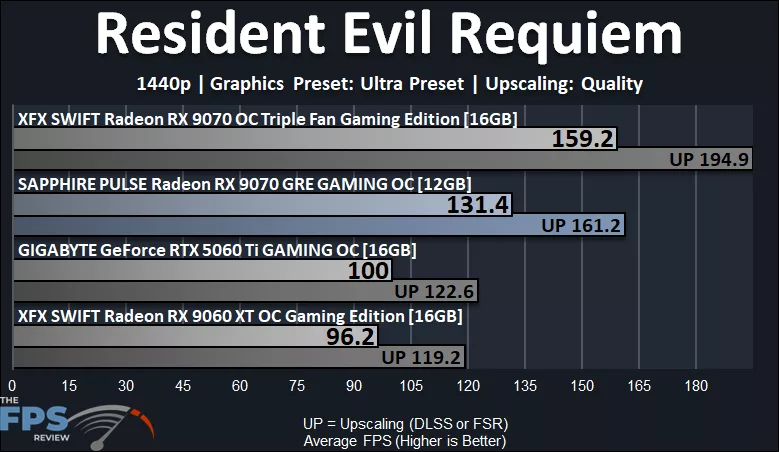
In Resident Evil Requiem, the SAPPHIRE PULSE Radeon RX 9070 GRE GAMING OC is 37% faster than the Radeon RX 9060 XT, which is a pretty big uplift. The SAPPHIRE PULSE Radeon RX 9070 GRE GAMING OC is 17% slower than the Radeon RX 9070, and much closer to it in performance than the 9060 XT. It is 31% faster than the GeForce RTX 5060 Ti.
S.T.A.L.K.E.R. 2: Heart of Chornobyl
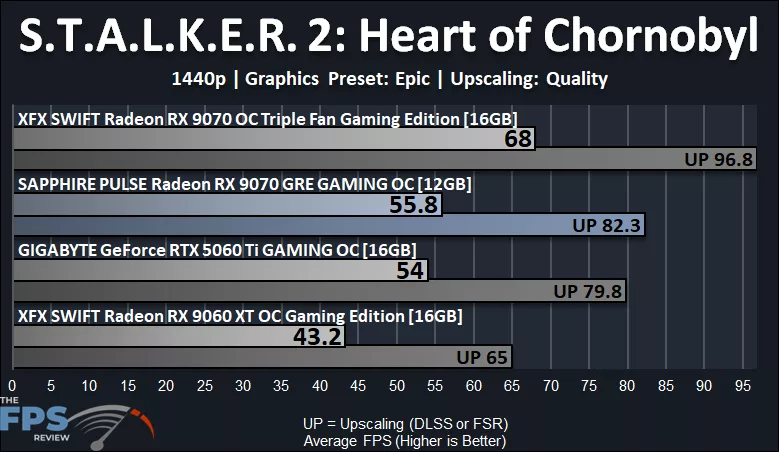
Stalker 2 uses Unreal Engine 5’s software Lumen for global illumination, ambient occlusion, and reflections. In Stalker 2, the SAPPHIRE PULSE Radeon RX 9070 GRE GAMING OC is 29% faster than the Radeon RX 9060 XT and 18% slower than the Radeon RX 9070. It is 3% faster than the GeForce RTX 5060 Ti.
Discussion
Join Discussion →No replies yet. Be the first to reply on the forum.